
- LIFESTYLE
- FASHION
- FOOD
- ENTERTAINMENT
- EVENTS
- CULTURE
- VIDEOS
- WEB STORIES
- SPORTS
- GADGETS
- CAR & BIKE
- TRAVEL
- SOCIETY
- GALLERIES
- NORTH EAST
- INDULGE CONNECT

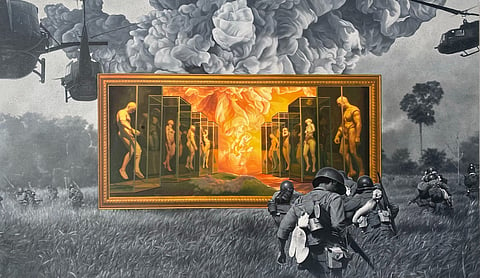
At Tao Art Gallery, He Who Permeates, curated by Mihir Thakkar, brings together two distinct artistic practices that quietly converge. Jayesh Sachdev works across painting, sculpture and immersive formats, drawing from mythology and symbolic iconography, while NFN Kalyan—presenting in India for the first time—approaches image-making through layered narratives shaped by global pop culture.
What unfolds is not contrast, but a conversation—where ancient symbols and contemporary visual language begin to overlap, shift and reframe one another. In conversation with Indulge Express, both artists reflect on their process, unpacking the ideas and instincts that shape their work.
Reimagining the sacred
For Sachdev, mythology is not a fixed inheritance but a space of continuous negotiation. The sacred, he suggests, doesn’t disappear—it transforms with the way we engage with it. As he puts it, “I don’t think it ever really stops being sacred. For me, I’m not even trying to remove that; it’s about changing how we relate to it. Once you move away from fixed or conditioned meanings, the icon opens up. It should be allowed to be questioned, reimagined, even played with. But the reverence doesn’t disappear; it just becomes something you define for yourself, rather than something you’re told to accept.”
Between spectacle and stillness
In a time when visual intensity risks becoming noise, Sachdev’s work leans into excess while resisting superficiality. What appears immediate on the surface unfolds slowly on closer attention. “The surface pulls you in, but the work isn’t just about impact. There’s a lot of layering—in form, in detail, in how things are constructed—that slows you down once you get closer. The idea is that it catches your eye first, but then holds your attention long enough for something more introspective to kick in. And sometimes, it may not lead to introspection but simply strike you visually—and that isn’t something I can control, so I allow my viewer to experience it in a way that seems more natural to them,” Sachdev explains.
Working alongside Kalyan, he adds, “If anything, it’s reinforced how aligned we are. Kalyan’s work has this depth and clarity in how it holds ambiguity, and that’s something I really respect. Even though our visual languages are different, we’re both interested in how meaning isn’t fixed, how it keeps shifting with perception; we’re both exploring how meaning keeps shifting. Being in that dialogue has pushed me to lean into that even more, to trust that the work doesn’t need to resolve — it just needs to stay open.”
An intuitive language of images
For Kalyan, the visual field is shaped by the simultaneity of contemporary life—where images collide, accumulate, and resist singular meaning. His compositions mirror this condition, assembling references into what he describes as a controlled chaos. “I believe the diverse references in my work are an intuitive response to the internet and social media. It is now commonplace to see so many images juxtaposed together. In my compositions, I curate the images to give a more coherent chaos, but still I like for there to be chaos,” he says.
He continues, “Images and the baggage of their meaning, when juxtaposed, force the viewer into questioning, ‘why?’ Since this is all intuitive for me, I work primarily by gut feeling. I feel my way through the composition. This leads to situations where even I have to consider what to understand from my own work. It was not born of my mind or of logic, but rather it comes from a more universal place — that inner understanding that we all have.”
Within this framework, mythology becomes a way to anchor larger philosophical inquiry. “I believe I use mythology as a way of focusing the viewer onto more complex philosophical issues. If one wishes to use only reference but still confront deeper questions, sometimes one must reference things that deal directly with those questions,” Kalyan explains.
He further adds, “By putting mythologies into a contemporary context, we are able to confront modern life in terms that are not superficial.”
“It is worth noting that I use ancient mythologies but also contemporary ones. Often, modern stories make profound philosophical inquiries, and I have no problem borrowing from these newer stories as well,” he says.
Beyond audience, towards truth
Despite navigating an India–US context, Kalyan’s practice remains inward-facing, shaped less by audience and more by instinct and conviction. “When I first started as an artist, I made the same types of art that I make now. I was alone in a room painting and drawing, and I had about 200 social media followers. Yes, I wanted my work to communicate, but my communication was natural and not tailored for any specific audience. No one was watching,” he recalls.
“A natural cynicism (and perhaps naïveté) about the world has led me not to change this approach. I make the thing that I feel has to be made at any given moment. I don’t know why I am making it. I often wish I had made something else. But I don’t question the instincts that I have honed over 44 years. And I don’t worry about audience,” Kalyan adds.
For him, the act of making is tied to a deeper responsibility. “I see myself as having a responsibility as an artist. I am responsible for saying something that has true meaning. That stance forces me into an inevitable direction: I cannot change the thing that is true. It is true no matter what. My imperative is to continue my inner growth to understand deeper layers of truth so that I may express them,” he says.
“If my expression is not accepted or recognized by any audience in my lifetime, then I will have to die hungry or find other work. But I believe that in the long run my art will resonate, because I believe in the strength of my artistic voice and I believe that what I’m saying has value,” he concludes.
Confronting the self
At its core, Kalyan’s work resists delivering fixed answers, instead turning the gaze back onto the viewer. “In my practice, I hope simply that the viewer confronts themselves. Whether my work gives them tension or ease, that feeling exists in their own body. My juxtapositions, for me, seem to create tension because that is where the greater questions lie,” he says.
“But regardless, I just wish for the audience to consider the nature of who they are and what they believe. I wish for them to view the world with a different outlook. All artwork is an attempt at that. There is little other reason to communicate artistically,” Kalyan adds.
“I don’t mean this in a pretentious way. The emotional and intellectual expressions of any person inevitably push the world around them,” he concludes.
What: He Who Permeates, a joint exhibition by Jayesh Sachdev and NFN Kalyan, curated by Mihir Thakkar
Where: Tao Art Gallery
When: Till May 28, 2026, daily from 11am to 6.30 pm
For more updates, join/follow our WhatsApp, Telegram and YouTube channels.