
- LIFESTYLE
- FASHION
- FOOD
- ENTERTAINMENT
- EVENTS
- CULTURE
- VIDEOS
- WEB STORIES
- SPORTS
- GADGETS
- CAR & BIKE
- TRAVEL
- SOCIETY
- GALLERIES
- NORTH EAST
- INDULGE CONNECT

At India Art Fair 2026, Akara Contemporary presents a booth that feels composed rather than crowded. Painting and sculpture are installed with a clear sense of spacing, allowing works to be read individually before they begin to register against one another. The emphasis is on material presence and scale, not visual abundance. It is a presentation that reflects a programme increasingly confident in its own parameters.
That confidence has sharpened since 2023, when Akara formally split its programme into Akara Modern and Akara Contemporary. The decision clarified how each strand would operate. As director Puneet Shah has explained, “The move to diversify into Akara Modern and Akara Contemporary allowed us to run parallel, simultaneous programmes giving modern masters the contextual space they deserve, while allowing contemporary artists to engage more freely with current practices, experimentation, and discourse.” The booth at India Art Fair sits firmly within the latter, with an emphasis on present-day concerns and how they take shape through material.
Rather than building the presentation around a single idea, Akara Contemporary allows the works to set the terms. Posthumous sculptures by Piraji Sagara bring a sense of weight and continuity to the space. The forms carry the authority of long engagement, both physical and intellectual, and establish a grounding presence. Nearby, works by younger artists such as Yogesh Rai operate at a different pitch. The scale tightens. The mood shifts inward. Meghna Shah describes the gallery’s approach as one that avoids competition between generations. “Bringing together artists from different generations allows for a natural exchange, where legacy and emerging voices coexist without one overshadowing the other.”
Rai’s graphite drawings are a case in point. They are restrained, attentive and closely worked, with the body treated as a site of experience rather than display. His practice draws from a lineage of writers and artists who reshaped how sexuality and identity are discussed, but the work itself remains grounded in the everyday. “When I draw, I am not beginning a conversation; I am continuing one that has moved across countries and decades,” he says. In the booth, the drawings read as quiet continuations rather than declarations, carrying that history into a contemporary Indian context.
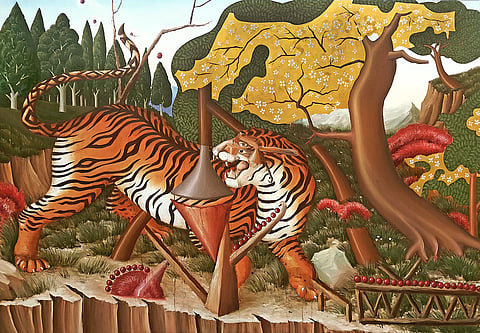
The presentation also introduces Italian artist Siro Cugusi to Indian audiences for the first time. His paintings are not positioned as a centrepiece or interruption. Instead, they are placed in relation to surrounding works, allowing formal and material connections to emerge naturally. As Puneet Shah notes, “The fair offered the right scale and visibility to introduce Siro Cugusi’s work thoughtfully to Indian audiences.” The paintings, shaped by surreal figuration and psychological tension, sit comfortably within the booth’s overall emphasis on control and surface.
Materials do much of the talking across the presentation. Marble, ceramic, graphite and paint show signs of pressure, revision and touch. There is little attempt to disguise the process. This interest in how work is made reflects a wider concern with what allows artistic practices to continue beyond the exhibition cycle. In 2025, Akara launched the Artist Mentorship Programme in response to gaps many artists face once formal education ends. “Many younger or independent artists lacked access to guidance around professional development, exhibition-making, conservation, and navigating institutions,” Meghna Shah explains. The programme connects artists with curators, restorers and senior practitioners, addressing practical questions that are often left unspoken.
Painting within the booth extends these concerns in a different direction. Bhagyashree’s works draw from architectural sources that range from temple structures to Gothic cathedrals and modern city grids. These references are layered rather than quoted, building imagined spaces that feel familiar without being specific. Placed alongside sculptural works that prioritise weight and surface, the paintings hold their own, allowing relationships to form through proximity rather than contrast.
India Art Fair provides a context in which this approach makes sense. The audience is accustomed to moving between geographies and practices, and the booth does not over-explain its choices. Connections emerge through looking and re-looking, through noticing how scale, texture and material register differently from one work to the next.
Within the larger fair, where attention is often fragmented, Akara Contemporary’s booth relies on editing rather than scale. The presentation holds together through placement and restraint. It feels neither instructional nor loose. At India Art Fair 2026, Akara Contemporary offers a booth that trusts its artists, its materials and its audience, and allows meaning to build gradually across the space.
February 5-8, 2026, At India Art Fair, Akara Contemporary, Booth B08