
- LIFESTYLE
- FASHION
- FOOD
- ENTERTAINMENT
- EVENTS
- CULTURE
- VIDEOS
- WEB STORIES
- GALLERIES
- GADGETS
- CAR & BIKE
- SOCIETY
- TRAVEL
- NORTH EAST
- INDULGE CONNECT
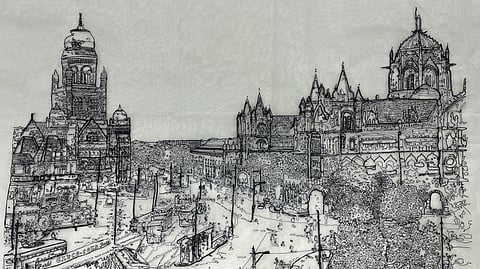
At 47A in Khotachiwadi, the narrow lanes of Girgaon will briefly mirror another set of streets. In Echoes of Bombay, Kailash Poojary translates the city’s older self into thread, turning walls into maps and memory into surface. The show unfolds like a walk through South Bombay before the skyline hardened, when stone, labour, worship, and commerce rubbed against one another daily. It is an exhibition that asks the viewer to slow their eyes, to read a city through stitch density and patience.
Kailash is no stranger to spectacle. His hand has dressed bodies for the MET Gala, the Oscars, and the Golden Globes. Those garments exist for an evening and then retreat into images and archives. Echoes of Bombay takes a different stance. Over 12 months, Kailash committed to a series of hand embroidered works that render Bombay’s architectural and spiritual landmarks with forensic care. The result sits somewhere between textile art and civic portraiture, resisting easy categorisation.

“When I decided to start something locally, I knew I didn’t want to do garments,” Kailash says. “I wanted to try something different, yet remain within the same field of embroidery and embellishments.” The decision reframed his relationship with his medium. Thread, here, is no longer in service of a silhouette. It becomes a recording tool, capable of holding geography, weather, faith, and labour in tension.
The series opens with a map of Old Bombay, the Seven Islands suspended in stitched water bodies. It is an origin story rendered without nostalgia, attentive to the meeting of land and sea that shaped the city’s temperament. From there, the works move through Kala Ghoda and Dhobi Ghat, where cultural aspiration and daily work share the same air, before reaching colonial statements like the Taj Mahal Palace Hotel and Rajabai Tower. Each structure is built slowly, with thick and thin threads layered to suggest depth, erosion, and use.
“As a fashion student in the late ’90s, inspiration came only from being physically present in the moment,” Kailash recalls. “With photography, there is only so much you can explore beyond light and framing, but with thread, we are able to enhance details, textures, and depth, creating something that can become a legacy, something that can be inherited,” he adds. That inheritance is key. These works are not souvenirs. They are propositions about how cities can be remembered outside official archives.
Embroidery carries its own history, often tied to domesticity and ornament. Kailash leans into that tension by applying it to monumental civic structures like CST, the BMC Building, Ballard Pier, and Regal Circle. The choice sharpens the contrast between scale and intimacy. A façade that once signalled governance or imperial power is now translated through thousands of hand movements, collapsing distance between maker and monument.
The most affecting work in the series is Mumba Devi. Unlike the Gateway of India or Flora Fountain, the goddess exists as much in belief as in built form. Her presence anchors the exhibition in something older than architecture. “Without Mumba Devi, Mumbai would not have its name,” Kailash says. “She is an essential part of the larger picture of the city. I couldn’t imagine creating my version of a city I adore and love without including this iconic temple and what it represents.” Coins nailed into pillars, the press of bodies, the stillness inside the sanctum, all find their way into stitch without tipping into illustration.
Echoes of Bombay does not present the city as a finished object. Bhendi Bazaar sits beside Flora Fountain, lived chaos meeting imposed symmetry. The skyline piece gathers icons that never co-existed in reality, allowing memory to override geography. Kailash resists romantic polish. His stitches insist on density and accumulation, mirroring how Bombay itself was built.
A year-long process leaves space for doubt. “I would be lying if I said I didn’t question myself several times about what I was doing,” he admits. The first piece, the map, took the longest. Translating photographs into thread demanded constant recalibration. Each work had to feel grounded rather than speculative. Completion was not about perfection but about reaching a point where further labour would dilute clarity.
The exhibition title makes its own argument. In choosing Bombay over Mumbai, Kailash steps into a charged linguistic field. His focus remains on South Bombay’s pre-independence architecture, at a time when glass towers and infrastructural amnesia dominate the city’s forward motion. Yet the work resists elegy. It does not mourn a lost city so much as insist on continuity. “Whether we call it Bombay or Mumbai, it is my city, and I love it for what it is,” he says. “I hope this body of work inspires people to look more closely at our heritage and feel the need to preserve it.”
Set within Khotachiwadi, itself a fragile pocket of old Bombay, the exhibition gains another layer. The location folds the work back into the kind of neighbourhood that once defined the city’s social fabric. Viewers are invited to move between past and present without instruction, guided only by thread and their own recognition.
Echoes of Bombay positions hand embroidery as a serious tool for urban history, capable of holding complexity without flattening it. Poojary’s city is layered, devotional, contradictory, and unfinished. Like Bombay itself, it refuses a single reading.
Show details:
Echoes of Bombay- One stith at a time
Designed by: Kailash Poojary
Location: 47A, Khotachi Wadi, Mumbai
Date: February 13 - March 15 | 11 am - 7 pm (Daily, except Monday)
For more updates, join/follow our WhatsApp, Telegram and YouTube channels.