
- LIFESTYLE
- FASHION
- FOOD
- ENTERTAINMENT
- EVENTS
- CULTURE
- VIDEOS
- WEB STORIES
- SPORTS
- GADGETS
- CAR & BIKE
- TRAVEL
- SOCIETY
- GALLERIES
- NORTH EAST
- INDULGE CONNECT

The Tarasha Craft Exhibit 2026 does not try to compete with Mumbai. It sidesteps the city’s appetite for scale and instead settles into a slower rhythm. What it foregrounds are things that tend to disappear in urban retail settings: the weight of materials, the logic of process, and the people behind both.
Presented by Project Tarasha, a social initiative by Titan Company Ltd., and curated by Aradhana Nagpal, the exhibition is built around a simple premise. Craft does not exist separately from land, climate or livelihood. To understand an object, you have to understand where it comes from, and who made it.
This year’s theme, Inspired by Nature, is not treated as an aesthetic brief. It works more like a point of departure. Twenty-one craftpreneurs travel to Mumbai from Maharashtra, Rajasthan, Madhya Pradesh, Telangana, Odisha, West Bengal and other regions, many encountering the city’s audience for the first time. What they bring with them is less a collection than a set of lived relationships with material. Clay, fibre, metal, pigment and paper appear as outcomes of geography rather than design trends.
For Nagpal, the exhibition is a marker in a longer process. “A significant highlight of our program is the annual exhibit, a milestone event eagerly awaited by our craftpreneurs,” she says. “It is a platform to showcase their year-long journey and work, while creating an elevated experience for craft connoisseurs and customers.” The emphasis on journey matters here. What visitors see has been shaped over months of mentoring, design development and market preparation.
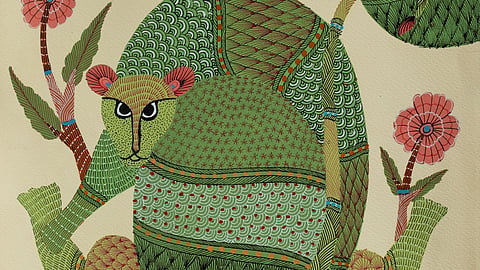
The idea of nature runs quietly through the space. You notice it in the way materials behave rather than how they look. Textiles carry the logic of weather and water. Folk art references landscapes that are still lived in, not remembered. Even the exhibition design resists theatricality. Palm-leaf stars and paper birds suggest natural forms without turning them into decoration. The result feels considered, almost understated.
“‘Inspired by Nature’ reflects the symbiotic relationship between craftpreneurs and their environments,” Nagpal explains. “Across the 21 participating craftpreneurs, nature appears through motifs, materials, textures and palettes rooted in local ecologies.” Curated craft walks expand on this idea, making clear how geography and daily life continue to shape technique and form.
Project Tarasha itself was conceived during the pandemic, at a moment when many craft communities were cut off from markets entirely. Its response was not limited to selling opportunities. Instead, it focused on helping artisans reposition themselves as independent operators within contemporary markets.
“Project Tarasha focuses on enabling artisans to transition from dependency to independence as craftpreneurs,” says Nagpal. “This requires a mindset shift towards entrepreneurship, understanding pricing, market positioning, customer engagement and branding.” That shift is visible on the floor. Craftpreneurs speak directly to visitors. They explain process, pricing and provenance without mediation.
The exhibition’s zero-commission structure sharpens this exchange. Every sale goes directly to the maker. In a sector where margins often thin out before reaching the source, this matters. It also places responsibility on the craftpreneurs themselves. They must articulate value, negotiate interest and stand by their work.
“The zero-commission model reflects Project Tarasha’s commitment to equity, transparency and fair earnings,” Nagpal notes. “The experience helps craftpreneurs understand pricing, presentation and market behaviour, while reinforcing dignity-led engagement.” It is not framed as a permanent solution, but as a learning ground.
Nagpal’s approach is shaped by long familiarity with this terrain. She began working with craft communities in 2000 and opened Dhoop in 2003, which became one of Mumbai’s most respected craft destinations. Dhoop has since evolved into a consulting and curation-led agency working with artisans, CSR initiatives and artisanal brands. Her work spans the JSW Craft Prize, collaborations with Dastkari Haat Samiti for Google Arts & Culture, and the development of Flourish, an Industree Foundation retail initiative. Alongside this, she runs Asivero, a community-focused platform centred on conscious consumption.
That experience shows in the exhibition’s tone. It is confident without being instructional. It trusts the audience to draw connections. It aligns closely with Titan’s broader commitment to building experiences that are responsible, well-crafted and culturally grounded.
What stays with you is not a particular piece, but the conditions under which it was made visible. Craft here is understood through circumstance as much as skill: shaped by land, by economics, by individual decision-making. Nature registers as a working presence, not an aesthetic device. And the act of selling feels closer to conversation than extraction.
For Mumbai’s audiences, this kind of access to makers is increasingly uncommon. For the craftpreneurs, it marks a step towards operating on their own terms. For Project Tarasha, it affirms an idea that often gets lost in translation: Indian craft holds its ground best when it is allowed to stand plainly, without embellishment.
Dates: 9th, 10th & 11th January 2026
Time: 10:00 AM – 7:00 PM
Venue: The Vintage Garden, Patkar Bungalow, 34D Turner Road, Bandra West, Mumbai
For more updates, join/follow our WhatsApp, Telegram and YouTube channels.