
- LIFESTYLE
- FASHION
- FOOD
- ENTERTAINMENT
- EVENTS
- CULTURE
- VIDEOS
- WEB STORIES
- SPORTS
- GADGETS
- CAR & BIKE
- TRAVEL
- SOCIETY
- GALLERIES
- NORTH EAST
- INDULGE CONNECT

Comedy and Tamil makkal are a match made in punchlines. Humour is not just their coping mechanism, but it is in their default setting. While sarcasm is like that quiet friend who always has a cheeky comeback ready, roasting each other is just their way of saying, ‘I’ve got your back.’
Tamil cinema cracked the code ages ago. From NS Krishnan’s sharp political satire in black and white to Chandrababu’s dance-and-joke acts to the legendary Goundamani-Senthil duo constantly pulling each other’s leg, comedy has always had a VIP pass. Add Vivekh’s witty mockery with a message, Vadivelu’s wild antics, Kovai Sarala’s chaos, and Santhanam’s roast sessions, and you have basically got the Chennai Super Kings of laughs. In fact, Tamil cinema ‘invented’ the full-length parallel comedy track. The villain might get punched, but it’s the comedian who gets the punchline.
And then, around the mid-2000s, one comedian dared to go on stage with nothing but a mike, a spotlight, and a bagful of jokes. And that little mike experiment became what we call today, ‘stand-up comedy.’
And the movement grew faster than Contractor Nesamani chasing his ‘kidnappers.’ From humble beginnings to headline acts, Chennai’s stand-up comedy journey is no joke. How did the laughs grow louder and the crowds bigger? We get the scoop from the game changers themselves.
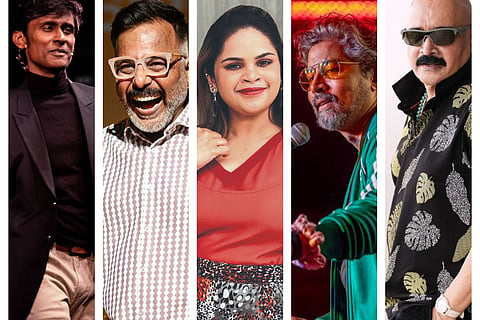
Breaking walls, building laughs: Karthik Kumar
Comedy without a playbook: When we did our first public gigs of what we now call ‘stand-up comedy’ in late 2009, we didn’t even know what to call it. South India had mimicry, stage jokes, and sketches, but no real stand-up, especially nothing opinionated or political. Cinema was stuck with body-shaming and outdated chauvinistic humour. Sharp opinions were risky. Even shows like Lollu Sabha got threatened and shut down because of too many sacred cows.
In that atmosphere, what we were doing felt quietly revolutionary. We called them ‘breaking the fourth wall monologues.’ It wasn’t until 2012 that we named it ‘Evam Stand-up Tamasha.’ From 2009 to 2011, we told urban, relatable stories at places like Alliance Française, and slowly pubs invited us for comedy nights, competing for attention where comedy was new.
Meanwhile, Mumbai was witnessing its own early comedy scene. The Comedy Store had arrived, All India Bakchod (AIB) was still ‘Mumbai Heroes,’ and Vir Das was performing for mostly the elite NRI diaspora. Vir’s was polished and cerebral, while ours was raw, rooted, and hyper-local—Tanglish comedy born from this soil. We didn’t know joke structure, but learning by doing and failing made it authentic and unforgettable. We had a ball.
From bomb to boom: My first solo show happened by accident. A theatre venue cancelled at the last minute, so we turned a long monologue into comedy. I did 40 minutes of improv—no prep, just talking. The first show was a flop—only five people came, two left early, and one lady asked me never to do it again. But an hour later, the night show was packed—100 people, buzzing with energy. The same material that bombed earlier killed that night. The jokes weren’t polished, but the stories were local and real—that made all the difference.
Comedy’s higher calling: When we started, the only aim was to make people laugh. Now, the bar is much higher. Audiences want to laugh, yes, but they also want to think, feel, and be challenged. They expect honesty and sometimes activism. We are delivering truth through laughter, a role that’s both beautiful and terrifying. As I say, clowns telling the truth are safer than politicians spreading lies.
The new groove: The current comedy scene is vibrant and alive. Of course, it’s always a grind for newcomers, and by young comedians, I don’t mean inexperienced. There are trailblazers selling out massive venues. Look at Zakir Khan! Look at Alexander Babu selling out auditoriums in remote towns in Europe! There’s room for all kinds of comedy now. Some comics label themselves as ‘clean comedy.’ Others lean into political or edgy material. There’s no single definition anymore, and that’s a healthy sign. Micro-genres are thriving. Everyone has their tribe.
As for audiences being sensitive, I think we’ve already been through that wave. Everyone got offended, got tired of being offended, and it’s now just background noise. Legal notices and police complaints against comedians aren’t even surprising anymore. Chennai audiences have matured too. They may flinch at frank talks about sex or gender, but they’ve never banned or boycotted us. The city supports dissent, humour, and commentary. And that says something about Chennai’s cultural maturity.
The comedy brotherhood: If there’s one thing I miss from the early days, it’s the fraternity—that sense of being part of a small, tight-knit community. The earliest group of comedians in India was truly borderless. I can still call up Zakir (Khan), Tanmay (Bhat), Amit (Tandon), or any of the old gang—because we started together. There was camaraderie. Today, I’m not sure if younger comics have that same bond.
Breaking the comedy ceiling: Vidyullekha Raman
The legacy of female comedians: Indian cinema has a proud history of female comedians like Aachi Manorama, Kovai Sarala, and Lakshmi garu. These women were often central to the story, not just sidekicks. However, after their era, there was a long quiet gap. When I entered the scene with Neethaane En Ponvasantham (2012), I felt, only in hindsight, that the audience had been yearning for another female voice in comedy. While I never intended to get into comedy, I found myself sharing a lot of screen space with Santhanam early on, and just like that, people started associating me with comedic timing and humour. I got a lot of screen space and a lot of laughs. And during those years—from 2012 to right before COVID—it felt like there was an upswing in opportunities for female comedians.
The pandemic pause: Post-pandemic, roles for women in comedy have sharply declined so much that I can’t recall the last film or show with a memorable female comedic character. Even the ‘Best Female Comedian’ award has disappeared, merged into vague supporting categories. Meanwhile, stand-up comedy is thriving, with women across the Tamil, Hindi, and Telugu scenes selling out shows. Clearly, audiences love women in comedy, so why is cinema lagging?
The cool makeover: Comedy tastes have also evolved. Today’s viewers want smart, socially aware humour and not outdated jokes targeting women’s bodies or identity. The late Vivekh sir mastered this blend of laughter and social commentary, and that responsibility now falls on us comedians. It’s about more than laughs; it’s about meaning.
Mokkai to kalaai: Chennai has shaped how I write and perform, with its unique mix of sarcasm and sharp wit. While Malayalam humour is subtle and Telugu is a tad loud, Tamil audiences love quick comebacks and clever punchlines, what we call kalaai. Mokkai is out; Kalaai is in.
Stand-up symphony: Alexander Babu
From pubs to packed houses: It all started in 2013 when Evam began doing Western-style stand-up shows at pubs, which were primarily for small weekly gatherings. And here, English was the main language because corporates were a big part of this scene, and they expected local stories in English that everyone from different states could relate to. I did my first show that year, and it went well.
By 2014, Evam began hosting public ticketed shows. Then around 2015, solo stand-up, what the US calls a ‘solo house,’ started selling out. Stand-up wasn’t just about comedy anymore; there was an unspoken expectation to share your life views. Meanwhile, Tamil comedy shows like Kalakka Povathu Yaaru? stuck to generic jokes. Mimicry, too, was strictly defined, as only certain actors were ‘allowed,’ while others were off-limits.
Grace to gamakams: Soon, I did a bit about hanging out at sabhas, those classic Tambrahm uncle music gatherings, as a Christian learning Carnatic music and practicing yoga. The goal was to normalise it all and make it inclusive. My opener was basically, “Hey, I’m a Christian into Carnatic music and yoga—let’s all just hang out!” It was my way of breaking religious conditioning and finding some middle ground.
The unexpected twist: I never planned to mix music with comedy, but music has been my passion since I was young, starting with the tabla, then singing and acting. I soon realised corporate cubicles weren’t for me. Friends nudged me toward acting, which felt real and exciting. Then stand-up showed up as the perfect answer—write your own script, get on stage, and perform—no waiting for opportunity. Stand-up is freedom. You stand; you speak. Since I love music, playing drums and singing felt like a natural extension. It lets me express who I am creatively, and the best part is that people can laugh, connect, and react to it.
Music meets mike: Back in 2013, I tried something different—a 30-second Ilaiyaraaja tune in the middle of my set. It broke the flow, changed the mood, and gave me a much-needed breather on stage. So, I thought, “Ithu nalla irukke? Why not do more?’ That 30 seconds soon stretched to three minutes, then a 10-minute singing break in my 30–45-minute shows. It wasn’t just enjoyable for me; it connected culturally.
Musical bone: In 2014-17, during my self-imposed three-year sabbatical from work, I promised myself that if it didn’t work out, I’d just sing my favourite songs and bow out. But then came Ilaiyaraaja and Sirkazhi Govindarajan, and the unexpected happened—the crowd loved it. Open mics were mostly young folks cracking boyfriend-girlfriend jokes, and there I was, a 40-year-old trying to keep up. Their acceptance gave me a high, and that spark gave birth to Alex in Wonderland.
When I performed Alex in Wonderland, something just clicked. Almost every show ended in a standing ovation. I packed it with 40–50 songs—the kind every Tamil kid grows up humming. Not a single note missed. It hit home every single time.
From epics to emojis: Badava Gopi
Vintage chuckles: Today’s stand-up comedy, I believe, has deep roots in Eastern traditions like Oranga Nadagam, where humour and audience banter were straight from the Ramayana and Mahabharata, but the format was not exactly a cash cow. It later morphed into social satire. About a decade ago, we imported the Western-style stand-up. Before that, ‘stand-up’ meant mimicry and quick festival jokes, with 10 comedians sharing the stage during Dasara or Ganesh Chaturthi in Bombay.
In the South, Kerala’s Kalabhavan had groups juggling sound effects, comedy, and drama—a kind of proto stand-up. When Western topics like saucy subjects and spirits landed, young crowds loved it, but according to me, that’s when comedy started sliding downhill. Political and religious satire got riskier, some comedians faced heat, and the edge grew sharper.
Now, with jokes spreading at WhatsApp speed, humour goes stale faster than you can say ‘forward.’ Writing good jokes is a grind; you whip up 100, and maybe four or five actually land. The rest are rejected, diluted, or over-shared. Comedy’s fun, but it’s serious business.
Mimicry’s midlife crisis: Back in the day, mimicking voices of MGR, Rajinikanth, or Kamal Haasan got big applause from the audience because seeing them in real life was as rare as a sunflower in the desert. That made the impression exciting. We used to do 15 voices in one show, and the audience would cheer for every single one. Today, only Dhoni’s voice gets a reaction, as he is still looked at as a phenomenon. Even Rajini’s and Kamal’s impressions need an extra layer of humour to land. The thrill of mimicry has faded, and honestly, without that spark, it just doesn’t pack the same punch.
Lungi dance moment: My act usually blends sound effects, mimicry, languages, even cricket commentary, and English documentaries. But the real showstopper? My take on Chennai fashion, especially the mighty lungi. That always lands well.
No-joke zone: We used to roast every festival; now even a sniffle could start a firestorm.
Chennai’s comedy code: Bosskey
The ultimate comedy challenge: Making people laugh is no cakewalk. You never really know what will click; sometimes I deliver what I think is a solid punchline, and the audience just stares. Other times, I sneeze and they’re in splits. That unpredictability is what makes comedy both fun and tricky. Honestly, it takes more effort than scripting a TV serial.
Punchlines from headlines: These days, humour comes preloaded on our phones, courtesy, memes and trolls; most jokes feel reheated. That’s why I stick to the news. I read the paper and spot the punchlines. Like when someone got an electric shock at an ATM, I said it’s because he has a ‘current’ account. Good puns stay fully charged.
Comedy heroes: Legends like Nagesh, Cho Ramaswamy, MR Radha, and Thengai Srinivasan. Their wit was sharp, and their timing sharper. They never resorted to cheap shots. I follow their lead and steer clear of body shaming, cuss words, and double entendres. Just clean punches straight to the funny bone.
Mylapore talks, Triplicane moos: If any Chennai locality was born to be the butt of jokes, it’s Mylapore because that place hasn’t known peace and quiet since the days of yore. And Triplicane? Where else can you step out and return to find a cow comfortably seated in your house?
But I must say, Chennai audiences aren’t easy to crack. They’re sharp, quick, and two steps ahead of your punchline. Slapstick won’t cut it here. They like their humour strong, like filter coffee!
Meme royalty: Vadivelu isn’t just a comedian; he’s a one-man meme factory. His comedy isn’t just about the way he delivers his lines; it’s in every eyebrow raise, eye roll, and exaggerated shrug. He could say something as simple as ‘Thambi’ and turn it into a comedy goldmine. Honestly, who else has sparked this many memes?
The case for comedy class: I picture a world where Humorology, the art and science of comedy, is an educational subject. I believe humour isn’t just for laughs; it’s a secret weapon that shapes how we talk, think, and bond.
For more updates, join/follow our
https://www.whatsapp.com/channel/0029Vb677uz60eBXiDYheb0n