
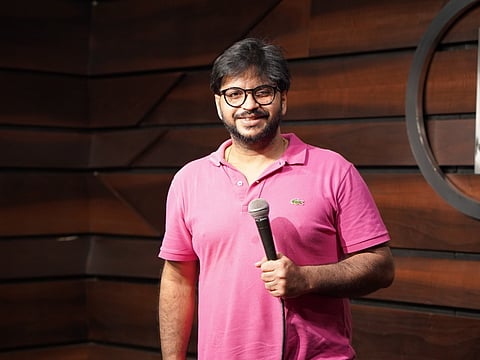
From political satire to personal stories, Sundeep Sharma is bringing his most honest show to Hyderabad

Stand-up comedian Sundeep Sharma isn’t interested in playing it safe. With his upcoming Hyderabad show, Tab Tum Kahaan Thhey?, he brings together political satire, social commentary, personal experiences and plenty of humour to ask audiences an uncomfortable yet timely question. From internet outrage culture and protest movements to the evolution of Indian stand-up comedy, Sundeep speaks candidly about finding his voice as a comedian and why comedy, at its core, is a form of protest.
Tab Tum Kahaan Thhey? Sundeep Sharma turns the internet’s favourite question into his sharpest comedy yet
Excerpts:
Tab Tum Kahaan Thhey? is an intriguing title. What’s the story behind it?
The title comes from the internet’s favourite question —“Tab tum kahaan thhey?” Whenever you raise your voice about something, people immediately ask where you were when some other incident happened. I thought, why not name the show itself Tab Tum Kahaan Thhey?
How do you decide which ideas are worth turning into a stand-up bit?
I write my material, share it with friends and then take it to open mics and trial shows. There’s no other way. Something may sound funny in your head, but until you test it in front of a live audience, you don’t really know if it works.
Your comedy often touches on political and social issues. Does that ever make you apprehensive?
Comedy is a polarising profession. You can’t make everybody happy. Some people may get offended and a few may even walk out. But that’s okay. I’ve had staunch supporters of political leaders come up to me after a show and say they appreciated hearing a different point of view. People are slowly becoming more open to listening.
What does your writing process look like?
It’s completely disorganised! I have whiteboards, notebooks and voice notes everywhere. An idea can come from a conversation, a news story or something happening online. I record all my shows and later listen to them to see what worked and what can be added to the script.
How has your approach to comedy evolved over the years?
Earlier, I was trying to make everybody happy with generic husband-wife jokes and family-friendly material. Today, I talk about things I genuinely care about — politics, the environment, relationships, books and society. India is a goldmine of content. Stand-up comedy, historically, has always been a form of protest, and I see it as an opportunity to exercise my right to free speech in a funny way.
What excites and challenges you about today’s comedy landscape?
We’re competing not just with other comedians but with reels, shorts and every form of digital content. At the same time, audiences are more informed and willing to call out problematic humour. That’s a good thing. Comedy needs to evolve along with society.
What do you hope audiences leave thinking after watching the show?
At the end of the show, I tell the audience that when future generations ask us where we were when all of this was happening, I want to be able to say that I raised my voice — for myself and for others.
What are you looking forward to about performing in Hyderabad?
Hyderabad has a wonderfully educated and open-minded audience. The city brings together students, IT professionals and families, all of whom are receptive to new ideas. And, of course, I love the monsoon here!