
- LIFESTYLE
- FASHION
- FOOD
- ENTERTAINMENT
- EVENTS
- CULTURE
- VIDEOS
- WEB STORIES
- GALLERIES
- GADGETS
- CAR & BIKE
- SOCIETY
- TRAVEL
- NORTH EAST
- INDULGE CONNECT

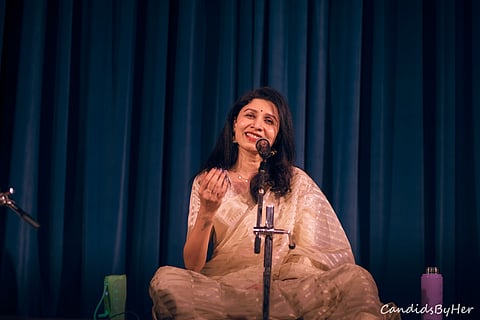
As the monsoon breeze gently rustles, the air is filled with melodies that are both soothing and exhilarating, promising an evening of musical enchantment and serenity. Music lovers, look no further than city-based Hindustani classical vocalist, Harini Rao’s concert at Saptaparni. This cultural centre, renowned for hosting events that preserve our rich heritage, is celebrating its 20th anniversary, with this concert being a part of the grand celebrations.
Envision the evening as Harini graces the stage, weaving intricate ragas into soulful khayals and thumris, perfectly synchronised with Upkar Godbole on the harmonium and Srinivas Haridas on the tabla.
Harini, a disciple of the late Swati Phadke (Naadbrahma Shastriya Sangeet Vidyalaya), currently trains with Vidushi Anuradha Kuber and Manjusha Patil. Before her performance, we had a candid conversation with Harini to learn more about her upcoming show and her musical journey.
What are you planning to perform at the concert?
The main objective is to perform various ragas, primarily through khayals and thumris — semi-classical presentations. Khayal, meaning ‘thought,’ is perfor med impromptu except for the precomposed bandish. We explore ragas in unique ways, making the experience immersive and personal for the artiste and the audience. Thumri, another form of raga sangeet, emphasises the lyrics of the composition. In khayals, the ragas take precedence, and the lyrics are minimal, allowing for extended exploration.
Thumris, on the other hand, focus on conveying emotions through the lyrics, allowing for improvisation and incorporating sounds from different ragas.
Tell us a bit about your musical journey.
Before diving into music full-time, I worked in corporate jobs and even explored jewellery designing, but music has always been my true calling. My musical journey began at a very young age in a household where great music was always playing, thanks to my parents’ deep appreciation for it. They recognised my interest early on and ensured I continued my music lessons, even alongside my studies. My supportive partner has also been a great pillar of strength. It’s important to recognise that pursuing art is challenging and can be risky, making it unconventional and often reserved for the financially stable. However, I personally aim to make it accessible to all.
What fuels your passion for classical music in an era dominated by diverse genres?
I’m open to enjoying various music styles, but my dedication to classical music stems from its discipline and the fact that it was my primary exposure growing up. I feel enchanted by the complexities of ragas and their improvisation.
Do you believe in doing fusions?
I love exploring musical fusions and collaborating with friends from various bands. While my core is classical music, I also revel in blending genres. I experiment with ragas (that are peppy) combined with Western instruments and enjoy integrating piano and guitar into some of my ghazal performances.
Music has healing properties. How has that helped you personally?
For me, music is work, not leisure. While it can be therapeutic, my engagement with music is always active and focused, keeping my brain in learning mode. Unlike those who use music for relaxation, I find silence is what truly helps me unwind.
How do you perceive the global perception of classical music?
I once performed in California at an educational institute, and during my performance, the audience spontaneously started doing Shavasana to relax and immerse themselves in the music. Such responses are rare in India. The appreciation for art abroad is profound.
Tickets at Rs 500. July 27. 6.30 pm.
At Saptaparni, Banjara Hills.
Mail ID: sakshisuresh.k@newindianexpress.com
Twitter: @kaithwas_sakshi