
- LIFESTYLE
- FASHION
- FOOD
- ENTERTAINMENT
- EVENTS
- CULTURE
- VIDEOS
- WEB STORIES
- SPORTS
- GADGETS
- CAR & BIKE
- TRAVEL
- SOCIETY
- GALLERIES
- NORTH EAST
- INDULGE CONNECT
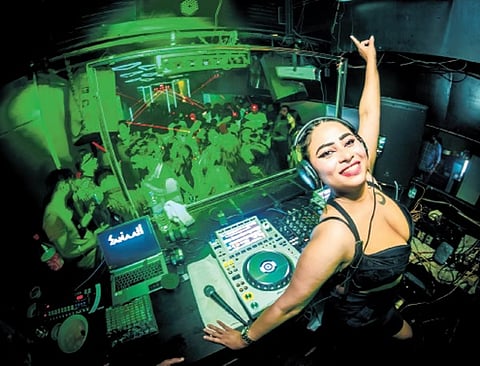
If it was a love for music that saw Shahana, who hails from a small hamlet in Thrissur, to become DJ Sanaah, one of the earliest woman disc jockeys in Kerala, it was sheer determination that kept her there.
In a span of a decade, she overcame societal trapping and a less-than-inclusive industry to become one of the most sought-after DJs out there, with regular shows on the international circuit and a FIFA gig under her belt.
In a candid conversation, TNIE maps DJ Sanaah’s meteoric rise, her gigs, creativity, the role of social media and more…
How did you get into DJing?
As a child, I was very interested in music and wanted to pursue a career in the field. To start a music band was the norm back then, and DJing wasn’t as popular. Even if it was, it was confined to small pockets. Also, there were not many women DJs. I wanted to change that. After learning the basics of DJing at an academy in Kochi, I moved to Pune, where I honed my skills. This was in early 2015. And even before I completed my studies, I was getting shows. I have been performing since then.
What was your family’s reaction to you taking up DJing as a profession?
They had no idea what it was, and to an extent, still don’t know what exactly I do. They see me travelling often, to different countries. I constantly remind them that it’s like a music band, that I get on the stage and perform at venues. Some in my family mistake it as gaana mela.
However, today, with DJs becoming a part of functions, family gatherings and weddings, they have some ideas, but the details of it evade them. That said, they do see the videos and photographs I post on Instagram.

A majority of people don’t have much idea about DJing…
Yes, most people think a DJ’s job is to stand there, turn some knobs and play music.
A loud criticism about the profession is this: a musician creates music and a DJ tweaks it. What’s your opinion on this?
A DJ is also a musician. While the level of creativity required to create original tracks is indeed very commendable, you can’t say DJing is without creativity.
It is also an art. To meld tracks of a clutch of musicians hailing from different periods and various corners of the world into a seamless and free-flowing playlist and perform it before thousands requires a different kind of skill. So, I can’t differentiate between the two.
What is the process of becoming a DJ?
It’s like learning any musical instrument. Of course, there are academies where you can learn it professionally. Or you can learn it from a seasoned instructor. But today, I think, you can learn it off YouTube as well.
But technical knowledge can only get you so far. You need practical experience as well to learn the true nitty-gritty of the profession. To please a crowd is no easy task. Also, creating a playlist out of the 10,000 songs that you have on your disk in a matter of seconds requires skill.
The job is definitely not standing there on the stage and turning a knob, as most people think.
Where did you play your first show and what was the response?
My first show was for the inauguration of a coffee shop. This was before I had even completed my course. The response I got here was tremendous. Likely because I was a girl performer.
From that show to now, I have not had any bad reviews or harrowing experiences while performing. Everywhere I go, I have received only love and respect.
Is a girl performing still an anomaly?
Yes, I’d say so. Many are very curious about it still. However, this is more true in Kerala than anywhere else. Outside the state, it’s a non-factor.
That said, women DJs in the state don’t get many opportunities. It’s a very male-dominated scene. I’ve managed because I’ve done shows abroad.
Now, I’ve built a profile as a resident DJ in Qatar.
It was after I started doing shows elsewhere in the country and abroad that Malayali event managers started to accept me as an artist and hire me. When I was here, I had nothing.
How many shows have you done so far?
Too many to keep count, I’d say. I was a resident DJ in Qatar for a while. I used to do daily shows every night at various clubs. For the past year, I’ve focused more on doing stand-alone shows, mostly abroad. This month will see me travel to Sri Lanka, Malaysia and Georgia for shows.
DJing goes hand-in-hand with an embracing of night culture. Were you always in tune with it or did you have to accommodate that into your lifestyle?
I hail from a very orthodox Muslim family. We were taught to not step outside after 6pm as it was considered unsafe for women. I had to break out of that shell to become the artist I am today.
Also, I’m an introvert. I can’t talk to people very much or openly. But on the stage, I’m a very different person. It’s almost as if I have a dual personality.
I stay alone, travel alone, and do everything alone, but when it comes to DJing, I work with a crowd. It helps that it is music. Who doesn’t love music?
People find it easier to connect through music. I think it’s this connection that has buoyed me throughout my career.
I bet there are many women artists unable to find wings because of societal trappings. What’s your advice to for them?
Be prepared to take risks. In some cases, there won’t be even role models for you to follow, as it was in my case. There won’t be anything going positive for you for a long time, but you have to stay determined. Stick to your goal and face hurdles head-on. Also, learn to handle social criticism.
You’ve faced a lot of criticism online lately...
Yes, nothing to do with my work or behaviour. But my clothes!
Since I perform at international circuits, I always dress in a ‘modern’ way. Of late, this has come under attack. I feel Malayalis are more preoccupied with what women wear than anything else. Our talents and achievements are ignored.
I was the only DJ from Kerala to play for the FIFA World Cup in Qatar. But this isn’t what is highlighted, but how I exposed myself with my clothes.
Yet, despite this setback, social media is indeed instrumental for an artist, you say?
Absolutely. You can’t dismiss the power of social media. Uploading music content here connects you with fellow creators and music enthusiasts. I regularly post videos and updates about shows here. Also, follower count has become an important metric in deciding the popularity of an artist and their fees. Event managers pay close attention to it these days.
You landed your FIFA gig through Instagram, I learned… How was that experience?
Yes. I was playing shows in Qatar at the time. The FIFA team contacted me on Instagram and invited me to an audition. I did and eventually got selected. It was a big honour… the chance to play before a crowd of 75,000 people from various countries at an event as big as this one. A rare opportunity.
What are you working on at the moment?
Today, I’m playing other artists’ tracks but soon, I will be playing a playlist of my own songs. I think it’s every DJ’s dream to make their own music. My ultimate dream is to become a music producer.