
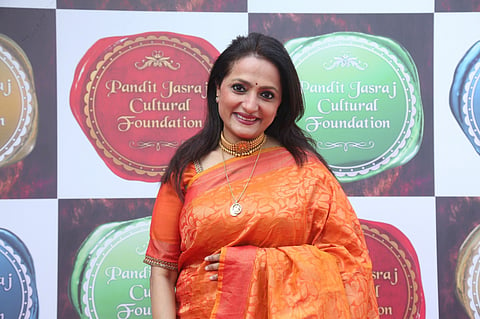
Durga Jasraj reflects on her deep love for the legacy she wholeheartedly carries forward and much more

Sometimes, it’s not just the art that deserves applause, but also the custodian who safeguards its soul. For every legend who leaves a mark, there is someone who lovingly carries the torch forward, nurturing the legacy, preserving the sanskar, and keeping the flame glowing for generations to come. And who better than Durga Jasraj, daughter of the legendary Indian classical vocalist Pandit Jasraj, a devoted torchbearer, who not only carries her father’s timeless legacy, but also continues to take Indian classical music far and wide.
An Indian producer, actor, and Hindustani classical singer herself, she has created groundbreaking musical shows on television. Durga, founder of Art And Artistes (I) Pvt. Ltd., co-founder of the Indian Music Academy, and the Pandit Jasraj Cultural Foundation, was in the city for the 53rd edition of the Pt. Motiram–Pt. Maniram Sangeet Samaroha — something that began as a tribute but has now become a sacred annual ritual. Each edition brings a new theme and concept, which Durga believes is guided by divine intervention.
Excerpts:
How does it feel to return to Hyderabad?
Watching Hyderabad grow has been remarkable; my heart fills with pride every time I see its progress and evolving spirit.
My grandfather, Pandit Motiramji’s last rites were performed here, at a small temple my father built. And when my father passed away during the peak of COVID, extraordinary efforts were made to bring him home. After his rites in Mumbai, people from across the country urged us to bring him to their cities (pilgrimage sites for last rites), saying, “He belongs to us.” But as a family, we felt there was only one place he truly needed to return to — to his own father. He lost him at four, and that temple in Hyderabad was where he sang for hours, offering his music as a prayer. It was his sacred space. So when we immersed his ashes there, it felt like completing a circle. My father kept coming back to Hyderabad to seek his father’s blessings through the audiences, and now I find myself doing the same.
How did your early experiences at home shape the way you understand music?
Everyone knows my father, one of the greatest of all time. But my mother’s lineage is equally remarkable. She is the daughter of V Shantaram, the famous Indian film director. Rajkamal Studios, my nana’s studio, was a familiar place.
My grandfather had a huge impact on me, just as my father did. So, the influences from both sides came together beautifully: first, the richness of the music, and second, the understanding of how to conceive, present, and elevate it. All of that, the larger-than-life artistic vision, the desire to create an experience, not just a performance, comes from my mother’s side.
And when one grows up in such a family, they have to work hard, stay focused, and carve their own distinct identity. It would have been easy for me to live in the shadow of these banyan trees, and I say that with pride because I am blessed to belong to such a family. But even when I grew up around banyan trees, I wanted to find my own sunlight. That mattered to me. That’s one of the reasons I stepped beyond just singing.
Your father’s music bridged the earthly and the cosmic, from innovations like Jasrangi to a minor planet bearing his name. How do these extraordinary recognitions shape the way you think about the idea of immortality through art?
When we speak of Jasrangi, we often call it a musical dialogue of gender equality. And he believed the world runs on duality; just as a cycle needs two wheels. However, in classical music, traditionally, either the male or the female vocalist ends up compromising their natural scale. My father questioned this.
Jasrangi emerged from there. By shifting the Sa, a female singer’s madhyam or pancham can become the male singer’s Sa. The melodic structure remains identical, yet the two voices inhabit different ragas. This concept is known as Murchana Bhed. Today, its popularity makes me incredibly proud. It even found its way into the OTT series Bandish Bandits, where they rightfully credited my father. He also brought Pushtimargi Sangeet, once confined to Krishna temples, to the stage, among the masses. People would come and say: “Ishwar ke darshan hoye.” If music can reach the divine, then my father’s certainly did. So, yes, naming a planet after him is a beautiful gesture.
As a woman shaping the conversation around classical arts, what challenges did you face?
Irrespective of your profession, women must support women. Only then will women truly rise and become a force.
One memory from my childhood probably shaped this belief in a profound way. We had a very close bond with the legendary Lata Mangeshkar — both through my grandmother, and through my father. One afternoon, all of us were at her home when someone informed us that Indira Gandhi would be passing the main road outside. Lataji, being a perfectionist in everything, even photography, immediately began preparing her camera, adjusting lenses for a shot. The road had been cleared; only people lined the sides. As Indiraji’s car approached, someone pointed up toward our balcony and said, “That’s Lataji.” The car slowed, Indiraji waved, and Lataji captured exactly the pictures she wanted before waving back. That moment is etched in my memory.
Lataji wasn’t just a great female singer; she was a force to be reckoned with. She demanded what she felt was right, including having singers’ names appear in the main titles, alongside actors. That was her insistence. And then there’s Indira Gandhi — what an extraordinary woman. These women didn’t ask for reserved space; they created space. They carved their mark.
And even I have never received any concession just because I am Pandit Jasraj’s daughter. In fact, there have been several moments when I’ve felt that had I been his son, I would have been treated very differently. I agree that times are changing, but there’s still a long way to go.
Mail ID: sakshisuresh.k@newindianexpress.com
Twitter: @kaithwas_sakshi
For more updates, join/follow our WhatsApp, Telegram and YouTube channels.