
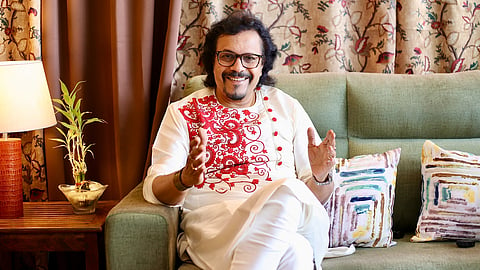
Renowned percussionist Bickram Ghosh on ‘Dear Ma’, his split musical personality and why he’ll never be a Pandit

His accomplishments extend far beyond being one of the most renowned tabla players of his generation. With over 200 album covers and an array of melodious compositions in over 58 films, Bickram Ghosh’s legacy is both vast and vibrant. He was Pundit Ravi Shankar’s tabla companion for nearly a decade, has played at almost all the global concert halls of repute, and yet, has refused to accept the title of Pundit. That’s maestro Bickram Ghosh for you — a musician who has never shied away from experimenting and fusing classical sounds with Western notes. The maverick percussionist, who has endeared tabla to the progressive and Westward-looking generations of music lovers and made it appealing to the young crowd through his music outfit Rhythm Scape for over two decades now, is back in the spotlight for his scores in the film Dear Maa. The film by Aniruddha Roy Chowdhury is all set to release in theatres next week.
We had a chat with the musician on what keeps him going, how his formative years made him open to experiments, and more. Excerpts:
How Bickram Ghosh rewrote the rules of classical music without breaking tradition
What’s keeping you busy currently?
There are two/three film compositions and seven/eight albums on the way, besides a whole lot of travel and tours.
Your musical journey spans classical, fusion, and film — but looking back, how did your early exposure to such diverse influences shape the kind of music you feel most connected to today?
I believe I have a split personality, and it’s been like that since childhood. As an only child, I spent long hours alone, and like many in that situation, I created entire worlds in my head. I used to do that all the time. My parents were busy during my growing-up years in San Rafael, California, where we lived till I was six. My parents, Shankar Ghosh and Sanjukta Ghosh, taught at the Ali Akbar College of Music there, and my dad travelled extensively on tour. So I had to fend for myself for many hours, playing with a ball and conjuring up a world inside my head.
When my dad decided to move back to Kolkata to keep me closer to my roots, it was again a culture shock. I was a bit reticent since I had to come to terms with so many different worlds at the tender age of seven. My life at school and then subsequently at college was very different from that at home. I was a part of the Western music band, Satellites, in school, where I played the conga. In the morning, before I left for school, I had to practise the tabla for an hour, and post-school hours, I used to go straight to vocalist Munawar Ali Khan’s house to listen to the Patiala Gharana. There were so many juxtapositions, musically and culturally, and I think that’s what split my brain, so to speak. A part of me is always the classical artiste, deeply rooted in tradition. But as I travelled and spent time with Jazz and African musicians, it enriched me further. That’s how I developed what I call a split personality, which turned out to be an advantage — I could absorb influences from every culture and use them to grow as a musician. As a child, I was unable to make sense of it but as I grew up, I realised the beauty of it and all of it fit into my head in a holistic manner and embellished my work as a composer.
How hard was it to make tabla the star of a concert?
It was indeed an uphill task since nobody wanted to do a show with no singers and where tabla was the main character of the concert. The sponsors couldn’t quite accept that people would attend a tabla concert and the audience, too, was sceptical about such shows. But I am pretty bullish as a person and I was resolved to go ahead with it, despite a few occasions where I had people leaving the concert halls midway. In 2001, when Sony entered the Indian market, I sent our first fusion soundtrack and subsequently created a whole album that went on to become a chartbuster.
Tell us about your days with Pundit Ravi Shankar.
I learnt tabla from my father, Pt Shankar Ghosh and S Shekhar. So knowing Carnatic percussion was a game-changer in my career. Since I was trained in both North and South Indian styles of classical music, I got to play with M Balamuralikrishna ji, Kadri Gopalnath, TN Seshagopalan, and many others in the South, and I still do.
In 1993, something magical happened in my life. I went to perform at an intimate house concert in Brussels with Pt Vishwa Mohan Bhatt, Pt Tarun Bhattacharya, Ronu Majumdar, and Ramesh Mishra. In the audience was the legendary sitarist Pt Ravi Shankar. After the concert, he greeted all the musicians — except me. I was in the attic, going through a major low-confidence phase, when the phone suddenly rang in the middle of the night. It was Pt Ravi Shankar on the other end. He not only praised me but also offered me a chance to play along with him at a concert in Brussels the very next day. Then one more followed in Dubai the next April, after which I became his permanent tabla player for the next few years.
How was Ravi Shankar as a person?
He was many people at once. He had seen the world by the time he was in his teens, even before he went to Maihar to train under Baba Allauddin Khan, where he became almost an ascetic in his discipline. He had experienced it all and calibrated it all in his mind so beautifully — he made classical music incredibly fun. I learnt from my father and Ravi Shankar how not to dwell on negativity or sorrow. He was quick with repartee, loved to play with words, and called himself a “pun”dit. He was a charming man who was also a great philosopher. Once in 1995, I accompanied him to an ambassadorial dinner in Japan, where I was reluctant to eat Japanese food. He said that I can only truly imbibe another culture and its music when you put their food into my mouth — with complete respect. Those very words changed my life forever. If you are sharp, intelligent, and receptive, his words can change your life forever.
How big an influence has your mother been in your life?
She has had a huge impact on my life, and if she hadn’t been a singer, I doubt I could have been a composer. My dad did have a huge role to play in me being a musician. But hearing my mother sing all day, all my life at home, going with her to Munawar Ali Khan’s house — all this left such an indelible mark on my musical psyche that it doesn’t take me long to compose a melody.
Composing for Aniruddha Roy Chowdhury’s Dear Maa is your first work with him. How was it?
I have known Tony (Aniruddha) from childhood, but our friendship grew after we entered our fifties, and for the last five-six years, we have hung out together at the Tolly Club almost every morning for tea. Our friendship is so precious that we hesitated to work together for the longest time, fearing creative clashes. So we waited for the friendship to become stronger before we worked together, and I think Dear Maa was a perfect film to start with. We sailed through it together — I see his vision and understand him, and working on this film was like a jugalbandi, where we helped each other bring out the best in ourselves and the film. The songs turned out beautifully, with Papon, Shubha Mudgal, and Tinni enriching the compositions with their soulful voices. Aniruddha is a sensitive and smart filmmaker who can take the right call by putting his ego aside. He knows perfectly well what’s going to touch hearts and has an ear for music, having learnt to play the sarod from Buddhadeb Dasgupta.