
- LIFESTYLE
- FASHION
- FOOD
- ENTERTAINMENT
- EVENTS
- CULTURE
- VIDEOS
- WEB STORIES
- SPORTS
- GADGETS
- CAR & BIKE
- TRAVEL
- SOCIETY
- GALLERIES
- NORTH EAST
- INDULGE CONNECT

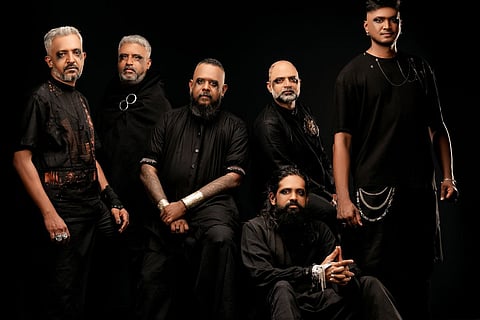
Carnatic progressive rock trailblazers, Agam, are back in the spotlight, courtesy their third studio album, Arrival of the Ethereal, a true testament to the Latin aphorism ‘omne trium perfectum,’ where the third time truly is the charm. A labour of love spanning eight years, this magnum opus unites 300 virtuosos from across the globe, weaving together Carnatic classical tradition with orchestral compositions and progressive rock, jazz, and funk. The album comprises a motley mix of songs—Walk of the Bride (Sita Kalyana Vaibhogame), The Silence that Remains (Mokshamu Galada), Shadows of Time, Flight to the Summer Sky, Between Doubt and Destiny, and Arrival of the Ethereal.
The lineup includes the Grammy Award-winning Czech National Symphony Orchestra and the legendary Mohan veena virtuoso Pt. Vishwa Mohan Bhatt, also a Grammy Award winner. The album features the centuries-old Chenda Melam drum ensemble from Kerala, alongside the nadaswaram, tavil, and pakhawaj, with chants by the South Indian Hindu priest community. It blends these traditions with brass and woodwind artistes from Italy & Argentina and Middle Eastern strings, including the saz, oud, and rabab. And the icing on the cake is that this long-awaited album, released after eight years, is now up for Grammy consideration!
The band, which was recently in Chennai, dives into the visionary album and their musical journey in a chat with Indulge.
Eight years, perfected sound
“It has been quite a journey,” begins Harish Sivaramakrishnan, the lead vocalist of the band. “One of the biggest challenges we faced was COVID. For nearly two-and-a-half years, we couldn’t come together physically, which slowed things down, and the vision we started with for this album evolved significantly. What began as one idea gradually morphed into something else. We revisited the songs we had penned before the pandemic and allowed them to evolve with our new perspectives. It took time to recalibrate and realign ourselves creatively. It was a great pursuit; a tad painstaking, but an incredible process.”
Aditya Kasyap, the lead bassist, says that the delay has made the soundscape more cinematic and refined. “The response has been humbling; people like AR Rahman, KS Chithra, and Salim–Sulaiman, heard the music and supported it wholeheartedly. So, in a way, the delay caused by the pandemic helped us create something richer and more meaningful.”
A symphony of 300 minds
Though the album comprises over 300 musicians, Harish tells us that the challenge was not just assembling 300 musicians. “Anyone can bring musicians together, but the real challenge lies in allowing their unique musicality to shine. We went through several iterations just trying to figure out what we should sound like and how these diverse contributions could come together in a coherent way. For instance, the orchestral sections were recorded with the Czech National Symphony Orchestra. Before that, we programmed everything ourselves. Similarly, for the Middle Eastern influences on the album, we spent an enormous amount of time experimenting, placing them into different sections of the songs, and refining how they would interact with our core sound. The musical alignment took a lot longer than expected. It was far more complex than the logistics of coordination.”
He adds, “The core of our music is rooted in Carnatic music with progressive rock elements. So, anything we brought in, we had to enhance, not dilute that identity. There were several moments when songs were scrapped and rewritten from scratch. But once we reached a point where we knew what we wanted, and when the artistes came in to play, it was like poetry in motion. Honestly, we’re not sure if we could pull this off in the same way again. Just thinking about doing it all over makes us a tad anxious.”
Soaring above the rest
Interestingly, Harish says that Flight to the Summer Sky was the first piece the band started working on for this album and, funnily enough, the last one to be completed. “The track is built on the foundation of Nagumomu, a popular Carnatic composition. So many renditions of Nagumomu exist, and we had to do something distinctly different with it or not touch it at all. The challenge was to reimagine it in a way that preserved its emotional core while presenting it through an entirely new lens, different in structure, different in sound, and different in production. The result is a version of Nagumomu that we feel is fresh and adventurous. One of the most defining aspects of the track is our marquee collaboration, Pt. Vishwa Mohan Bhatt. The instrument he’s associated with is practically synonymous with his name. Getting him to play on this track, we knew this song had taken flight. It became something we’ll be proud of for years to come.”
He adds, “Musically, it’s a melting pot of global influences. There’s a full section that brings in a Broadway-like grandeur and a jazz-funk-inspired outro that adds a completely different flavour. The female vocal chorus on this song is also impeccably performed. It’s a bold experiment on a popular song. And there’s a little Easter egg woven into the arrangement too, as we’ve included Subramania Bharathi’s Vellai Thamarai, which is a welcome detour. Personally, I loved singing this one.”
Two decades of sound
Ask Agam about their 18-year journey in the musical realm, and Harish says that there’s a sea change in them as musicians. “When we started out around 2007, YouTube was still in its infancy, there were no such things as streaming platforms, and music largely revolved around CDs and cassettes. Access to global music wasn’t just limited; it was expensive. If you wanted to listen to an international artiste, you had to buy a CD or import DVDs. Back then, discovering new music felt like a privilege, and we were fortunate enough to be part of that small group that had access. The way the global music space has opened up over the last 15–17 years, our exposure today is on a completely different scale. What excites us now is how accessible everything has become. Ideas are flowing in from everywhere; young musicians around the world are doing phenomenal crossover work, and collaborations have never been easier. So we have been the beneficiaries of a rapidly democratised music space.”
Adi weighs in and says that with the access comes a bigger responsibility to stand out. “One of the key reasons Agam has not only lasted for 18 years but has continued to thrive, touch wood, is that we have always made an effort to push boundaries. It’s also much harder now to make music that connects with people, simply because listeners have such easy access to everything. The love from the audience has only been compounding.”
Harish adds, “Our songs, on average, run about nine-and-a-half minutes. That’s in an era where the average Instagram reel is 30 seconds long. The fact that people still attend our concerts—we are grateful for that. No artiste can sustain without that kind of support. We’ve also been seeing two generations of listeners showing up together. Kids who first heard our music when they were five are now in their 20s, coming to gigs with the very parents who introduced them to Agam. Moments like that remind us why we do what we do.”
AR Rahman’s seal
The band has also found an ardent advocate in The Mozart of Madras, AR Rahman. “Mr Rahman is one of the most generous musical entities you could ever meet. I can say this with conviction from my own interactions. He’s someone who listens to music with incredible passion, sincerity, and seriousness. He’s passionate about supporting musicians who are trying to find their wings, and we are exceptionally grateful to him for the time he has spent with us. He didn’t just listen to us briefly but also gave us detailed feedback, suggestions, and encouragement.”
Carnatic music for a new generation
Agam takes immense pride in the fact that they are taking Carnatic music to Gen Next. “Carnatic music has been around for centuries, and its relevance has never diminished. You can hear shades of Carnatic music in so many aspects of music, especially in South Indian productions. In fact, a lot of them have their base in Carnatic music. Carnatic music itself is a warm-hearted and shape-shifting style of music. The challenge, I think, lies more in the formats we use to present it. Formats need to evolve to keep pace with changing audiences. We have nothing but respect for the traditional kacheri format. I myself actively perform kacheris. What we are trying to do is offer an alternate format of presenting Carnatic music that stays true to its grammar, idioms, and discipline but isn’t confined to the traditional concert format.”
He sums it up, “And whenever we perform abroad, we carry the cultural essence of South India, as this music is tied to our identity and culture. All of us in the band are South Indians, though we have also been exposed to various musical styles from across India. When we perform, our identity as South Indians and practitioners of classical South Indian music shines through, and we take immense pride in that heritage. This pride resonates especially with expatriate audiences, who often feel a longing for the cultural roots they’re far from. Bringing them a piece of the music they grew up with creates a powerful connection.”
Quick Five
One word to describe Agam: Happiness
Pre-show ritual: Eat good food
Studio or Stage: Stage
Agam listens to: Ghulam Ali, Hariharan, Dream Theater, Rush, and jazz of all forms
Dream venue to perform: Historic venues that match the timelessness of music, whether in Europe or India
sangeetha.p@newindianexpress.com
X-@psangeetha2112
For more updates, join/follow our
https://www.whatsapp.com/channel/0029Vb677uz60eBXiDYheb0n