
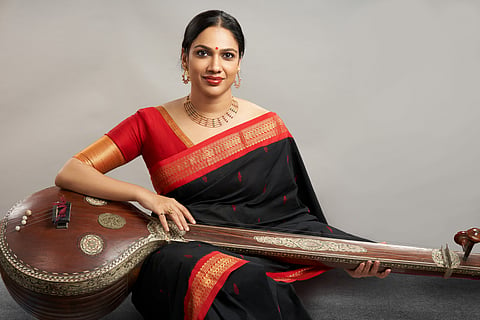
Dhun Ki Katha is Gayatri Asokan & Ruchira Kedar's musical journey through the roots of Indian melody

State Government Awardee and acclaimed vocalist Gayatri Asokan presents Dhun Ki Katha – The Story of Indian Melody, an audio-visual musical experience that traces the emotional, cultural and historical journey of Indian music. Conceptualised and led by Gayatri, the performance brings together storytelling, visuals and music, with a special collaboration featuring hindustani classical vocalist Ruchira Kedar. Moving across genres like ghazal, classical, bhajan and folk, the show explores how different musical forms are rooted in the same Indian melodic tradition. Ahead of her performance, Gayatri talks to us about the idea behind Dhun Ki Katha, her long association with Indian melody, the role of storytelling in the performance and why this collaboration is deeply personal to her.
Dhun Ki Katha feels more like a story than a concert. When did this idea first come to you?
Ruchira and I have been friends for more than 28 years. We learnt classical music together in Pune under Alka Marulkarji in 1997 and 1998. Later, I returned to Kerala to pursue my career, which was primarily in South Indian playback singing, while Ruchira became a pure classical artiste after completing her studies at the Sangeet Research Academy. When I later moved back to Mumbai, we began discussing the idea of doing something together, like a jugalbandi with a concept. Since I also perform ghazals, we thought about collaborating across genres rather than just presenting them separately. Ghazal, classical and thumri all have different shades and forms, but the root is the same — Indian melody. That is how this concept came about. We wanted to present all these genres under one umbrella, while keeping everything rooted in Indian classical music.
Classical music can sometimes feel difficult for new listeners. How did you make this experience easy to connect with?
Yes, classical music can sometimes feel difficult. In Dhun Ki Katha, we present classical music in small capsules. We perform a few bandishes and also take a raga as the base, then present a ghazal or a bandish in the same raga, so that the audience understands that, in the end, it is all raga sangeet. The duration is also abbreviated, which makes it easier for listeners who are uninitiated.
You sing across many styles like ghazal, devotional and classical. How did that help shape this performance?
The visuals give a glimpse into the whole milieu of the music. For example, if we are presenting a ghazal by Ghalib, we show visuals of Ghalib along with imagery from the Mughal era. This makes the presentation more engaging and attractive for the audience.
Storytelling is an important part of the show. How do stories help the audience understand a raga better?
Storytelling is mainly about providing context to the different genres we present. For instance, if we are presenting a bhajan, we talk about the bhakti movement. If it is a Daag Dehlvi ghazal, it is important to explain the meaning of the Urdu poetry. Similarly, if it is a Holi song, we talk about its origins — how thumri developed, how kajri is connected to the rainy season and what each composition represents. These are things the Indian audience finds interesting because every genre has a story, an origin and a meaning behind it.
Was there a moment or raga in Dhun Ki Katha that felt especially close to your heart?
Every moment and every raga in Dhun Ki Katha is very special to me, so I cannot pick one particular moment.
What made you choose Ruchira Kedar for this collaboration?
It was not about me choosing Ruchira or Ruchira choosing me. It was a very organic decision, shaped by our many years of friendship. Our taste in music is the same, we listen to similar artistes and we have both surrendered our lives to the pursuit of music. Since we started learning music together in Pune, there has also been a sacred bond of the guru–shishya parampara. We were guru behens for many years and that bond naturally led to this collaboration.
After more than twenty years in music, how has your bond with Indian melody changed?
Indian melody continues to fascinate me every day. I still enjoy my journey as a student because there is so much to learn and the more you learn, the more you realise how much is still left. After getting married to Purbayan Chatterjee, I received incredible guidance in classical music — how to improvise and how to think out of the box. I am forever indebted to my husband for taking my musical understanding to another level and inspiring me to do more and to compose.
These musical forms that you perform are very old. How do you keep them relevant for today’s audience?
These musical forms are old, but they are also very fresh. While their origins are ancient, the melody and poetry are still relevant today because human emotions and consciousness have not really changed. To make them more appealing, the presentation can be more modern — keeping it crisp, using good sound systems, strong stage design and visuals. Attention spans today are shorter due to smartphones and constant distractions, so it is important to present these forms in an engaging and contemporary way. The melody and poetry are timeless. Only the presentation needs to evolve.
The visuals play a strong role in the show. How do they support the music?
The visuals help paint a picture of the story behind the music. For example, when we sing a kajri, we show visuals of legendary artistes who have contributed to the form, such as Girija Devi and Shobha Gurtu. This gives the audience a glimpse into the lineage of the genre. When elements like rain appear in the background, it visually reflects what we are singing. In this way, the visuals add another layer of enrichment and turn the performance into a more immersive, all-encompassing sensory experience.
When people leave the concert, what feeling do you hope they carry with them?
We want the audience to leave with a deeply enriched experience — both intellectually and emotionally. It should be educative, fill their hearts with joy and help them reconnect with their roots.
INR 500 onwards. January 23 & 24, 7 pm onwards. At Nehru Centre, Worli.
Email: alwin@newindianexpress.com
X: @al_ben_so