
- LIFESTYLE
- FASHION
- FOOD
- ENTERTAINMENT
- EVENTS
- CULTURE
- VIDEOS
- WEB STORIES
- SPORTS
- GADGETS
- CAR & BIKE
- TRAVEL
- SOCIETY
- GALLERIES
- NORTH EAST
- INDULGE CONNECT

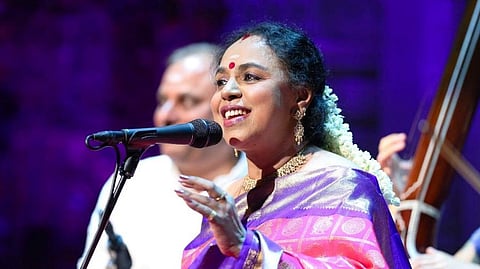
There are few names in carnatic music as revered as Sudha Ragunathan. A Padma Bhushan awardee and one of India’s finest classical vocalists, she has spent decades captivating audiences with a style that honours tradition while carrying a distinctive musical identity of its own. Trained under the legendary Dr ML Vasanthakumari, Sudha’s performances are celebrated for their emotional depth, intricate raga explorations and effortless virtuosity. As part of the sixth edition of Nada Sambhrama, presented by the Nadathur Foundation, Bengaluru, audiences can look forward to an evening that celebrates the enduring beauty and brilliance of Indian classical music where Sudha will be accompanied by Kalaimamani Embar S Kannan (violin), Tumkur T Ravishankar (mridangam) and Giridhar Udupa (ghatam). We catch up with the artiste for a quick preview.
What can we look forward to at the concert, do take us through what you will be presenting?
Truthfully, I don’t plan a concert from the beginning to the end… depending on vibes that I get from the audience I progress with the concert. I have already got a request for Mathé which is a very vibrant varnam and popularised as I had sung it for the movie Morning Raga that featured Shabana Azmi as a carnatic vocalist. The evening’s concert will encompass kritis in several languages, multiple ragas and by many composers. There will also be a composition that will reflect the title of the concert Nada Sambhrama. There will also be several dasara padagalu.
As a carnatic vocalist, how do you think you can introduce this art form to the GenZ to keep the form alive within that audience and expand the already existing audience?
The subject is vast and very explorative! However, to begin with, luring the younger audience kind of happens magically when you unravel your music in a concert. Also, explaining about the composition, the emotions that are embedded in the raga… perhaps that can help the Gen Z relate to the kriti. While the traditional backbone of carnatic music is spiritual, younger audiences connect deeply with emotional vulnerability and storytelling. Also curating shorter, concept-driven capsule concerts (60-90 minutes) in alternative, intimate spaces like art galleries, independent theatres or open-air cafés makes the atmosphere more relaxed rather than a serious concert hall that could get a little intimidating. I also have observed that collaborations and cross overs is what most of them enjoy.
One vocalist of all time that has always been an inspiration and why?
It is obvious — my guru Dr ML Vasanthakumari. She is a legend and her genius lay in her boundless, lightning-fast manodharma and her masterful approach to complex structures like the ragam thanam pallavi. There is nothing that she has not delivered — she has sung everything — from the most intriguing and difficult ragas to a variety of compositions in so many languages. Her film hits — each one is a gem and still evergreen. One can continue being overawed by her mastery and versatility.
Right now, what is the one ragam that is on your mind and your favourite composition in that ragam?
More than saying what fascinates me, I would rather say I am right now concentrating on the Tyagaraja kriti Balendu Bhushani in the raga reetigowla, kind of refreshing myself once again as I had sung it quite some time ago — and each time you rework on it, it gets more interesting to imbibe.
If there was one thing you would change about the carnatic music scene right now, what would it be?
Well, somewhere we are all lost in our own world and so busy with our schedules that we don’t really mingle with fellow musicians. There is hardly any meeting or getting together without an agenda for banter and camaraderie. This is something all of us can work upon.
Any international form of music that intrigues you and why?
Arabic music and Turkish music intrigues me because the melodic tones have micro tones and quarter tones which are very difficult to produce. I have experienced this when I was collaborating with world musicians for the project of world music — Le Rythme de la Parole with internationally renowned artistes. The Iranian artistes who were a part of the project sang these microtones. It really was so intriguing yet so very difficult! I tried to sing along with them but found it hard to be as precise.
Finally, if you were not a carnatic singer today, what else do you think you would have been doing?
I initially wanted be a gynaecologist but because I wanted to do music as a parallel, I got into economics where I aspired to do IFS or IAS.
Free entry. July 11, 6.30 pm onwards. At Mangala Mantapa Auditorium, NMKRV College Campus, 3rd Block, Jayanagar.
Email: romal@newindianexpress.com
X: @elromal