
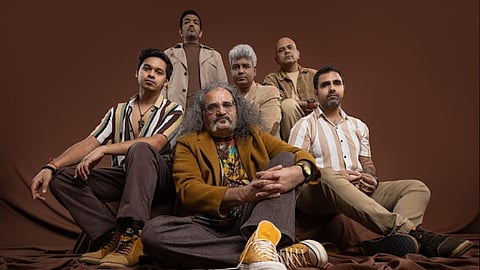
World Music Day special: Rock band Parikrama reveals what it really takes to build a lifelong career in music as they turn 35

In an era when streaming algorithms dictate success and social media feels like a non-negotiable full-time job, maintaining a music career requires more than just raw talent. It demands strategy. In this interview, we sit down with rock and roll band, Parikrama, who just turned 35, and isn’t afraid to pull back the curtain on the modern music industry. The band comprises lead vocalist Nitin Malik, guitarists Abhishek Mittal and Saurabh Choudhary, organist and synthesiser player Subir Malik, bassist Gaurav Balani, and drummer Srijan Mahajan, accompanied by violinist Suhail Ali Khan, percussionist Shambu Nath, flautist Shashank Singhania, sitarist Dhruv Bedi and sound engineers Rajesh Nair, Nitin Sidhu, and Vikram Mishra.
What does it actually take to rock and roll your entire life? It’s not just about the 30 or 40 nights a year that you spend on stage; it’s about what you do with the rest of your time, the band shares.
This World Music Day, we catch up with the members of Parikrama to talk about the hustle behind the music, why social media is a necessary evil for modern creators, and how digitisation is reshaping the indie music landscape. Excerpts:
What does it mean to still be regarded as one of India’s most influential rock bands after 35 years?
Subir: Well, 35 years seems a very long time, but for us it’s as if we just started yesterday. It has just been brilliant, and as we always say, this is just the beginning. But there’s a lot more to do, to accomplish. We’ll keep playing rock and roll, and we intend to die with our boots on. So, rock and roll for life!
What were the highs and lows of these 35 years?
Nitin: In terms of time, number of days and years, yes, it is a long time, and we did a lot of things.
Highs are many…many! Great friendships, great relationships—so many of us are still together, creating music, touring the world for decades and growing alongside our audiences…frankly, what else would you want? We feel incredibly fortunate to still be doing what we loved in our school and college days. There could be no greater high than that.
Also, what is really close to us is playing in the Northeast. We have met great audiences and lovely people there. Every show in the Northeast is a great highlight for us.
The lowest phase would surely be the passing away of one of our founding members, Sonam Sherpa, on February 14, 2020.
What do you feel is the reason that you are still getting 100 gigs a year? Is it the soundscape, rock-and-roll music or something else?
Saurabh: Frankly, we don’t count the number of gigs. Whether it’s two gigs a month or 10, we’re still those young kids who love getting on stage, playing rock and roll and celebrating afterwards. It is just about being together. The number of gigs keeps fluctuating.
However, the last two seasons were a little rough because of our vocalist’s health concerns, mainly because of his throat, and we had to cancel a lot of shows. But we have been able to overcome that.
Abhishek: Luckily, rock music is making a comeback globally, and from nearly no college shows for the past 8-10 years, to getting invites again is a huge thing. We have just played at Jadavpur University, Kolkata, and we are playing today at CMC Vellore, Tamil Nadu. So, yes, rock is coming back in a major way, and it isn’t just a great time for Parikrama but for the entire Indian rock community.
Which band/musician do you consider to be a rival?
Subir: We look at our competitors differently. Of course, we are all fighting for the same spot; that’s natural, and thousands of bands are better than Parikrama, musically. But it is the whole package that matters.
I still remember when the Bengaluru-based band Thermal and a Quarter (TAAQ) played at the Edinburgh Festival, others perceived them as competition. But I felt TAAQ was representing India on a global platform, opening doors not just for Parikrama but many other Indian bands and artistes too. We have always looked at our contemporaries’ achievements through a broader lens.
Has the band’s voice changed over the decades? You have written songs relevant to the times. Has it become more critical in the current social scenario?
Gaurav: Of course. As people, we evolve with time. The person you are at 18 is very different from the person you become at 36, there are a lot of changes in your perspective. You become calmer, and your approach to life becomes different. It is the same with musicians.
Subir: It is not that we have changed drastically. It wasn’t until we opened for Iron Maiden in Bengaluru in 2007 that we started writing heavier songs. We realised we’d be playing to a crowd full of metalheads. We didn’t know how they would react to our music, but luckily it turned out to be one of the most memorable shows of our lives. So yeah, we have matured over the years.
But a lot of our songs were always about social issues. We wrote a song in 1997 called Don’t Cut Me Down about deforestation, when people hardly knew the term. But It Rained was about the families of missing people based on a magazine article we had read long back. With Translucent Night, we tried to spread awareness about organ donation, which is badly needed in our country.
Even the new song we have written, In My Skin is about anxiety and what a person goes through inside. Nitin has written a trilogy of songs; Am I Dreaming, Tears of the Wizard and Demons of Time, that are based on The Lord of the Rings. So our songs are not just about social issues, but a lot more than that.
A long time ago, you made a decision not to depend on Parikrama for your livelihood. Given the time and commitment required to sustain a band of Parikrama’s stature—writing music, rehearsing, jamming, and performing—how have you managed to balance it all over the years?
Subir: The decision was made because rock music had always been an underground movement, especially in India, where only a small percentage of people spoke English back then. We knew our audience would be niche. Not everyone listens to rock music, let alone rock music by an Indian band. We knew that the band alone cannot sustain us for a lifetime. So all of us continued with our own professions.
Nitin: Any band that isn’t dependent on the live circuit or the band for its livelihood, and whose members have separate careers, sustaining both is 100 times more difficult—especially for 35 years.
So you can imagine how passionate everyone is that we still manage to rehearse, write music, and perform live gigs. The passion, commitment and ffort that each band member continues to put in, even after all these decades, is something most people would find difficult to sustain.
Also, is this why bands/musicians/performers cannot survive the initial struggling days and leave the profession? Is sustaining as a band or musician still a struggle in India?
Subir: I would always suggest being smart about it. Don’t wait for those 30-40 shows in a year. Say a band or a musician has 30 shows a year, what are you going to do for the rest of the 335 days? Do not waste that time. You may want to focus only on music, and that’s fine. But if you have 30 shows a year, what will you do with the remaining days? Make that work. Play for other bands, learn from them, do associated work, learn the technicalities, make jingles, but please let your income flow in, and you can play rock and roll all your life.
Is social media of any help?
Srijan: Social media is a necessary evil. Besides making music, you also have to be a content creator, or you have to hire someone to do it for you. But look at the positive side. There are trillions of artistes out there, and you can reach out to them so easily. Back when Parikrama started, people wouldn’t even know about a band 10 km away from their home. Today, whether you like it or not, whether I like it or not, you have to be on it.
It is a very important tool in our lives right now.
Where have you found the most dedicated audience in India? What has that experience been like?