
- LIFESTYLE
- FASHION
- FOOD
- ENTERTAINMENT
- EVENTS
- CULTURE
- VIDEOS
- WEB STORIES
- SPORTS
- GADGETS
- CAR & BIKE
- TRAVEL
- SOCIETY
- GALLERIES
- NORTH EAST
- INDULGE CONNECT

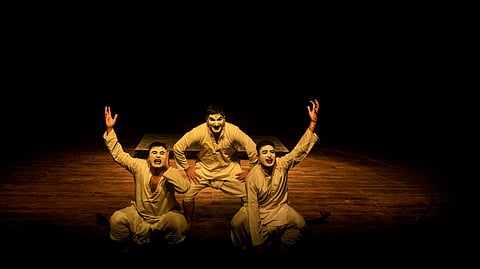
Founded 2016, the city-based theatre troupe, Kahe Vidushak, meaning ‘thus speaks the jester,’ began with a handful of productions. Over time, the vision behind Kahe Vidushak evolved: the focus shifted beyond just the content of the stories to the form in which they were told. “One of the key tools I embraced to keep storytelling simple was folk theatre. With its lively mix of song, dance, bright costumes and exaggerated performance, it stands in stark contrast to the realism that dominated theatre in the ’90s and 2000s. Folk forms can engage any audience, distil complex narratives into accessible, entertaining for mats and still leave them with something to reflect on,” founder Srinivas Beesetty begins.
Jester's Journey
The jester (vidushak) doesn’t just entertain; he questions the hero’s righteousness and the villain’s intentions, too; challenging notions of absolute right and wrong. “Through him, we’re reminded that the world isn’t black and white — it exists in shades of grey. I believe the primary role of theatre is to question. I’m not convinced that theatre can directly change society — that kind of transformation is rare and difficult. But what it can do is raise the right questions, even if it doesn’t offer all the answers,” he explains.
Vidu-Dashak: Kahe Vidushak’s 10-Year Celebration
This year, the troupe completes a decade! To commemorate the journey, the ensemble presents Vidu-Dashak: Kahe Vidushak’s 10-Year Celebration. The name is a thoughtful play on words — Vidu refers to someone who is witty and intelligent, while Dashak means a decade. The festival has been thoughtfully curated by Srinivas Beesetty and is divided into two distinct segments. “One part of the celebration is taking place this week, while the second is a festival scheduled for September, where four new productions will be show cased,” Srinivas shares.
What to expect from the two-day event!
This week’s two-day anniversary will present two plays and one dramatised reading, all of which are revivals of past productions. On May 15 is Jine Naze, an anthology comprising two short plays titled Namak and Rashan, both penned by acclaimed playwright Abhishek Majumdar. These powerful works delve into the lives of migrant labourers and the hardships they endured during the COVID-19 lockdown. “One of the main reasons I wanted to bring this production back is that we struggled to reach the marginalised communities, as everything was heavily restricted at that time. Now, the aim is to take it directly to the communities that matter — those for whom the story was written. This includes migrant labour settlements, the outskirts, villages and more,” he elucidates.
On May 16, the festival will feature two productions. The first is a dramatised reading of Do Kodi Ka Khel, followed by the staging of Waiting for Naseer. “The former is a Hindi adaptation of Bertolt Brecht’s iconic Three Penny Opera, presented in a nautanki style — a form not widely explored in Bengaluru. Having staged it before, we’re reviving it on a much larger scale, starting with a dramatised reading to give the audience a taste of what’s to come. The latter, Waiting for Naseer, centres on two actors who are waiting to meet Naseeruddin Shah at Prithvi Theatre. The twist? There’s only one ticket to his play and both characters are dead. The piece satirically explores existentialism,” he reveals.
Kahe Vidushak’s vision for the future
Looking ahead, Kahe Vidushak’s vision for the future rests on two key goals. The first is all about making theatre more accessible — not just for audiences, but for artists as well. The hope is to create a space where theatre isn’t merely a passion project pursued after a 9-to-5 job, but a viable career path in itself. A space where artistes can see theatre as a full-time profession, through the many roles that support and surround the theatrical ecosystem. “The idea is to explore all the avenues theatre can engage with — from education and corporate training to podcasting, voiceovers and more. While the education wing collaborates with schools, for corporates we conduct workshops on themes like diversity, storytelling with data and communication skills — all areas where theatrical tools enhance expression and engagement,” Srinivas details.
The second is shaped by the theatre artiste’s largely matriarchal upbringing, leading to a natural affinity towards stories centred on women. These narratives, layered with deeprooted complexities and the weight of both overt and subtle histories of exploitation, seem to find their truest expression through folk theatre. Its raw, direct form allows stories to be told with honesty and emotional clarity, making space for overlooked voices.