
- LIFESTYLE
- FASHION
- FOOD
- ENTERTAINMENT
- EVENTS
- CULTURE
- VIDEOS
- WEB STORIES
- SPORTS
- GADGETS
- CAR & BIKE
- TRAVEL
- SOCIETY
- GALLERIES
- NORTH EAST
- INDULGE CONNECT

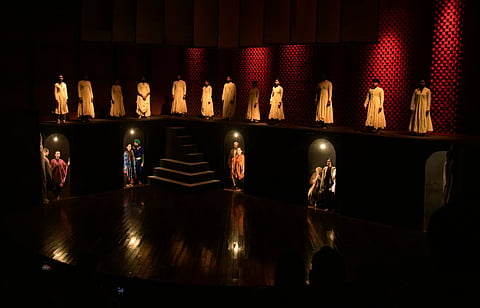
Drawing inspiration from Italo Calvino’s novel Invisible Cities boasting lyrical prose poems in which Marco Polo describes fictitious cities to the Mongol emperor Kublai Khan, Darpana Academy brings Meanwhile Elsewhere. Written and directed by Yadavan Chandran, the production offers a theatrical odyssey that blends poetic narration, movement and live music, exploring the themes of memory, impermanence and the relationship between the places we build and the places we leave behind. The play is currently on an India tour and ahead of its Bengaluru staging, we speak to the director on what the audience can expect from the show.
How and when did you first encounter Italo Calvino’s work? What made you feel it needed to be brought to the stage?
It was on my birthday, November 1, 2024. My father took me to a small bookstore in Thiruvananthapuram and asked me to choose a book he could gift me. I picked up the only copy of Invisible Cities on the shelf. I had heard of Calvino (producer and lead actress), Mallika Sarabhai had often mentioned him as a favourite, but I had never read him. That night, I opened the book and began to read: the first lines about Kublai Khan, the empire, the decay and the lies that sustain grandeur. I remember the sentence: ‘Kublai Khan does not necessarily believe everything Marco Polo says... but he continues to listen.’ It struck me as a metaphor for all creation — for every artist who speaks in metaphors and every listener who must decide whether to believe.
Beyond the book’s structure, what specific philosophical or emotional themes served as the primary inspiration for Meanwhile Elsewhere?
What stayed with me was not the travelogue but the ache, the realisation that beauty and ruin, live side by side. Italo’s vision of cities was never about geography; it was about memory, desire, time and decay. I saw in that a reflection of the world we inhabit — cities built of ambition, silence and erasure. Meanwhile Elsewhere became my meditation on those invisible architectures, what we build and what we lose. Each city in the performance begins with a small poetic fragment and those become emotional keys for doors through which the audience enters the invisible.
Did you allow the narrative to diverge from Calvino’s text? How have you introduced contemporary life into this framework?
Almost none of the original text survives, perhaps three pages, if that. What remains is the spirit of listening, of searching for patterns amid collapse. Marco and Kublai in my piece are not two men but many — voices, bodies, impulses. My cities are our own, loaded with anxiety, luminous, contradictory. They breathe WhatsApp notifications and political noise, gender expectations and fleeing tenderness. There’s a section called Voices of the City — a soundscape of commands we hear every day: ‘Cover yourself properly or people will talk. You must have a plan for your future.’ These are our invisible empires, the subtle tyrannies we live by. Calvino gave me the metaphor; life provided the raw material.
Which distinct art forms have you utilised and how do they work together?
The work sits between theatre, dance, music and cinema. There are projections that breathe, light that behaves like memory and choreography that becomes architecture. The performance doesn’t unfold; it reveals, like a photograph developing in slow water. Music is the bloodstream of Meanwhile Elsewhere. When Eduardo Catemario was at Darpana creating his Mahabharata opera, our paths crossed almost by accident. Out of those late-night sessions came a song called There Comes a Time, which Penelope now sings in the performance, a moment that all feels like a quiet heartbeat running through the piece. The set has two levels, the mezzanine above and the main stage below. That architecture lets Valdrada, the city of mirrors, exist in dialogue with itself: what happens above is echoed below, like a reflection that moves, hesitates and breathes. The structure itself becomes the mirror. Suspended flags and projections help the cities appear and vanish before our eyes. The scrim plays a crucial role, a translucent skin between the audience and the city. Sometimes it conceals, sometimes it reveals and sometimes it simply becomes a frame through which we glimpse fragments of another world. Text appears and disappears upon it, like fleeting memories caught in air.
How does the use of multiple languages enhance the play’s themes?
Italo himself wrote about communication and misunderstanding, so using multiple languages felt essential. The mix reflects how urban life sounds today — fragmented yet interconnected. Even if you don’t understand every word, the emotion travels through tone, music and movement. Seven languages are used in the performance including English, Hindi, Gujarati, Italian, Malayalam, Khasi and American Sign Language.
₹300. November 8, 6.30 pm. At Prestige Centre for Performing Arts, Konanakunte.
For more updates, join/follow our WhatsApp, Telegram and YouTube channels