
- LIFESTYLE
- FASHION
- FOOD
- ENTERTAINMENT
- EVENTS
- CULTURE
- VIDEOS
- WEB STORIES
- SPORTS
- GADGETS
- CAR & BIKE
- TRAVEL
- SOCIETY
- GALLERIES
- NORTH EAST
- INDULGE CONNECT

Pandavani is one of India's most distinctive oral storytelling traditions, originating in the central state of Chhattisgarh. The name literally means "the story of the Pandavas" and refers to a musical narration of episodes from the ancient Indian epic, the Mahabharata. Blending music, poetry, drama, and expressive performance, Pandavani has been passed down through generations as a living folk art that keeps the epic accessible to ordinary audiences.
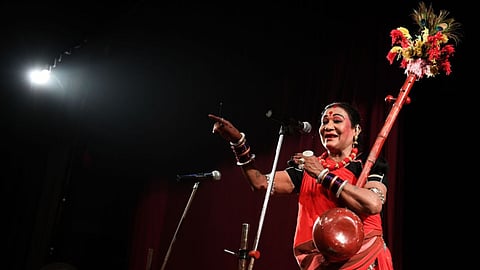
Unlike classical theatre, Pandavani relies primarily on a single lead performer, who narrates the story while singing verses and acting out different characters. The performance is accompanied by musicians playing traditional instruments such as the harmonium, tabla, manjira, and dholak. The storyteller often carries a tambura or ektara, using it not just as a musical instrument but also as a prop that transforms into a weapon, chariot, mace, or bow depending on the scene being enacted.
There are two major styles of Pandavani: Vedamati and Kapalik. The Vedamati style is relatively restrained, with the narrator remaining seated and focusing on the lyrical recitation of the story. The Kapalik style is far more theatrical and dynamic. Performers move around the stage, adopt different voices, enact battle scenes, and use dramatic gestures to bring the Mahabharata's characters to life. It is this energetic Kapalik tradition that became synonymous with Teejan Bai.
Few artists have shaped Pandavani as profoundly as Teejan Bai. Born into a modest family in rural Chhattisgarh, she developed a fascination for the Mahabharata at a young age by listening to stories narrated by her grandfather. At a time when women were discouraged from performing the physically demanding Kapalik style, she broke convention by mastering it herself. Her decision challenged long-standing social norms and transformed the role of women in this folk tradition.
Teejan Bai's performances were marked by extraordinary energy and emotional depth. Whether portraying the courage of Bhima, the wisdom of Krishna, or the anguish of Draupadi, she shifted effortlessly between characters using only her voice, facial expressions, and body language. Her commanding stage presence allowed audiences to experience the Mahabharata not as a distant religious text but as a vivid human drama filled with heroism, betrayal, grief, and resilience.
Her contribution went beyond performance. Teejan Bai played a pivotal role in taking Pandavani from village gatherings to national and international stages. She performed across India and in numerous countries, introducing global audiences to a centuries-old storytelling tradition that had previously remained largely confined to central India. Through her tours, she demonstrated that regional folk arts could command the same respect as classical performing traditions.
Recognition soon followed. Over the course of her career, Teejan Bai received some of India's highest civilian honours, including the Padma Shri, Padma Bhushan, and Padma Vibhushan, acknowledging her immense contribution to preserving and promoting India's cultural heritage. Her achievements inspired countless young performers, particularly women, to pursue careers in folk arts without fear of social barriers.
The significance of Pandavani extends far beyond entertainment. The tradition preserves local dialects, oral history, music, and performance techniques that have been transmitted through generations. Each performer brings personal interpretation and improvisation to familiar episodes, ensuring that every performance remains unique while staying rooted in the Mahabharata's timeless themes of duty, justice, sacrifice, and morality.
For more updates, join/follow our WhatsApp, Telegram and YouTube channels.