
- LIFESTYLE
- FASHION
- FOOD
- ENTERTAINMENT
- EVENTS
- CULTURE
- VIDEOS
- WEB STORIES
- GALLERIES
- GADGETS
- CAR & BIKE
- SOCIETY
- TRAVEL
- NORTH EAST
- INDULGE CONNECT

Most retellings of Hamlet keep the gaze intact and change the furniture. This one walks in through a different door entirely and refuses to leave.
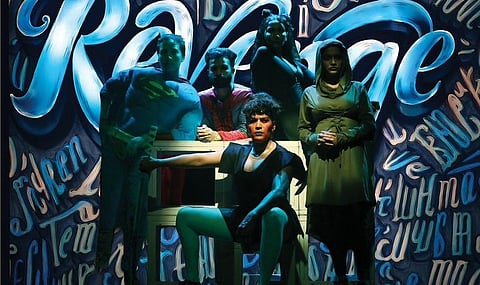
A Woman Or Not To Be, Adishakti’s bold reimagining of Shakespeare’s tragedy, interrogates the assumptions buried inside it rather than just updating the classic through a new lens. By asking what happens when Hamlet becomes a woman, the production shifts the centre of gravity away from princely anguish and towards questions of agency, power and who gets the right to rage or seek justice.
Written, directed, and designed by Vinayakumar, the work grew out of a disturbing contemporary reality. Reflecting on public outrage surrounding an acid attack case in Uttar Pradesh, he found himself returning to Shakespeare’s men. “What about Othello?” he asks. “Did Othello do anything greater? No. Othello’s misogyny is hid behind great literature.” That casual exposure of the gap between canonical veneration and ethical accountability is exactly the kind of thinking that makes this production a long overdue reckoning.
For Vinayakumar, the production began with a growing discomfort around the archetypes that generations of theatre practitioners have been taught to revere. “I felt it's time to question these archetypes that are shoved down our throats and held up as the greatest works of all,” he says. While acknowledging Shakespeare's literary brilliance, he is interested in interrogating what he describes as the canon's “venerated male destructive brooding” and “male misogynist existential crisis”. The question that emerged from this critique was simple yet radical: “If Hamlet is a woman, a princess, will she have all the agencies that Hamlet freely available, literally or physically?” In Shakespeare's world, Hamlet can stage a play, expose guilt and set events in motion. But, Vinayakumar argues, “we live at a time where hiding the guilt is a pastime,” and for a woman, “to prove guilt... is like a Herculean task.” Hamlet therefore becomes an inquiry into agency itself: whether a princess would possess the same freedoms as a prince, or be forced to imagine an entirely different path towards justice.
The adaptation does not simply swap Hamlet's gender and retell the story. Instead, Vinayakumar describes it as a parallel work that retains some of the original play's central crises while relocating them to contemporary contexts. New monologues and scenes sit alongside Shakespeare's ideas, creating what he calls a "reimagining" or "rewriting" rather than a straightforward adaptation. Central to that process was a question the team repeatedly posed: is revenge male or female? While most people agreed that both men and women are capable of revenge, Vinayakumar became interested in who gets to define what revenge looks like. Society, he argues, tends to recognise revenge only when it fits masculine frameworks of violence and retribution. Acts that fall outside those frameworks, particularly those born from powerlessness, are rarely understood as responses at all. The gender shift therefore opened up a much wider field of inquiry, allowing him to reconsider not only Hamlet's motivations but also his own "language, gaze and way of looking" at questions of agency, protest and justice.
The adaptation does not simply gender-swap Shakespeare's protagonist. Instead, Vinayakumar describes it as a work that "retains some core ideas of Hamlet" while placing them in "different contemporary spaces" that examine the prince's dilemmas through the body and experience of a woman. New monologues and scenes run parallel to Shakespeare's text, making the production less an adaptation than a "reimagining" or "rewriting" of its central concerns. One of the questions that shaped the process was deceptively simple: "Is revenge male or female?" While most people answered that revenge belongs to both men and women, Vinayakumar found a deeper contradiction. "Society thinks everybody can take revenge, but it's only when you fit within the categories of revenge defined by male" that such acts are recognised and legitimised. A violent avenger in the mould of Kill Bill is culturally legible, he argues, but figures such as Medea, who kills her children, or Clytemnestra, Agamemnon's wife, who murders her husband, occupy a far more uncomfortable space. Even contemporary instances of women ending their lives alongside their children are rarely understood as acts of protest or resistance. "When you have no agency, when you are making your body as a protest, we need to look at that," he says. "That act is not simply about ending a life; sometimes it is the only agency left to them." For Vinayakumar, the decision to make Hamlet a princess therefore became a way of expanding the conversation beyond Shakespeare. "The gender shift really, really helped us," he reflects, opening up "a much wider canvas" through which to "rearrange myself, my language, my look, my gaze, and so on."
Princess Hamlet is 20 years old, a martial arts practitioner and manga devotee, restless and electric in the way only the young grieving can be. She returns home to find her mother, the queen, murdered, her aunt installed in her father’s life. And then the ghost appears, not to demand blood, but to ask for restraint. The ghost here does not fuel revenge. She sees forward and backward simultaneously, carrying what neuroscientists describe as the female amygdala's capacity to corroborate memory with the past, present and future all at once. "I used this to shift within the physicality of the character," Vinayakumar explains, "from rigorous warrior-like moments, then deconstructing later towards a large amygdala that can see past, present and future and take a decision unlike a male counterpart. Human beings should be allowed to try, fail, crawl and evolve those tools. That space is vastly missing. That is why I place the father as a mother. She says, in essence, "It's happened. It's happened. I am the collateral now. What are you going to do next? Are you going to kill? Are you going to destroy?" She offers a different worldview, one often dismissed as weakness within the dominant male paradigm. But I do not see it as weakness. I see it as a survival technique. I would rather embrace a mother's survival strategy than glorify revenge and receive applause from a male community.”
The mother argues for restraint. That is my counter-narrative to revenge. Of course, anger is necessary. We should not confuse anger with violence. Every woman needs access to the language of anger — not necessarily to harm others, but to communicate, "Don't mess with me." The ability to embody anger is important. The mother is saying: stand on your own feet, occupy your space, and you will find a different kind of revenge.
Princess Hamlet enters the world steeped in the visual mythology of invincible figures, people who transform and fight and win. Then the real world asserts itself, and not one of those symbols can hold her weight. “This manga, martial arts, anime-loving superhero-loving girl falls flat on her tragedy,” he says, “and suddenly realises she doesn’t have any of that power.” Rosencrantz and Guildenstern appear here as the superhero companions who follow her through the rest of the journey, revealing their own fragility, their own marginalised narratives.
Feminist discourse around revenge has long been split. One argument, Vinayakumar notes, sees anger and revenge as forms of agency that women must “claim or reclaim” in order to confront the structures that have historically constrained them. Another warns that if revenge merely repeats patriarchal notions of power, it risks reproducing the very gender stereotypes feminism seeks to dismantle. “It’s not a conclusive answer,” he says plainly. “It’s still a stone between these two arguments.” Rather than taking a side, Hamlet inhabits that unresolved space, asking what revenge means when viewed through a female body and experience.
Vinayakumar argues that contemporary culture continues to glorify the figure of the troubled male, from blockbuster films to politics and public life. Rather than merely self-destructive, he says these characters often "destroy everything around them", yet their rage, anger and refusal of discourse are repeatedly romanticised. In contrast, female anger is frequently marginalised or ridiculed. Pointing to the aftermath of the Me Too movement, he notes how isolated incidents were used to discredit a larger push for accountability, resulting in what he sees as the systematic dismantling of a movement that could have brought meaningful change in gender parity.
As a male practitioner, he sees this inquiry as central to his work, asking how he can sustain a dialogue around gender “within my paradigm, within my practice”. For Vinayakumar, A Woman Or Not To Be is “for me a self-dialogue,” he says, describing the play as an attempt to examine his own understanding of gender, power, and privilege. If it sparks reflection or conversation among audiences, he believes it has served its purpose. “Some questions need to be asked.”
Rs 250. On June 6. At 5 pm and 7.30 pm. At Alliance Francaise de Madras, Nungambakkam.
Email: shivani@newindianexpress.com
X: @ShivaniIllakiya
For more updates, join/follow our WhatsApp, Telegram and YouTube channels