
- LIFESTYLE
- FASHION
- FOOD
- ENTERTAINMENT
- EVENTS
- CULTURE
- VIDEOS
- WEB STORIES
- GALLERIES
- GADGETS
- CAR & BIKE
- SOCIETY
- TRAVEL
- NORTH EAST
- INDULGE CONNECT

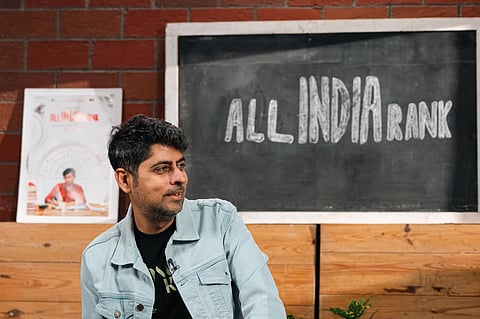
In Lucknow, back in ’98, Varun Grover was hitting the books, aiming to crack IIT JEE. Son of a military engineer and a teacher wrapped up in academic destinies, grades seemed to be the golden ticket. The world appeared to have laid out just three paths for him: Engineer, MBA, or IAS officer. Riding high on erudition, Varun sailed through the exams and landed in the corridors of IIT BHU, Varanasi. But beneath the achievements and societal expectations, a storyteller was waiting to break free. “I actually tried working on what I wanted to be — a writer,” Varun tells us. Just a teenager, he was wrestling with the colossal question of his life’s calling amidst a generation strapped into a one-track success story. Fast forward to the sets of Masaan, and the wheels in Varun’s head started turning, sketching the blueprint of his film as a writer. Later on, the real-life dilemma mirrored in cult classic 3 Idiots, ignited his creative spark. All India Rank, Varun’s directorial debut flips the script on finding one’s purpose. It’s a refreshing take on the journey to self-discovery, questioning the rush to figure it all out at 17. After marinating in the imagination and drafts since 2014, and getting the nod from the NFDC script lab, his vision was set in motion. Despite the natural flair for writing, directing was an uncharted colony. Between the sets of Sacred Games and Masaan, Varun was schooling himself in the art of cinema. Then, in a twist of plot and fate, after Andhadhun’s success, Sriram Raghavan passed the baton to Varun, selecting All India Rank for Matchbox Shots. The pursuit was about to be realised, but then came the curveball — COVID-19, delaying the shoot to 2022. Fast forward to 2024, a decade since its inception, All India Rank is a 25-year pilgrimage from ideation to a triumphant premiere at the Rotterdam Film Festival, making history as the first-ever Indian film to close the event. In an exclusive interview, Varun talks about his junket from Lucknow to filmography and spotlight as a tale of patience, persistence, and the power of storytelling. All India Rank is a message to everyone — it’s fine to take your time to find your purpose.
Excerpts from our conversation:
All India Rank explores aspirations, presumed academic success and belonging. What creative liberties did you feel were necessary to convey the nuances of an Indian middle-class family?
When I was putting the story together, I just kept it real, focusing on that whole vibe of life being dull for the Indian middle class. It’s funny because there’s this undercurrent of privilege they live with, which they can’t see. They’re always feeling like they’re missing out or just one lucky break away from something better. And for a lot of them, that big break is either nailing a competitive exam or snagging a government job. For the film, I dialled up the drama here and there to make things more impactful or stir up the emotions, but honestly, all of it is ripped straight from real life. I’m talking about stories from my friends, and their families, or just piecing together bits from various parents I know. I didn’t have to make elements up.
To you, how important are goals, discipline and aspirations?
My perspective is a paradox that many creatives might resonate with. On the one hand, I have this unbounded ambition, a wellspring of goals, aspirations, and creative endeavours I wish to pursue — be it writing poetry, crafting stories, or exploring the world of stand-up comedy. It’s as if you’re standing at the edge of a vast ocean of possibilities, eager to dive into every wave. Then I am drawn to the essence of being goalless, embodying the spirit of a fakir — detached, content in the moment, immersed in the joy of creation without the constraints of tangible achievements. This duality, craving both the thrill of pursuit and the peace of existential contentment, is a dance on the tightrope of creativity. My involvement with Qala exemplifies this beautifully. It wasn’t about adding another feather to my cap but about treasuring a new experience and living fully in the moment. I live with the constant reminder that each day could be my last.
What is crucial about a storyteller? Are empathy and a sense of the other enough?
I feel empathy is most important. If I don’t feel what the character I’m writing is feeling, then I don’t think it will ever feel true. But at the same time, what can we do to gain empathy? It is not a very natural process for us because we all are kind of self-centred and we always look to protect our ego and our way of life. That’s what we have learned in this evolutionary cycle where we are selfish, we gang up when we feel threatened. But to achieve empathy, what becomes important is deep research from multiple angles, like fact-based research. But if you choose to be a writer, then I assume you come into the profession with an open mind and ready to listen to all the perspectives and then kind of make up your mind. We need to be living with these characters, going to meet them in their spaces, spending time with them in their day and their spaces, in their social and financial conditions. Another thing which helps being a storyteller, is constantly being curious about the world and being in awe of the world, of things which are generally ignored in the world; for example, how a meal is brought to your plate from the inception of it. Just one meal on a plate comes from so many sources and if you just follow even one grain out of it its story will keep you occupied for months.
What excites you most about the future of comedy, storytelling and filmmaking?
There’s this thing I keep saying — the worst times for comedy are the best times for comedy. What excites me is that if things get even more difficult for freedom of expression, then comedy will get sharper and better and of course, more dangerous. The more dangerous the comedy, the better it is in terms of quality. About filmmaking, I think there are newer technologies that change the way cinema is made, The worst times for comedy are the best times for comedy. What excites me is that if things get even more difficult for freedom of expression, then comedy will get sharper and better and of course, more dangerous consumed, and stories are told.
How do you respond to the criticisms from within Bollywood after you have called it out for its flaws?
The thing with powerful people, like most of the systemic flaws I’ve called out in Bollywood or other spheres of life in India (because I do talk about a lot of things in my stand-up comedy, not just Bollywood), is that they don’t care until they suddenly do. So, I’ll find out the day they start to care, but until now, I haven’t had to deal with anything where I’ve consciously, knowingly suffered because of something I’ve said somewhere. What I have encountered are more subtle types of repercussions, where I might not realise that someone is choosing not to work with me because of my outspoken nature. As far as I’m aware, nothing direct has come my way. Another factor that has probably helped me so far is that I work sparingly. I’m not churning out music albums back-to-back, nor am I constantly on set for films or writing show after show. I focus on one or two projects each year, and that’s enough for me. So, for now, I think they are too big to care about what I say, and I hope it stays that way.
How do you guide yourself through moments of self-doubt?
The constant companion is self-doubt. It’s not just an occasional visitor; it’s more like a permanent resident in the psyche of mine. It’s there, almost as a default state of being, overshadowing my existence. Occasionally, I manage to push it aside momentarily to get some work done, but it never really leaves. It’s as if self-doubt is the norm, and moments of clarity and confidence are the exceptions. I find myself constantly battling this shadow, trying to remind myself to take a break, make a sandwich, just so I can sneak in some productive work. During a film promotion event at IIT Kanpur, I travelled from Kanpur to Lucknow, passing through a small town called Unnao, which I’ve crossed countless times since childhood on trips. Something caught my eye: A welcome board for Unnao that proclaimed it as a ‘city of literature.’ This was a revelation to me. Despite my familiarity with the area, I’d never heard Unnao described this way. It sparked a flurry of questions and a desire to learn more. Unfortunately, due to time constraints, I couldn’t research it immediately, but the intrigue stayed with me. The world is full of surprises and mysteries, waiting to be noticed and explored. And these instances of discovery momentarily lift my self-doubt.
chokita@newindianexpress.com @PaulChokita