
- LIFESTYLE
- FASHION
- FOOD
- ENTERTAINMENT
- EVENTS
- CULTURE
- VIDEOS
- WEB STORIES
- SPORTS
- GADGETS
- CAR & BIKE
- TRAVEL
- SOCIETY
- GALLERIES
- NORTH EAST
- INDULGE CONNECT
Every Bujji is a faithful companion, whether for Dora from Dora the Explorer or Bhairava from Kalki 2898 AD. While the former is a cartoon character, the latter is an AI-powered electric vehicle that embodies intelligence beyond its physical form.
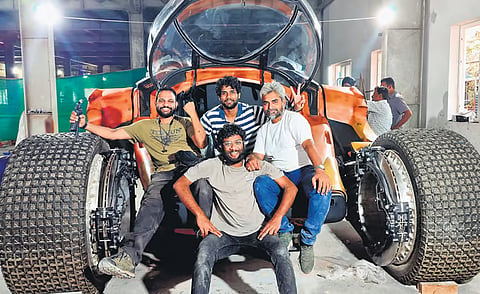
In the Nag Ashwin’s post-apocalyptic dystopian universe, Bujji is all brains without a body. Its physical shape — orange-coloured exterior, black biceps (wheels), and a glass domed head — took almost three years to make. Now, Bujji is hailed as a statement of the talent load the country has and is claimed to be the fifth hero of the film. This character, brought to life in the movie in actress Keerthy Suresh’s voice, was manufactured in Coimbatore. Members from the production team take us through the process, the hurdles, and the success of creating Bujji on screen.
Starting trouble
The story of Bujji’s making can be traced back to 2020. Nag Ashwin, the director of the movie, is a huge fan of the Star Wars franchise and the Marvel movies. He reached out to Haisu Wang, an acclaimed award-winning international concept designer, who has previously lent his contributions to films like Avengers Endgame, Avatar Sequels, and Galaxy of the Guardians Vol 3, to come on board Kalki 2898 AD. “Everyone on the team knew that Bujji was the next big thing. So, Haisu provided us with a proper 3D model of the vehicle with every part to be designed. This gave us an idea of how it should look and build it with every feature explained in detail,” says Saaduddin Syed, the vehicle build supervisor from Vyjayanthi Movies that produced the film. Consequently, the discussions with Haisu went back and forth for a while.
With this lead, the engineering team built miniature versions and brought remote-controlled cars to figure out the dynamics of Bujji. “We also thought we could take an existing vehicle and modify it. We brought in a Jeep and a Thar and were figuring out if we could put Bujji on top of it,” he shares. Three prototypes of Bujji were outlined with others, specifically for tyres, steering, and rear. These were built out of cardboard, thermocol, and laser-cut steel.
Kickstarting the manufacturing
With the design in hand and the modifications not working, the road ahead for the team was difficult. Not knowing where to start or how, Ashwin took to X (formerly Twitter) on March 4, 2022, and wrote, “We are making an Indian sci-fi film called #ProjectK. A few vehicles we are building for this world are unique & beyond the tech of today. If this film does wat it is supposed to, it will be the pride of our nation. V have a talented, fully Indian team of engineers and designers, but the scale of the project is such that we could use a hand. Such a film has never been attempted before. It would be an honor if you can help us engineer the future” (sic), tagging Anand Mahindra, the chairperson of Mahindra and Mahindra, who agreed to offer his assistance.
“Six months after that a lot of discussions took place to get the engineering and dynamics right. Mahindra said that they could not accommodate the vehicle’s manufacturing under them. So, they forwarded us to Jayem Automotives,” shares Vishnu Pratap, automotive designer and prototyping engineer from Vyjayanthi Movies. One of the leading manufacturers in India, Jayem Automotives is based out of Coimbatore.
Vishnu was sceptical about the completion of Bujji. Then the automotive company designed and built the rolling chassis. “This was when the team and I realised that Bujji was happening. We were unsure of where it was going when it was on paper. Finding vendors to mould the vehicle’s parts was a task,” explains Vishnu. The static version of the vehicle was put together in five months by Vishnu, Saaduddin, and Harsha Venna, under the production in-charge Ramesh. This model weighed four-odd tonnes and a truck was modified to transport it from Coimbatore to the set in Hyderabad.
For a bigger purpose
The shooting of ‘Project K’ began with a static Bujji. Later, Ashwin wanted a realistic vehicle that could move around. The team came under one roof again to build the moving Bujji. This version weighed six tonnes, a little less than 12 feet in width, 22 feet in length, and 7 feet in height. The team could not complete the manufacturing on time as it took almost three years to give shape to Bujji. “We worked with parts that could be easily dismantled and put together for the shoot while the moving Bujji was in the making,” points out Saaduddin.
The raw materials were imported from Germany for the windshield, rear, and tyre cover. Composite Tomorrow, aircraft manufacturers in Vadodara, manufactured the body panel consisting of 75% of the carbon fibre. The windshield — more like the canopy of fighter jets — was made by Acros World, a plastic fabrication company. “The machine to make a windshield of this scale and size was custom-made because no powder coating oven could place that large sheet of acrylic,” adds Vishnu.
Bujji was 80% complete. Now, the team did not have the front tyres as they were too huge to mould. At one point, the team started testing the vehicle without the wheels. “The requirement was pneumatic tyres and through my father’s help we got in touch with CEAT Tyres,” says Vishnu. “There were no moulds for the tyre. We showed them the design and they tweaked it. They got it right in the first attempt,” shares Saaduddin, adding that until the tyre company completed the production the team made use of truck tyres to shoot the film.
A few changes were consciously made to the shooting set to fit the vehicle of this measurement. “The engineers made the prototypes of Bujji and Nagi for the set. And all these were with respect to the size of Bujji. When the vehicle is going through the streets of Kashi, the width of Bujji defines the width of the streets,” he says.
Testing and driving
The set was wider, the vehicle was put together before the director said “Action” and the actor sitting in Bujji was Prabhas. “Prabhas went through the instructions carefully and was following them quite well. Once he was used to the vehicle, he was at home with it,” says Saaduddin, adding that the engineering did not push Bujji to find its full capacity, as much as Prabhas did.
Bujji came into its final form on May 20, 2024. Prabhas did the test run on May 21. “Prabhas was doing so many runs that the practice run went on till sunrise. He was pushing Bujji so hard that there was a moment when one of the wheels was in the air,” he shares. The fully-manufactured Bujji was revealed to the world on May 22. Since then the vehicle has been doing rounds across cities. On Tuesday, Bujji was sent to Vyjayanthi Movies’ set in Hyderabad. “It has incurred repairs from the touring. Probably we will send it back to its birthplace, Coimbatore. Bujji will be back home soon,” concludes Saaduddin.
