
- LIFESTYLE
- FASHION
- FOOD
- ENTERTAINMENT
- EVENTS
- CULTURE
- VIDEOS
- WEB STORIES
- SPORTS
- GADGETS
- CAR & BIKE
- TRAVEL
- SOCIETY
- GALLERIES
- NORTH EAST
- INDULGE CONNECT

The Odyssey and the Ramayana are two of the oldest epics known to the world. While the Ramayana is believed to be written around 7th to 1st Century BC by the sage Valmiki, the Odyssey has been authored by Homer in around 8th or 7th Century BC. Both these epics talk about journeys of the heroes, loss of their beloved wife, the struggles that they go through and also about the restoration of justice. According to French academician Hippolyte Fauché, who was studying Indian literature in the 19th Century, Homer was probably influenced by the tale of Ramayana. However, this idea is debated by modern scholars.
A hero's long road back home
The similarities between The Odyssey and Ramayana begin with the extensive duration that the hero has spent away from his family. The 10-year war and the following 10 years of travelling back home to see his wife Penelope and his son Telemachus make for a 20-year journey filled with many hardships and threats along the way.
The journey taken by Rama is also similar. He goes into exile for 14 years along with Sita and Lakshmana. In his journey, Rama passes through forests, crosses the ocean, kills Ravana, and comes back to Ayodhya. In both cases, the return of the protagonist heralds the restoration of peace at long last.
The famous bow that only the true hero can master
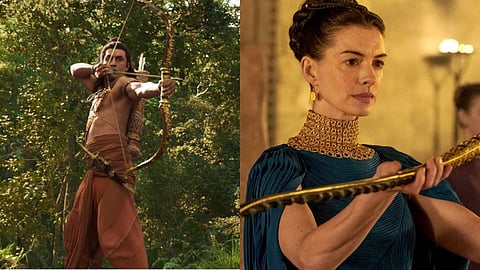
Another similarity lies in the well-known archery contests. Penelope poses a challenge for her suitors to draw a huge bow. They all fail. Meanwhile, Odysseus (disguised as a beggar) manages to accomplish this task effortlessly.
A similar instance is illustrated in the case of Sita's swayamvara in the Ramayana. Here, King Janaka declares that any individual who is able to wield the celestial bow of Lord Shiva will get married to Sita. Many kings have tried but failed. Rama successfully lifts the bow and snaps it while stringing it.
Wars fought to rescue a woman
Conflicts featured in The Odyssey and Ramayana have some similarities as well. After Helen is carried to Troy, the Greek army goes to siege the city, which starts the Trojan War. In the Ramayana, the abduction of Sita by Ravana forces Rama and his companions to attack Lanka. The wars that these characters fight do not only serve to gain power; they are personal wars fueled by love and loyalty.
Supernatural forces shape every journey
Both of these epics transcend human representations. Odysseus faces monsters such as the Cyclopes and Sirens, while the harmony Watcher shows him that his fate is controlled by the gods. In contrast, Rama has to overcome demonic forces during his mission.
Temptation too has its place in the epics. Odysseus has to stay away from the Lotus Eaters, the Sirens, and Circe. Rama too is distracted from Sita by the golden deer, which was actually the demon Maricha in disguise. Both instances involve illusions that are meant to distract the heroes.
Loyalty, faith, and the return of the rightful king
One of the most important similarities in The Odyssey and Ramayana is that both Odysseus and Rama have loyal families that stand by them throughout their adventures. Penelope does not marry anyone else despite the continuous harassment of the suitors in her palace. Sita remains faithful to Rama despite her captivity in Lanka.
The other important thing is that their journey ends at the kingdoms that have been waiting for them. Odysseus comes back to his kingdom to restore justice in Ithaca. Likewise, Ram comes back to Ayodhya, where Bharat was eagerly waiting for him.
However, despite the intriguing similarities, the ideals celebrated in The Odyssey and Ramayana differ in nature. Odysseus is admired for his wisdom and shrewdness, while Rama is revered as an incarnation of Lord Vishnu, who places duty and righteousness above everything else.
For more updates, join/follow our WhatsApp, Telegram and YouTube channels.