
- LIFESTYLE
- FASHION
- FOOD
- ENTERTAINMENT
- EVENTS
- CULTURE
- VIDEOS
- WEB STORIES
- SPORTS
- GADGETS
- CAR & BIKE
- TRAVEL
- SOCIETY
- GALLERIES
- NORTH EAST
- INDULGE CONNECT

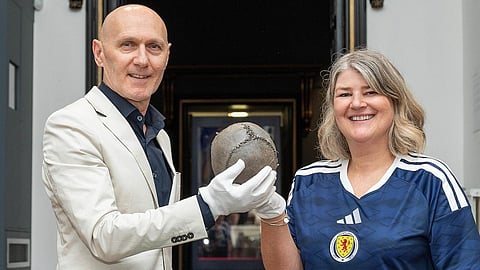
A worn-out, hand-stitched leather football, thought to be the oldest football still in existence, was shown to the audience prior to Scotland and Morocco's pivotal Group C match in the FIFA World Cup 2026.
The ball, dating back to the 16th century and discovered inside the rafters of Stirling Castle, looked nothing like the aerodynamic precision-engineered match balls used at modern World Cups. It was uneven, weathered and primitive. But that was precisely the point. Football did not begin in luxury sponsorship suites or algorithm-fed highlight reels. It began in muddy fields, crowded streets and chaotic local rivalries played for pride long before anyone imagined a global spectacle.
Modern football owes an enormous debt to Scottish influence. Scotland played in the world’s first official international match in 1872, helped shape passing football into an art form and remains deeply woven into the sport’s foundation. The Tartan Army still travels like football pilgrims rather than consumers.
The emotional burden of a 28-year World Cup absence weighed heavily on this Scotland team going into the competition. Paradoxically, their final World Cup appearance before to 2026 concluded against Morocco in France in 1998, a game that plagued Scottish football for many years.
Morocco stunned Scotland with Ismael Saibari’s goal after just 71 seconds — the fastest strike of the tournament so far — sealing a 1-0 victory and tightening their grip on Group C.
Football, at its core, is memory. The game survives because every generation believes it belongs to them while unknowingly borrowing it from the last. That old leather ball represented continuity — from castle rafters to packed World Cup stadiums, from medieval Scotland to a tournament spread across North America.
For more updates, join/follow our WhatsApp, Telegram and YouTube channels.