
- LIFESTYLE
- FASHION
- FOOD
- ENTERTAINMENT
- EVENTS
- CULTURE
- VIDEOS
- WEB STORIES
- SPORTS
- GADGETS
- CAR & BIKE
- TRAVEL
- SOCIETY
- GALLERIES
- NORTH EAST
- INDULGE CONNECT

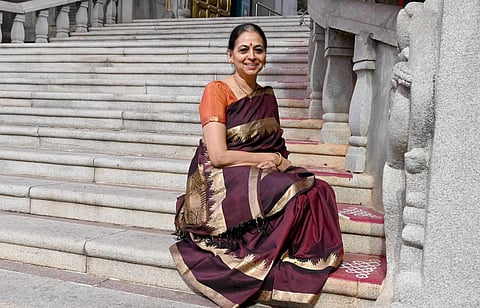
Annually, namma Bengaluru hosts hundreds of festivals, spanning music, dance, theatre, art, literature and lots more. However, one festival that truly stands out among these cultural extravaganzas is the one that revolves around devasthanas, devalayas, gudis or quite simply, temples. Holy shrines have been a pivotal entity of our society playing multifaceted roles by influencing our environmental, financial, educational, health and cultural spheres. Gudiya Sambhrama, an initiative curated by indic enthusiast Vijayalakshmi Vijayakumar, aims to breathe new life into this ignored ecosystem that due to limitations has been reduced to popularity only among the older generations. The curator, nurtured in the traditional ambience of a South Bengaluru household, steeped in Indian arts and value systems, envisions Gudiya Sambhrama as a medium for passing on ancient teachings and traditions to the current generation, helping them reconnect with their roots.
Organised by the Heritage Trust, a non-profit organisation, Gudiya Sambhrama — The Bengaluru Temple Festival 2024 is all set to host its glorious 15th edition to restore the lost interest in historical narratives, ecology, traditional folk arts and the love for the local language, Kannada. This festival stands as an annual celebration, a homage to our cultural and natural heritage. Spread across various sacred heritage temples in the city, the festival commences on January 20, promising to host over 32 events, featuring 50 visual artists, 60 performing artistes and 10 scholars. Attendees can immerse themselves in live dance and music presentations, enlightening talks, workshops, plant exhibitions, art shows, poster displays and even temple walks. On a mission to revive traditional performing arts within temple precincts, the temple fest also aims to disseminate knowledge from vedic texts and Indian epics, creating a forum for easy access to art forms and spreading awareness about the significance of cultural symbolism and practices. “Temples lost their charm when they stopped being the place we all gathered at,” Vijayalakshmi Vijayakumar reveals. We speak to her to learn more about this unique celebration of temples, culture, heritage and art forms that proudly define us:
As Gudiya Sambhrama marks its 15th anniversary, how has this journey been, thus far?
The journey has been truly enchanting — a continuous exploration where I’ve imbibed profound insights into my heritage and culture. Every day, embracing my identity as an Indian fills me with an overwhelming sense of pride and joy.
How did your fascination with arts and culture begin?
I hail from a traditional family immersed in diverse art forms — music and dance. In my early years, attending the Ramanavami festival at the Gayanasamaja Old Fort High School was a compulsory tradition. Events like these formed an integral part of our upbringing, laying the foundation for my appreciation of indigenous arts and culture.
What sets the 2024 edition of the temple festival apart?
The uniqueness of Gudiya Sambhrama lies in its annual themes, introducing a fresh perspective each year. This year, the spotlight is on Srishti, Sthithi and Laya— the cycle of creation, sustenance and dissolution — accompanied by the Tridevis and the Trimurtis. Critics often assert that the mention of this theme tends to overshadow the Tridevis, leading to accusations of promoting patriarchy. However, what escapes notice is that these goddesses are integral parts of these supreme deities. In this religious order, creation requires knowledge, symbolised by Brahma and Saraswati; sustenance needs wealth, embodied by Vishnu and Lakshmi; and dissolution calls for power, represented by Shiva and Parvati. This intricate interplay is a self-explanatory concept, rooted in the understanding that each deity complements the other, however, in today’s contemporary society, there seems to be a growing tendency where individuals need everything to be explicitly explained. Besides, this year we also have a manuscriptology exhibition and scholars from Sanskrit universities who will be hosting talks on these spiritual texts. Followed by Alankara — a session on heritage weaves, when the audience has been requested to attend in their heritage handloom saris and a special presentation by Raadha Kalpa Dance Company where the dancers will be performing all over the Basavangudi temple. We are currently in the process of publishing a curation of articles on Srishti, Sthiti and Laya from a puranic aspect, which will be unveiled in a few months.
What can culture and art enthusiasts expect from the 10-day extravaganza?
The festival commences on Saturday with Nritya Kainkaryam, a unique event where dancers offer their worship by performing before the temple’s garbhagudi at numerous temples across the city. On Day 2, the Devakula Yatra: Temple Walk, led by Vinay Varanasi, kicks off from Ragigudda Sri Prasanna Anjaneyaswamy Devasthana. As we step into January 23, the ladies from Rangavalli Art Foundation will adorn the temple surroundings with their intricate rangoli at Varaprada Sri Devagiri Devasthanam. Simultaneously, we inaugurate Divya Varna, a traditional art exhibition. Subsequent days are filled with diverse activities, including tulsi archané, Vishnu Sahastranama chanting, teaching the art of kolam (red & white rangoli), young talents showcasing their skills in Bala Kala Leela and Yuva Kala Leela programs, Upanyasam, Hasta Kala: Chant & Colour, Krida: Traditional Board Games by Kavade Hive, Jugalbandhi, Pushpamalarpanam (garland weaving), vocal and instrumental music concerts, Bhakti Sangeet and storytelling by Vikram Sridhar.
Can you name a few eminent personalities gracing the occasion?
We have upanyaasakar Dushyanth Sridhar, popular odishi dancer Rahul Acharya, vedanta scholar R Rangan speaking about this year’s theme, Shubam Kulkarni heading the Healing Swaras event, kuchipudi artiste Sreelakshmy Govardhanan from Kerala, Niraakara to Saakara: Temple Architecture Talk by conservation architect and researcher —Sushant Bharti — based in New Delhi, Trichur Brothers — Srikrishna Mohan and Ramkumar Mohan who are world-renowned carnatic musicians, heritage architect Meera Natampally and renowned actress and bharatanatyam dancer Rukmini Vijayakumar.
At which temples will the events will be held?
The main stage will remain at Devagiri (Banashankari) along with Siddhi Vinayaka Temple (HSR Layout) and Sri Guddada Ramanjaneya Devasthnam(Hanumanthanagar)but the events will span across Sri Mallikarjuna Devasthanam, Dodda Basavanna Devasthanam, Bedara Kannappa Devasthanam, Balanjaneya Devasthanam, Srirama Devasthanam, Dodda Ganesha Devasthanam, Govar-dhana Giri Devasthanam, Nava Mantralaya Rayara Mutt, Sri Venkateshwara Swamy Devasthanam, Gavigangadhareshwara Devasthanam, Harihareshwara Devasthanam, Kaadu Malleshwara Devasthanam, Dakshinamukha Nandi Tirtha Kalyani Kshetra, Lakshmi Narasimha Swamy Devasthanam, Gangamma Devi Devasthanam, Prasanna Ganapathy, Ragigudda Sri Prasanna Anjaneyaswamy Devasthana and Sreedevi Bhudevi Sametha Chokkanathasawamy Temple.
What are some principles from religious and spiritual scriptures that you would like to impart to the new generations?
Beginning with the akki flour rangoli intended for ants and small birds, extending to the act of feeding crows and cows, each gesture was intricately linked to the five sacred duties outlined in vedic texts called the Pancha Maha Yajnas. These duties, namely Ahuta, Huta, Prahuta, Brahmya-huta and Prasita, were not merely rituals but a way of life, emphasising the essence of living in harmony as they are the framework of leading a dharmic life. The foundation of these yajnas lies in recognising our place within the broader scheme of existence and cultivating sensitivity towards ourselves, others and the environment. Valmiki’s Ramayana dedicates an entire chapter to the qualities expected of both rulers and citizens. While much discussion revolves around the responsibilities of rulers, the duties of citizens are often overlooked. Gudiya Sambhrama seeks to bridge this gap by incorporating these principles, offering a platform to instill and uphold these values.
Could you also give us some insights about Srishti Sambhrama, The Earth Mother Festival?
This is an annual festival offering a profound exploration of our natural heritage — each edition of this event brings forth a specific facet of mother nature. Collaboratively organised with the esteemed BNM Institute of Technology, the primary objective is to foster an appreciation of the intricate relationship between humanity and our environment. We had one session on devi’s vahanas (mythical entities used as vehicles by goddesses) where a wildlife expert spoke from an environmentalist’s perspective along with another scholar who presented the traditional aspects. It resulted in a beautiful cohesion of tales answering questions like why Durga rides the lion before unfolding the details about the animal.
Quick Five:
Which is your favourite temple in Bengaluru?
Devagiri Varaprada Sri Venkateshwara Gudi, BSK
A temple that requires more attention?
Halasuru Someshwara Temple
A temple that remains an old favourite?
Vasantapura Temple
Which temple’s prasada do you enjoy the most?
Himavad Gopalaswamy Temple Chamarajanagar
A temple that has retained its charm?
Bull Temple, Basavanagudi
Entry Free. Pre-registration is required to attend the workshops. January 20 - February 11. For more information, visit: heritageparampara.org
Email: srushti@newindianexpress.com