
- LIFESTYLE
- FASHION
- FOOD
- ENTERTAINMENT
- EVENTS
- CULTURE
- VIDEOS
- WEB STORIES
- GALLERIES
- GADGETS
- CAR & BIKE
- SOCIETY
- TRAVEL
- NORTH EAST
- INDULGE CONNECT

South Indian women are known for their love of jasmine garlands, festivals and local cuisine. However, their affection for saris is unmatched. Every time you travel to a new state or place, you might notice how they ensure to bring back a sari as a souvenir. As you ponder ways to make the women in your life feel special, we have the perfect plan to give them everything they love and more, all under one roof. Welcome to Saras Mela Bengaluru 2024.
Kicked off on February 29 at the National College Ground in Bengaluru, this mega exhibition and trade fair under the National Livelihood Mission invited over 250 women self-help groups to participate and exhibit their products. The mela, inaugurated by chief minister Siddaramaiah, saw deputy chief minister DK Shivakumar and skill development and livelihood minister Sharan Prakash Patil in attendance, unveiling the logo of Namma Saras Mela Bengaluru 2024 and Akka Cafe.
Women self-help groups from different states have set up 100 stalls here, while women from Karnataka have 150 stalls exhibiting a variety of handicrafts and food products. This 10-day fair boasts a huge collection of saris from Karnataka, Chattisgarh, Andhra Pradesh, Odisha and Bihar, among others. But that’s not all; visitors can also find traditional handicrafts, accessories, jewellery, home decor and scrumptious food, making it a day out filled with shopping.
Starting with the ilkal sari, a traditional handloom sari from Ilkal in Karnataka’s Bagalkot district, these saris are renowned for their unique weaving technique, vibrant colours and distinctive patterns, often made using cotton and silk yarns. One of the most notable features of ilkal saris is the kasuti embroidery, featuring intricate geometric and floral patterns. For those seeking loom saris, there is a variety detailed with unique textures and intricate designs such as kattam and vari. Available in various hues from rich jewel tones to pastels in materials like cotton and silk, these saris offer a wide range of options.
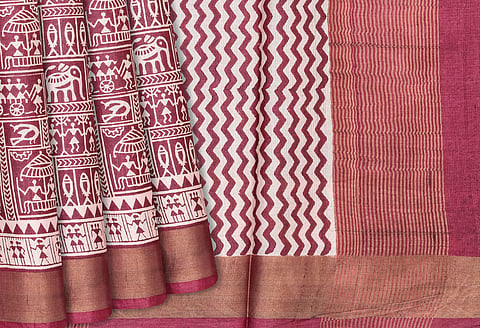
Moving further into the mela, offerings become more intricate. Saris adorned with 2,500-year-old folk art madhubani painting or mithila painting, traditionally created on pure desi tussar silk by women from the Mithila region of Bihar, is a standout. For those interested in Andhra’s kalamkari, the mela offers the choice of either kurtas or saris, both finished with motifs inspired by mythology, nature and the state’s culture. Hopping to the neighbouring state, Odisha’s kotpad saris in variants like kotpad cotton and kotpad silk, famous for their artistic tribal weaves were all the rage. From block-printed cotton saris popular in Bilaspur, Chhattisgarh to the ajrakh saris of Kutch, Gujarat, known for their unique colours and detailed geometric and floral patterns, the mela has something for everyone.
In the accessories section, men’s khadi kurtas made from sustainable hand-spun and hand-woven fabric, originating from India’s freedom movement led by Mahatma Gandhi, are a highlight. Handbags, totes, purses and clutches designed by women artisans and enthusiasts passionate about sustainability and reducing plastic waste are also available, along with leather Jaipuri jutis and Kolhapuri chappals. But what caught our eyes were the naturally dyed wooden jewellery, Lambani jackets featuring mirror-work and traditional Naga shawls, which have a GI tag, thanks to their unique materials and making process. If you shop till you drop, the food court has enough local snacks to replenish your energy but we suggest you try the girmit.
Entry free. On till March 9. At Basavangudi.
srushti@newindianexpress.com
@Sru_Kulkarni