
- LIFESTYLE
- FASHION
- FOOD
- ENTERTAINMENT
- EVENTS
- CULTURE
- VIDEOS
- WEB STORIES
- SPORTS
- GADGETS
- CAR & BIKE
- TRAVEL
- SOCIETY
- GALLERIES
- NORTH EAST
- INDULGE CONNECT

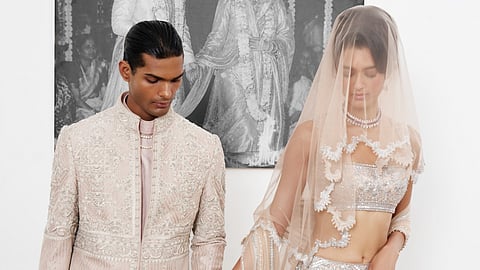
Shantnu Nikhil Couture have often revisited ceremonial dressing through sharp tailoring and sculptural drapes. Their latest collection, Becoming, turns the lens inward, drawing from the designers’ own family archives to reimagine wedding wear shaped by memory, tradition and a softer expression of occasion dressing. Inspired by archival Indian wedding imagery, the collection revisits ceremonies through the emotions, rituals and traditions that have travelled across generations.
What emerges is a wardrobe that balances family heritage with the label’s contemporary approach to ceremonial dressing, bringing together radical drapery, precise tailoring and a softer approach to occasion wear for both men and women.
“There is a photograph in almost every family that you grow up seeing without really looking at it. For us, it was our parents’ wedding portrait. It was always there. We knew the story, we knew the people in it, but I think you understand certain images differently as you grow older. At some point, we stopped seeing it simply as a wedding photograph and began seeing everything that had started there. The family that came after it. The life that was built from it. Even our own understanding of ceremony, drape and celebration had, in some way, grown around that image before we realised it. That became the starting point for Becoming,” co-founder Nikhil Mehra begins.
The duo became interested in the idea that tradition is never inherited unchanged. Every generation receives something, lives with it and eventually gives it a shape of its own.
“For over two decades, our work has been about unshackling traditionalism while remaining deeply rooted in Indian culture. This collection simply made that philosophy more personal. Inspired by our parents’ wedding photographs, we began thinking about everything that gets passed forward, not just rituals or clothing, but memories, relationships and the idea of celebration itself. That thinking shaped every silhouette,” shares designer Shantanu Mehra.
Becoming features over 50 looks across bridal, groomwear and family dressing, offering a complete wardrobe for the modern celebration.
“Perhaps the most important thing is that Becoming isn’t just about dress ing a wedding. It’s about dressing everything that leads up to it. The collection looks beyond the ceremony itself and celebrates the people, relationships and memories that shape it. That’s what From Theirs to Yours means to us. Every generation inherits something, but every generation also adds something of its own. We wanted the collection to honour both. The edit also extends to parents and family members, recognising that today’s celebration is shaped by everyone who is part of it,” Shantanu tells us. The colour palette softens, while the craftsmanship becomes more tonal and nuanced. “You’ll find shades of ivory, blush, taupe, champagne, greige and muted metallics, accented with deeper tones like oxblood and crimson,” he adds.
Heritage is interpreted through contemporary drape, precision tailoring, softer colour palettes and refined detailing.
“Compared to our previous collections, the biggest difference is that this collection began with emotion rather than silhouette. For the bride, we’ve expanded our ceremonial offering with intricately crafted lehengas, fluid draped gowns and saris that feel both timeless and distinctly modern. For the groom, the collection moves effortlessly between ceremonial and cocktail couture, from embroidered sherwanis layered over draped kurtas and contemporary dhotis to cropped bandhgalas and sharply tailored evening tuxedos,” Nikhil reveals.
Instead of treating textiles, embroidery and silhouette as separate elements, the label developed them together.
“The result is a collection where craftsmanship isn’t applied to the garment, but becomes intrinsic to its construction and character. The detailing is inspired by Baroque foliage, European lace traditions and floral forms, interpreted through the Maison’s contemporary lens. You’ll see intricate silk-thread embroidery, freshwater pearls, tonal beadwork and layered textures that gradually reveal themselves through movement and light. Rather than making embroidery the focal point, we wanted it to become part of the architecture of the garment, working alongside drape, tailoring and propor tion,” Shantanu concludes.
For more updates, join/follow our WhatsApp, Telegram and YouTube channels.