
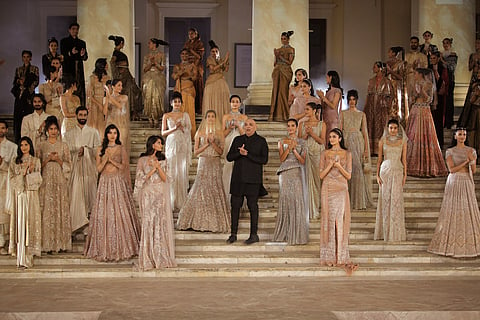
As celebrated couturier Tarun Tahiliani completes 30 years in fashion, he takes us through his vivid design journey and experiences

In the ever-changing dynamics of the fashion world, what keeps Tarun Tahiliani relevant and ahead of his time is his keen sense of design and a sharp, intuitive mind that understands sartorial trends, beautifully incorporating and upholding traditional Indian elements through intricate craftsmanship. That’s precisely the reason why his bridal couture appeals across all generations, holding a place of pride in wardrobes of fashion-conscious women.
To celebrate three decades in fashion, Tarun held a gala showcase of his work at the British Residency in Hyderabad. This 30-year collection is not a retrospective in the literal sense. It is a distillation of three decades of learning, experimentation, and refinement. Instead of revisiting specific garments or moments, the collection revisits ideas that have consistently shaped his work — India Modern.
Tarun Tahiliani breaks down the new codes of couture: featherlight silhouettes, tonal palettes and quiet confidence
“In that spirit, it is for today. It reflects a long engagement with Indian craft, drape, and construction, viewed through the lens of today’s realities. Over time, I have come to believe that luxury is not about ornament alone; it is about proportion, comfort, climate intelligence, and emotional resonance. Therefore this collection is about continuity rather than nostalgia. It acknowledges where the journey began but speaks clearly to the present and where we are headed next,” explains Tarun.
Ahead of the show, the boisterous couturier sat for an exclusive chat with Indulge on his journey so far, the evolution of wedding fashion and the way ahead.
Three decades in the industry. How does it feel?
It feels like I have just got started. To be honest, our generation started by knowing nothing; we learnt on the job. I went back to study, and I would say it was a good 20 years before I really had a hang of it because I work in the classical tradition, and I like to understand the fabric and all the different components. Now I feel that we have a command over what we are doing, so I think it is very exciting to go forward.
From 1995 to 2025, how have you seen the Indian fashionscape change?
It has changed completely in the last 30 years. In 1995, Ensemble was the only boutique in South Bombay. When we opened, we were told that it would not work in that area. There are thousands of designers, brands, and retail stores now. There were no fashion weeks; none of this existed. So, it is quite an extraordinary transformation when I look at it through my mind’s eye.
For a self-taught designer, how tough or easy has the journey been so far?
Well, it was difficult in the beginning, but it was a very simple environment. In any job, you learn on the go. I went back to study, and I worked at it relentlessly. Along the way, different people’s expertise grew around me as well—the master cutters, the embroiderers, the people who manage production—and so all of us grew together. And of course, the whole is always greater than the sum of the parts. For me, education was important, and self-education is imperative in any job one does. The biggest lesson that I have learned, and others should learn, is that it is easy to think that design is the only part of a business that matters. If you are running a design business, it is one of multiple parts, just like every other business.
What was the defining turning point in your fashion career, and how long did it take to arrive?
I think the turning points were the start of the Indian Fashion Week, because it brought a different kind of exposure, and of course showing in Milan, because it forced us to raise the bar—to value things that perhaps at that time were not that important in India, such as perfect fit, finish, economy of thought, and ideas, multiple things that going international forced us to cope with. We made many mistakes and fell on our faces, but to have survived them, I would say yes, that was a turning point in 2003.
What are the personal sacrifices you have made for a career as a fashion designer?
Not being around my family as much as I would have liked to or should have. I think that was the biggest sacrifice, although I might not have been fully aware of it at the time. I still sometimes work seven days a week, and I have just got used to it. There are a lot of things that I love doing but do not do.
If life had given you another chance, what would you have done differently?
I would have gone straight to a top design school after graduating from high school, completed both a bachelor’s and a master’s degree, and worked alongside the Indian industry. That is the only thing I would have done differently. Everything else—the hours, the sacrifice, the time you have to give it—I would have just been better equipped.
The Indian Fashion Weeks—do you think they are losing the touch they had when you began?
Oh, there was such excitement when it started, and such a feeling of camaraderie as well as interest. People fought to come to shows. The press was there. Buyers came. People flew in. Today, partly because of Instagram and too much content, people are jaded. But I also blame the Fashion Weeks themselves because they have allowed themselves to descend into the worst form of press—through showstoppers and using Bollywood, cricketers, and other things. Everything that does not matter in fashion has been elevated and put on a pedestal. While fashion is consumed hugely compared to what it was then, it seems to have lost its gravitas.
“Chicness is my only weakness” is a phrase we have heard you saying often. What defines chicness for you?
I am quoting a friend of mine, Malini Ramani. It is her phrase—“chicness is my weakness.” She loves a good rhyme. I think chicness is having your own style and being consistent. As individuals, we are not dressing to play different parts. You might have different selves, and that is fine, but even so, a point of view, consistency, inner elegance, and enduring style—these are all the components of people I think are chic.
What will rule the fashion scene in 2026?
I feel fashion in 2026 is not going to be about excess. It is about mastery—quieter and more intentional. Colours too will reflect that. We will see fewer complementary colour schemes paired together, and more tonal shades will emerge, suggesting our desire for stability in today’s world. Silhouettes will be fluid but disciplined. It is less about being seen and more about being understood.
What design directions will your couture and prêt labels take in 2026?
The couture is becoming featherlight, much more stylised, and very global. We have a bridal line that will be ready-to-wear bridal, much more refined, and drawing from older couture techniques as standards go up. Our prêt label OTT has now reached numbers that allow production in much better factories and economies of scale.
A few useful tips for readers from you to put their best foot forward?
I think the best foot forward should always be the most authentic foot. There is no right or wrong. India has a vast repertoire of fabrics, fashion, and drapes, and people can express themselves in a non-conformist way— more so women, but even men. It is all right to be very Indian; it is all right to be global; it is all right to find a mix in between that synthesises different worlds. Fashion is meant to live your life in. So find what works for you, wear it again and again, and find your own style.