
- LIFESTYLE
- FASHION
- FOOD
- ENTERTAINMENT
- EVENTS
- CULTURE
- VIDEOS
- WEB STORIES
- SPORTS
- GADGETS
- CAR & BIKE
- TRAVEL
- SOCIETY
- GALLERIES
- NORTH EAST
- INDULGE CONNECT

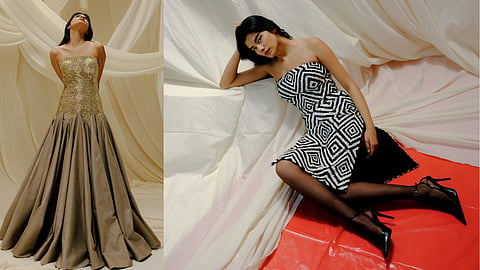
This collection comes from the hills and valleys of Manipur. With Phiruk, the latest offering from 11 Tareng, founders Jayshree Koijam and Reena Ahanthem reinterpret one of the most symbolic objects in Manipuri life—the phiruk, a traditional vessel used to carry sacred and everyday essentials.
More than a utilitarian object, the phiruk holds layered cultural meaning. Traditionally crafted by the Maring tribe and used widely in Meitei rituals, it represents protection, abundance, continuity and belonging. In many ways, it also reflects the quiet strength of the women who carry it. The designers translate this idea into clothing through silhouettes that echo structure and geometry while remaining fluid and wearable.
“More than a container, the phiruk symbolises protection, abundance, continuity and belonging. It holds not only life’s essentials but also the stories of the women who carry it,” explains Jayshree.
At the heart of 11 Tareng lies a mission to spotlight Manipur’s handloom heritage that survived largely through oral histories and generational knowledge. For the founders, fashion became a natural medium through which these stories could be preserved and shared with a wider audience.
“In Manipur, culture isn’t something you visit; it’s something you live,” they say. “It’s in the clothes we wear, the festivals we celebrate and the quiet moments shared at home. Almost every household had a loom, and weaving was a language spoken daily. We grew up surrounded by silks that shimmered with stories and motifs that spoke of nature, faith and everyday beauty.”
Their personal journey has shaped the identity of the label. After spending years studying and working in Delhi, the designers felt a strong pull back to their roots. The result was 11 Tareng, a platform that seeks to bring global recognition to Manipuri textiles while ensuring their cultural integrity remains intact.
“Our culture has so much to offer—the beauty of the craft, the skill of the weavers and the stories woven into every thread,” they say. “By exploring new forms and silhouettes, we allow these textiles to find a place in modern wardrobes while keeping their soul intact. Through our designs, we’re simply giving these traditions a new language to speak to the world.”
Central to the collection is Khurkul silk, a fabric celebrated for its radiant sheen, fluid drape and exceptional ability to absorb colour. The material itself carries a powerful legend within Manipuri folklore, one that traces its origin to Leima, a Burmese princess who, according to oral history, discovered the art of silk spinning while living in the village of Khurkhul.
“Our fascination with handwoven Khurkhul silk—its unique texture, fluid drape and natural sheen—inspired the birth of 11 Tareng,” the designers say. “We recognised not only the fabric’s beauty and versatility but also the cultural richness embedded in every thread.”
According to the legend, Leima spun silk in secrecy, transforming herself into a silkworm in the process. When the sacred secrecy surrounding her craft was broken, she died—or fully transformed—leaving behind a legacy that continues through the silk produced in the region. Even today, Khurkhul silk is woven with a quiet reverence for patience, care and continuity.
“We carry forward the legacy of Khurkhul silk by treating it not merely as a material, but as a living inheritance,” Jayshree and Reena explain. “By using techniques passed down many centuries ago, the creation happens without spectacle, and continuity is valued over excess.”
In the Phiruk collection, geometry becomes the visual language that connects tradition with modern design. Inspired by the structural weave of the vessel itself, the designers use clean lines and architectural shapes to reinterpret heritage motifs.
“Geometry allows us to abstract tradition,” they say. “It makes the designs feel architectural, intentional and relevant to contemporary sensibilities.”
At the same time, the garments remain deeply rooted in storytelling. For the founders, every element—fabric, motif, structure—emerges from lived experience and cultural memory rather than surface-level inspiration.
“Manipur has so much to offer—the beauty of the craft, the skill of the weavers and the stories woven into every thread,” they say. “Nothing is created randomly. Everything carries meaning.”
That philosophy also aligns with the direction in which fashion itself is evolving. As conversations around sustainability and identity grow stronger, labels like 11 Tareng are demonstrating how heritage crafts can shape the future of design.
“This collection reflects a move toward thoughtful design,” the founders say. “Identity becomes authentic, and design intelligence lies in restraint and depth. By empowering local weavers and artisans and encouraging the next generation to learn these skills, we’re aligning with a future that values cultural integrity and purpose-driven creativity.”
Prices start at Rs 45,000. Available online.
—manuvipin@newindianexpress.com
@ManuVipin
For more updates, join/follow our WhatsApp, Telegram and YouTube channels.
https://whatsapp.com/channel/0029Vb677uz60eBXiDYheb0n