
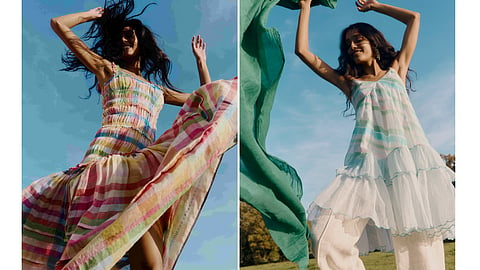
Desert-inspired SS26 line celebrates leheriya, handwoven textiles and fluid silhouettes

For EKA’s Spring Summer ’26 collection, designer Rina Singh turns to the shifting sands of the Sam dunes near Jaisalmer, where wind-sculpted ripples, desert blooms, and sun-washed colours shape the mood of the season. Anchored in textiles—a starting point for every Eka collection—the line draws from traditional techniques like leheriya and the layered tones of the desert landscape, translating them into fluid silhouettes and breathable fabrics. In conversation, Rina reflects on the memories of places that inform her work, the continuing inspiration of Indian crafts, and why clothing, for her, is meant to move with the many lives a woman lives every day.
Kota, handwoven silk and breathable fabrics for warm weather
Your Spring Summer ’26 collection finds expression in the sand dunes of Sam near Jaisalmer. What drew you to that landscape?
I’ve been there a couple of times, and since I work a lot with textiles, I’ve always been fascinated by that region. Many of the people I work with are from Rajasthan—they’ve studied there or lived there for long periods, and some still do. So over time I’ve developed a deep love for the textures of that place: the cities, the culture, the traditions, and the colours. There is also a very special spirit in the way the seasons shift there. For us, every season begins with textiles. One technique that really inspired this collection is leheriya, where particular colour combinations traditionally signal the arrival of spring. That sense of announcing a new season became an important starting point for the collection.
Every season I try to anchor the collection in a particular place—whether it’s Himachal, Shillong, the Aravallis, Kashmir or Goa. Over time, these places become memories that live within the work. The motifs this season come from desert elements—flowers, leaves, the arid landscape—and the colours and stripes are inspired by the layered tones of the dunes.
Was there a first visual or object that sparked the collection?
Yes, actually there was a safa—a traditional turban cloth—that I had picked up while collecting antiques. I often buy antique textiles, and this particular safa really stayed with me. Its colours and textures became the base reference for the collection. That one piece almost held the entire story of the collection within it.
Eka is known for fluid silhouettes. Did the desert landscape influence the way the garments move?
In a way, yes. The kind of clothing we historically wore in India was never very fitted or tailored. We didn’t really have sharply structured garments the way the West did. Our clothing evolved from the lifestyle and the weather we lived in. Traditionally we sat on the floor, lived in homes that were open to the climate, and didn’t always have heaters or cooling systems the way we do now.
Because the climate could be humid or harsh, garments needed to allow air and movement. That’s why we mostly wore saris or lehengas—things that draped rather than clung to the body. Personally, I feel textiles reveal their beauty when they are used in fluid silhouettes. I really enjoy working with that idea. It also feels more authentic to the way we live.
Were there specific fabrics or techniques that helped you capture the spirit of the desert?
Yes. As I mentioned earlier, leheriya played an important role in the colour story. In terms of fabrics, we worked with a lot of handwoven and natural textiles—kota, handwoven silk and other lightweight materials. We also work extensively with block printing.
For this season we developed a chevron-like pattern inspired by desert lines. Achieving that through block printing is actually quite technical. We had to work closely with block makers and artisans to build the blocks and print them onto the garments.
It might look simple when you see it, but it takes a lot of time and skill to achieve that effect through hand processes.
Eka often celebrates everyday moments. What feeling did you want women to experience through this collection?
For me, comfort and freedom are extremely important. I don’t like restricting women into rigid size categories—small, medium or large—based on a couple of inches.
When I design, I want the garment to allow movement and flexibility. Someone might wear a piece with trousers; someone else might wear it as a dress. It can be layered with a jacket and worn with kolhapuris, sneakers or even denim. The idea is that the clothing should move with a woman’s life.
I also feel that clothes shouldn’t exist only for special occasions. Most of our lives are made up of everyday moments. A woman might be writing her thesis, performing a difficult surgery, fighting an election, or asking for a promotion. She lives so many lives.
I want the clothes to become part of that life story—not something that belongs only to one moment.
You’ve worked closely with craft clusters for many years. What continues to inspire you about Indian textiles?
When I first started out, I worked with the National Institute of Fashion Technology, and part of my work involved travelling to craft clusters across the country. Those travels were incredibly important for me. I was constantly learning—from artisans, from techniques, and from the local knowledge that exists within these craft traditions.
Later, when I started my own label, all of that learning naturally flowed into the work. The vocabulary of EKA really comes from those experiences. I still work with many of the same artisans and craft communities. Every season we try to develop something new—like experimenting with different block printing techniques.
The chevron block this season, for example, took a lot of technical effort to achieve. But that process is what I find fascinating.
Prices start at Rs 12,000. At The Amethyst Room, 106, Chamiers Road, RA Puram.
—manuvipin@newindianexpress.com
@ManuVipin
For more updates, join/follow our
https://www.whatsapp.com/channel/0029Vb677uz60eBXiDYheb0n