
- LIFESTYLE
- FASHION
- FOOD
- ENTERTAINMENT
- EVENTS
- CULTURE
- VIDEOS
- WEB STORIES
- SPORTS
- GADGETS
- CAR & BIKE
- TRAVEL
- SOCIETY
- GALLERIES
- NORTH EAST
- INDULGE CONNECT
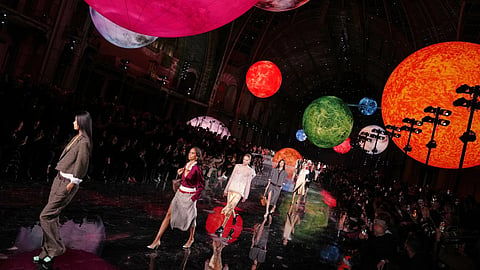
Chanel reclaimed its flair for theatre on Monday as Matthieu Blazy unveiled his long-awaited debut under a sky of planets. At Paris Fashion Week, the brand’s new creative director opened the show on a mirror-black runway, its surface reflecting a vast suspended solar system — Saturn’s rings, glowing orbs and orbiting moons — that transformed the venue into a celestial stage.
From the first moment, Blazy set out his intent: a spectacle rooted in craft, wit and confidence. A constellation of guests — Nicole Kidman, Marion Cotillard, Tilda Swinton, Lauren Sanchez and Jeff Bezos — looked skyward as reflections mirrored the cosmos below. By night’s end, a standing ovation confirmed what many in the industry sensed: Chanel, once again, had a showman.
Heritage and high stakes
Founded in 1910, Chanel has long defined modern femininity — liberating silhouettes from corsets, introducing jersey and trousers, and later refining the codes of Parisian chic through tweed suits, pearls and the little black dress. Under Karl Lagerfeld’s grand showmanship, it became a global blueprint for heritage reinvention.

That legacy cast a long shadow over Blazy’s debut. Coming after Virginie Viard’s quiet tenure, this moment was less about a mere designer handover and more a test: could a century-old house still astonish?
With theatre restored and symbols recontextualised, Blazy’s approach was clear — Chanel as a living language, not a museum.
The opener, an androgynous, slouchy trouser suit with asymmetric tailoring, set the tone. It nodded to the freedom Coco Chanel once claimed by wearing her lover Boy Capel’s clothes. A hand tucked casually into a pocket underscored the point — ease and self-possession as luxury.
Blazy’s collection, months in development, felt like a dialogue between eras — a meeting of Coco’s rebellion and his own conceptual precision.
Gone were the ribbons reportedly debated in the atelier. Sparkle, too, was dialled down, replaced with sculptural silhouettes and feathers in abundance. Tweed arrived more global in texture and hue — an interwoven statement of inclusivity.
Accessories struck a confident rhythm: oversized hats, metallic clutches, chain-strap handbags and egg-shaped minaudières added playful punctuation. Jewellery — layered pearls, gold cuffs, and statement earrings — grounded the look in house tradition while refreshing its proportions.
Humour threaded through the styling. Feathered wigs and sly headpieces evoked Lagerfeld’s irreverence — his oft-quoted reminder that “Chanel is an institution… you have to treat an institution like a (prostitute) — and then you get something out of her.”
Where Viard’s tenure leaned towards restraint, Blazy reintroduced irony and audacity. Known for subversive twists at Bottega Veneta — frogs on heels, trompe-l’œil leather — he carried forward that spirit, delivering visual wit without slipping into parody.
The closing look — a silk shirt paired with a multicoloured feathered skirt trailing across the mirrored floor — captured his central argument: joy, motion, and spectacle, all tethered to the codes of the house.
“It’s exciting to be here for a new era,” filmmaker Sofia Coppola said after the show. “You recognise the house, but it feels fresh.”
With planets overhead and history underfoot, Chanel’s new orbit seems set — a house once again reaching for the stars.
For more updates, join/follow our WhatsApp, Telegram and YouTube channels.