
- LIFESTYLE
- FASHION
- FOOD
- ENTERTAINMENT
- EVENTS
- CULTURE
- VIDEOS
- WEB STORIES
- SPORTS
- GADGETS
- CAR & BIKE
- TRAVEL
- SOCIETY
- GALLERIES
- NORTH EAST
- INDULGE CONNECT
NASA's Perseverance Mars Rover Mission achieved a groundbreaking milestone by utilizing Artificial Intelligence (AI) on the Red Planet to autonomously make decisions based on real-time analysis of rock composition, according to mission officials.
Although the Rover Mission has been leveraging AI for nearly three years to autonomously identify minerals within Martian rocks, this marks the first instance of using the technology on Mars to make immediate decisions regarding rock composition. These advancements represent significant progress toward future "smart" spacecraft capable of independently determining which data to collect, where to locate it, and how to analyze it, thereby bringing scientists closer to interpreting Mars' mysteries.
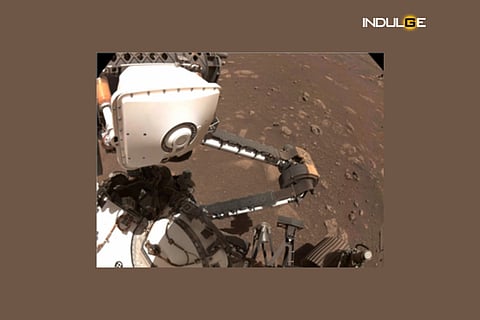
The Perseverance Rover integrates AI with its PIXL instrument to determine optimal times for drilling rock cores, which are stored for eventual return to Earth as part of the Mars Sample Return campaign.
Abigail Allwood, principal investigator of the PIXL instrument at NASA’s Jet Propulsion Laboratory (JPL) in Southern California, explained, “We use PIXL’s AI to home in on key science.”
Both Perseverance and the Curiosity Rover, positioned 2,300 miles apart, utilize AI for autonomous tasks: Perseverance for navigation and adaptive sampling, and Curiosity for laser-based rock composition analysis.
This AI functionality significantly reduces the workload on scientists and enhances mission efficiency, allowing for accelerated scientific discoveries.
PIXL utilizes AI for precise positioning, employing a hexapod with six robotic legs to adjust the spectrometer mounted on Perseverance’s arm. The camera on PIXL measures the distance to the rock, making micro-scale adjustments to compensate for temperature-induced arm expansion or contraction, ensuring precise placement without contact.
PIXL employs AI to scan the surface of rocks, emitting thousands of X-ray beams to map their chemical compositions. This process aids in identifying minerals like carbonates and phosphates, providing valuable insights into Mars’ geological history and potential for past life.
When PIXL identifies specific minerals, it can automatically execute a "long dwell" to gather additional data. As Machine Learning capabilities improve, PIXL's repertoire of targeted analyses expands.
AI-driven autonomy is critical for future deep space missions, particularly for exploring astrobiological possibilities and conducting complex scientific investigations in environments like Mars. These advancements underscore NASA’s commitment to leveraging cutting-edge technology to unravel the mysteries of our neighboring planet.
