
- LIFESTYLE
- FASHION
- FOOD
- ENTERTAINMENT
- EVENTS
- CULTURE
- VIDEOS
- WEB STORIES
- SPORTS
- GADGETS
- CAR & BIKE
- TRAVEL
- SOCIETY
- GALLERIES
- NORTH EAST
- INDULGE CONNECT
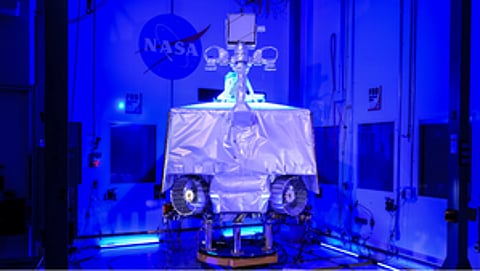
NASA announced on Thursday the cancellation of its $450 million Volatiles Investigating Polar Exploration Rover (VIPER) moon rover program due to budget concerns. The robotic mission, originally scheduled to launch in 2025 aboard an Astrobotic Griffin lander as part of NASA's Commercial Lunar Payload Services initiative (CLPS), aimed to explore the Moon's south pole for ice deposits over a 100-day period.
Joel Kearns, Deputy Associate Administrator for Exploration at NASA headquarters, emphasized that while the VIPER team was highly capable, the decision to cancel was driven by cost constraints in the US budget environment. Scrapping the mission is expected to save NASA an additional $84 million in development costs.
Despite acknowledging the program's successful progress and the dedication of VIPER mission officials, NASA officials cited delays in the launch schedule and the potential for future cost escalations as contributing factors to the cancellation. Originally planned for a late 2023 launch, the mission was postponed to late 2024 and subsequently rescheduled to September 2025.
Nicola Fox, associate administrator of NASA's Science Mission Directorate, described the cancellation as a difficult decision but necessary due to budgetary constraints. She praised the VIPER team's efforts, particularly highlighting their resilience during the challenges posed by the pandemic.
NASA plans to "de-integrate" the car-sized VIPER rover and reuse its scientific instruments in future lunar missions. Meanwhile, Pittsburgh-based Astrobotic Technology will proceed with its Griffin Mission One as contracted, scheduled for launch in 2025 without the VIPER rover. This mission aims to demonstrate the Griffin lander and its engines.
Despite cancelling VIPER, NASA remains committed to exploring the lunar south pole for ice deposits. Alternative methods, such as the Polar Resources Ice Mining Experiment-1 (PRIME-1), are being considered. PRIME-1 is scheduled to land at the south pole in late 2024 as part of these ongoing exploration efforts.
