
- LIFESTYLE
- FASHION
- FOOD
- ENTERTAINMENT
- EVENTS
- CULTURE
- VIDEOS
- WEB STORIES
- GALLERIES
- GADGETS
- CAR & BIKE
- SOCIETY
- TRAVEL
- NORTH EAST
- INDULGE CONNECT

Xiaomi has really stepped up its tablet game off-late, bringing hardware and modern conveniences found on much pricier slates to the mid-range segment. With the Pad 8, Xiaomi makes a compelling case for affordable Android tablets that don’t suck…finally.
Building on the clean and minimal design of the Pad 7, Xiaomi has somehow made the Pad 8 slimmer and lighter while adding a larger battery. It has slimmed down to 5.75 inches and the weight down to 485g, give or take, depending on whether you pick up the standard version or the one with the anti-glare, anti-reflective Nano Texture display – in either case, the Pad 8 is slim enough to slip into a backpack, light enough to carry around the house from desk to couch, and compact enough to use on cramped economy seats. It’s available in a pleasing titanium blue or a staider graphite grey. And while you can use the Pad 8 in portrait orientation, the buttons, ports and quad speakers lend themselves well to being used in landscape orientation with the new Focus keyboard (₹8,999).
Speaking of, the Focus keyboard attaches to the Pad 8 via pogo pins and allows for multiple degrees of adjustment, even as the Pad 8 floats above the keyboard. The Focus keyboard offers a full set of backlit keys with good travel, plus a trackpad for gestures and for tasks that require more precision than our stubby fingers can manage. Of course, the 590g weight does weigh things down. The Focus Pen Pro stylus (₹5,999) is great for scribbling and drawing, with haptic feedback, pinch shortcuts, and ultra-low latency that rivals the Apple Pencil Pro.
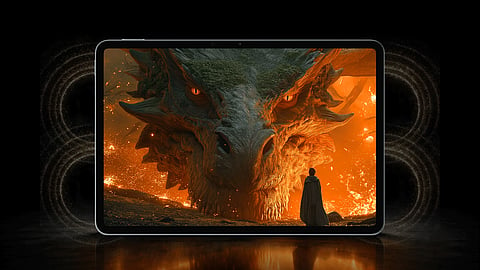
Xiaomi has taken the “if it ain't broke” approach to the 11.2-inch, 3.2K-resolution LCD, and its choice of a 3:2 aspect ratio and a 144Hz refresh rate means it’s useful for watching Dolby Vision content, editing documents, browsing the web, or playing games. The display is as crisp and vivid as I’ve seen an LCD panel get on a tablet, and the 600 nits brightness helps immensely for outdoor use. The four-speaker setup with Atmos support comes in clutch when you want to watch a quick episode and couldn’t be bothered to look for a pair of headphones. No headphone jack, though – you can connect over USB-C or Bluetooth 6.0.
Generationally, the big leap forward is the use of the higher-end Snapdragon 8s Gen 4 (the same chip that powered the Nothing Phone (3) and the OnePlus Nord 6). The difference is immediately visible – the interface is super fluid, even when you’re at the end of a day and multitasking or switching between heavier apps. If your budget allows for it, opt for the 12GB memory variant with faster LPDDR5T memory and 256GB of faster UFS 4.1 storage. HyperOS 3 (based on Android 16) is clean and polished, and I rather liked the Workstation mode, which let me quickly open apps into their own floating windows, instead of limiting myself to split screen multitasking. If you already have a Xiaomi phone, the tablet plays well with your phone, duplicating the paired handset’s home screen, mirroring notifications, sharing clipboards and handing off between compatible apps. You get the obligatory AI tools for speech recognition, live subtitles, writing and art. On cameras, you get a 13MP rear and an 8MP front-facing shooter, and they’re adequate for document scanning, video calls and some casual shots…and that’s fine.
Despite its sleek dimensions, the Pad 8 rocks a 9,200mAh battery, and the longevity is enough to assuage even the most anxious of users – I was able to use it for writing, browsing and streaming content throughout the day over a long weekend, and have it drop to 20 per cent at the end of the day. On lighter days, it would go up to two days per charge. Charging speeds max out at 45W, but Xiaomi bundles a fast 67W adapter in the box, which takes well past an hour and a half to fully charge. Plus, there’s 22.5W reverse charging, so you can use it as a power bank in a pinch.
Rating: 8/10
Price: ₹33,999 onwards.
For more updates, join/follow our WhatsApp, Telegram and YouTube channels.