
- LIFESTYLE
- FASHION
- FOOD
- ENTERTAINMENT
- EVENTS
- CULTURE
- VIDEOS
- WEB STORIES
- SPORTS
- GADGETS
- CAR & BIKE
- TRAVEL
- SOCIETY
- GALLERIES
- NORTH EAST
- INDULGE CONNECT
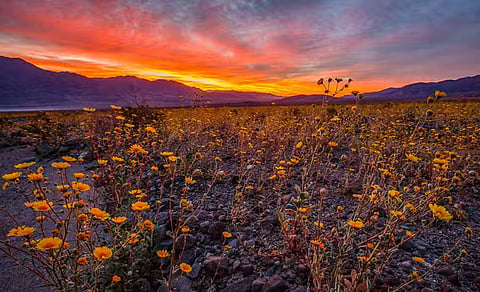
A superbloom has emerged in Death Valley following unprecedented and heavy rainfall, blanketing the renownedly barren desert in a blanket of vivid pink, purple, and yellow flowers. Travellers from all over the world can anticipate being welcomed by a quilt of subtle hues and fragrant air when they arrive in the desert.
Although the term "superbloom" has no official definition, the National Park Service uses it to "describe conditions when so many flowers are present that they appear as swaths of colour across the landscape, rather than isolated plants, especially striking at low elevations where the ground is typically sand, gravel, and rock."
The National Park Service claims that this year's superbloom is the most stunning Death Valley has witnessed in ten years. It is a result of the region seeing more rainfall than usual in the fall and early winter.

Thousands of dormant seeds are hidden in the desert soil despite these difficult circumstances. Until the proper amount of rain falls, these seeds may lie dormant for years. Certain plants that evolved in arid regions also acquired therapeutic applications.
Due to exceptionally heavy rainfall in the area in late 2025 and early 2026, these seeds were able to sprout and flower.
Death Valley National Park's acting deputy superintendent, Abby Wines, stated that the park normally receives only two inches of precipitation annually.
“From November through early January, we had about two and a half inches of rain, so we had more than our annual average in just two and a half months,” she mentioned.
According to Wines, the wildflowers at lower elevations won't last until the middle to end of March. Blooms are expected to appear at higher elevations between April and June. However, she noted that both of those time estimations are very dependent on the weather.
The finest places to see the flowers are indicated on a banner outside the visitor centre. Early in March, fields of wildflowers bloom along Badwater Road to the south and immediately north of the visitor centre. An hour's drive from the visitor centre lies Ashford Mill, which is equally vibrant.
Visitors are advised by ecologists and park rangers to stay on approved pathways and refrain from stepping on the flowers. It is forbidden to pick the blossoms, and handling the purple phacelia could irritate your skin. When a flower is picked from the ground, fewer seeds are planted for the enjoyment of future generations.