
- LIFESTYLE
- FASHION
- FOOD
- ENTERTAINMENT
- EVENTS
- CULTURE
- VIDEOS
- WEB STORIES
- SPORTS
- GADGETS
- CAR & BIKE
- TRAVEL
- SOCIETY
- GALLERIES
- NORTH EAST
- INDULGE CONNECT

In a city where headlines scream scams and soaring gold prices, and with Mumbai gearing up for the BMC elections on January 15 after 9 years, I found myself stepping into history—the BMC building, open to the public after 128 years.
Completed 68,113 rupees under budget in the 1890s, it wasn’t just architecture; it was civic honesty carved in stone. The central dome, now restored with 23.5-carat gold leaf, literally shines over Mumbai, a reminder of a time when governance aimed to impress the sun as much as the citizens.
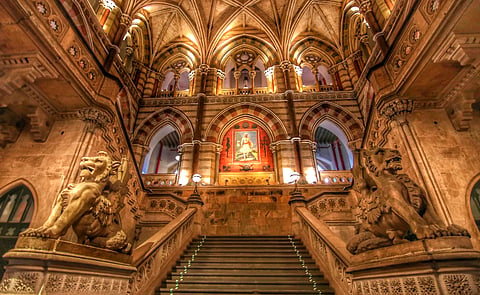
Walking its halls feels like stepping into 1893: hand-carved pillars, stained glass, dark woodwork, and grand staircases all still in daily use. Atop the central dome, a winged figure carrying a ship proudly displays the Latin inscription “Urbs Prima in Indis”—a bold statement of Mumbai’s status as India’s “First City.” Every engraved budget saving, every gilded detail, every worn stone tells a story that modern Mumbai rarely sees.
A Landmark That Built Civic Identity
The Municipal Head Office, today’s iconic BMC building stands not only as a Gothic Revival landmark, but as a record of what the city once believed a public institution should stand for. Its foundation stone was laid in 1884, and F.W. Stevens, the mind behind CSMT, designed it.
The Construction Story Hidden in Plain Sight
Construction unfolded between 1889 and 1893, across changing presidencies and commissioners, as the city’s civic machinery was still taking shape. Inside, plaques quietly carry the names of everyone who shaped those years, giving permanence to people that administration usually forgets. In person, these elements feel less like design features and more like intention—each crafted to project stability, confidence, and civic pride.
A Building That Feels Alive With History
What no historical record fully prepares you for is the sensory power of the place. The coolness of the stone. The echo of footsteps in halls that have not changed in 130 years. The precision of hand-carved pillars. The fragments of old woodwork were darkened by time. Together, they create the uncanny sensation of stepping inside a functioning time capsule. The building is not just architecture; it is continuity made physical.
The Most Surprising Detail: It Came in Under Budget
The sanctioned budget for the building was Rs. 11,88,082. The final cost was Rs. 11,19,969—a saving of Rs. 68,113. In the 1890s, this was not a minor number; it was a fortune. That this saving was not hidden, absorbed, or quietly distributed—but engraved into the walls themselves—transforms the building from a heritage structure into a civic statement. A moment when public money was treated as trust, not opportunity.
Why This Building Still Matters Today
Taken together—what the walls record, what the spaces suggest, what the numbers quietly prove—the BMC building becomes more than a landmark. It becomes a reminder of a moral rhythm that feels almost unfamiliar today: of an era when public institutions were built with precision, pride, and an unembarrassed sense of duty. It is this combination of beauty, ambition, and integrity that makes the structure extraordinary.
For more updates, join/follow our WhatsApp, Telegram and YouTube channels.