
- LIFESTYLE
- FASHION
- FOOD
- ENTERTAINMENT
- EVENTS
- CULTURE
- VIDEOS
- WEB STORIES
- SPORTS
- GADGETS
- CAR & BIKE
- TRAVEL
- SOCIETY
- GALLERIES
- NORTH EAST
- INDULGE CONNECT

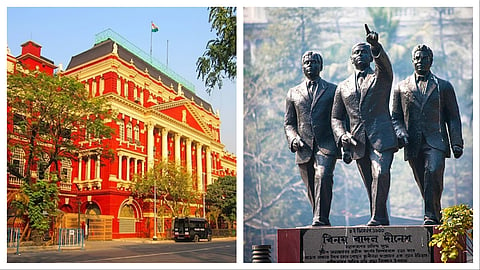
For years, the 'mahakaran' or Writers' Building, was for Kolkatans, a hallowed sanctuary of the state's collective identity.
The Writers' Building, located at B.B.D. Bagh has stood as a resilient witness to the Great Famine of 1770, the architectural evolution of the British Raj, the rebellious era of the 1930 revolution, the dawn of Indian Independence and the state’s transition from a colonial capital to a vibrant democratic powerhouse.
After years, the administrative pulse of West Bengal is set to return to its historic roots, as a new government is being formed in West Bengal following the 2026 assembly elections. Plans are underway to relocate the state secretariat back to the iconic Writers' Building. This move marks a significant homecoming for the state’s executive branch, which had been operating from Nabanna since 2013.
The transition is expected to wrap up within the coming weeks, and will be centred on the newly renovated second floor. While the first floor, historically the office of former Chief Ministers, is still undergoing work, the second floor’s spacious layout has been identified as the most functional and suitable environment for modern administrative operations.
Why the return to Writers'?
The decision to return is deeply rooted in the historical and symbolic weight of the structure. Originally constructed in 1777 to house East India Company clerks, the Writers' Building evolved over centuries into the definitive seat of power in Bengal. For many, the red-brick landmark represents more than just an office; it is a cultural anchor.
The current 102 crore rupee restoration is set to equip the historic halls with the modern facilities and logistical changes required for a high-functioning government. With this move back to Dalhousie Square, it' likely that officials hope to reconnect with a long-standing sentiment shared by many in the state who view the Writers' Building as the true, traditional home of Bengal's governance. The reopening of its doors signals, for some, the revival of a storied legacy.
The Writers' Building: Origin and history
The Writers’ Building has had a deep connection with all three ruling entities the city has had: The East India Company or EIC (it housed the "writers" or junior clerks of the EIC and served as the functional engine of a growing trading post), The British Raj (As Calcutta became the capital of British India, the building underwent a dramatic transformation, its Greco-Roman features and red-brick tiling, mirroring the administrative weight of an imperial headquarters) and post-Independence India (following 1947, the building became the seat of a newly independent state government).
The landmark remained the beating heart of Bengal’s administration for nearly 250 years. Originally designed in 1777 by Thomas Lyon, the building was intended to house the junior clerks, or "writers," of the East India Company.
The origins of the Writers’ Building are inseparable from the rise of Calcutta itself. In 1690, the East India Company’s (EIC) Job Charnock established a trading post at Sutanuti. By 1698, the EIC purchased Sutanuti and two neighboring villages, eventually fortifying the settlement into the original Fort William. By the mid-18th century, a city of 100,000 had emerged, strictly divided: the British lived in the fortified "White Town," while the Indian population resided in "Black Town" to the north, with the two zones separated by palisades for two decades starting in 1742.
As the EIC shifted from trade to "straightforward pillage" and military dominance over European rivals, Calcutta became its imperial nerve center. In 1777, the carpenter-turned-builder Thomas Lyon was commissioned to house the EIC’s junior clerks, known as "writers." Completed in 1780 on the edge of Tank Square, the Writers’ Building was Calcutta's first three-story structure.
Though historically significant, its original form, comprised of 19 residential quarters, was described by contemporaries as something of an eyesore.
When the British empire shifted the capital from Calcutta to Delhi in 1911, the building became the seat of the government of undivided Bengal, British India's largest province.
British journalist Geoffrey Moorhouse, author of a well-known book on Calcutta, once wrote that the building looked like a "shabby hospital or poorhouse".
The B.B.D. Bagh Siege: Battle of the Verandah
The relationship between the Writers' Building and the Indian freedom struggle has been documented widely. December 8, 1930's Battle of the Verandah was an event so crucial to the freedom movement, it eventually renamed the very ground the building stands upon. It became the stage for a suicide mission that fundamentally altered the psychology of colonial rule in Bengal.
On that afternoon, three young revolutionaries of the Bengal Volunteers, Benoy Basu, Badal Gupta, and Dinesh Gupta, disguised themselves in European attire and entered the building. Their target was Colonel N.S. Simpson, the Inspector General of Prisons, notorious for his brutal treatment of Indian political prisoners.
In a daring conflict, the trio engaged the British police in a gunfight within the corridors of power.
The assassination of Simpson sent shockwaves through the colonial administration, proving that even its most secure fortress was not impenetrable. Faced with capture, the revolutionaries chose martyrdom: Badal consumed cyanide, while Benoy and Dinesh shot themselves. Though Benoy and Badal died shortly after, Dinesh survived to be hanged later.
Today, the square where the building stands is named B.B.D. Bagh in their honour. For locals, the "Writers'" is not just a colonial relic; it is a sacred site where the myth of British invincibility was shattered. The red-brick walls serve as a silent memorial to the moment the youth of Bengal took the fight directly to the heart of the Empire.
Why the exodus to Nabanna?
The Writers' Building served as the fortress of the CPIM-led Left Front for 34 years, and was in many ways a symbold of their absolute grip on Bengal's administration from 1977 to 2011. It was within these red-brick walls that former Chief Minister Jyoti Basu and later Buddhadeb Bhattacharjee orchestrated the state's policies.
However, after a crucial regime change, in 2013, the government of West Bengal moved out of the historic Writers Buildings so it can receive a much-needed structural overhaul. After serving as the state's administrative nerve center for over two centuries, the building had become a labyrinth of safety hazards; decades of unplanned partitions, makeshift wooden cabins, and tangled electrical wiring had turned the historic site into a potential fire trap.
Chief Minister Mamata Banerjee established a strict two-month timeline for the transition. This expedited deadline was designed to clear the premises, allowing for a comprehensive renovation focused on upgrading safety systems and making the historic structure fire-proof.
"My department alone had to move 8,000 files, 50 computers, 15 telephones, 25 typewriters, 20 photocopiers and lots of furniture," Ashoke Majumdar, chief official of the information and cultural affairs department, had said back in 2013.
Needless to say, the move has been sharply criticised by the state's main opposition Communist Party of India (Marxist).
"No government can be run from a place so far away from the capital city," said Marxist leader and former minister Gautam Deb.
Banerjee's government moved to the blue-and-white 14-story structure in Shibpur, Howrah, which was originally designed as a textiles business hub by the former Marxist government. After the Trinamool Congress (TMC) came to power, the building was rapidly repurposed by the Public Works Department (PWD) into the temporary state headquarters to and was renamed Nabanna.
The real changes and the path ahead...
As per reports, the Public Works Department (PWD) demolished two annexes previously located within the iconic ‘E’-shaped footprint. While this move reduced the total office space from 300,000 to approximately 250,000 square feet. At the moment, the building can house eight to ten key departments, including the Chief Minister’s Office (CMO).
Although redevelopment hit several bottlenecks, the current focus is on a phased reopening. If the transition occurs immediately, operations will be centralised within Blocks 1 and 2. Because the CMO’s traditional first-floor suite requires an additional six months of work, the second floor, where renovations are nearly finished, has been designated as its temporary home.
The return to the Writers’ Building is more than a simple change of address; it is a complex balance between heritage preservation and administrative necessity. It makes sense that a new government would want to back to this seat of power which conjures up nostalgia for Kolkatans, as the building is welcomed as resilient nerve center for 21st-century governance.
For more updates, join/follow our WhatsApp, Telegram and YouTube channels.