
- LIFESTYLE
- FASHION
- FOOD
- ENTERTAINMENT
- EVENTS
- CULTURE
- VIDEOS
- WEB STORIES
- SPORTS
- GADGETS
- CAR & BIKE
- TRAVEL
- SOCIETY
- GALLERIES
- NORTH EAST
- INDULGE CONNECT

There is a particular kind of irony sitting on the campus of Northern Coalfields Limited in Singrauli, one of India's largest coal-producing hubs. It is not a tree. It is not a smokestack scrubber, either. It is a tank of green water, quietly photosynthesising, that its makers say does the work of an urban forest in the footprint of a filing cabinet.
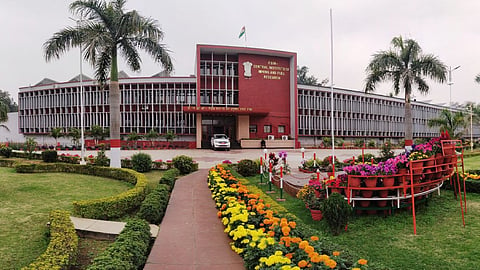
The device is called the Smart Algal Liquid Tree, or SALT, and it was developed by scientists at the CSIR-Central Institute of Mining and Fuel Research (CIMFR) in Dhanbad. Most of the coverage so far has focused on the technology itself: a sealed unit of microalgae that absorbs carbon dioxide and releases oxygen through photosynthesis, marketed as a fix for city blocks too crowded or too paved-over for a real tree to take root.
But the more interesting story may be about where it has ended up first — not a shopping mall or a metro station, but a coal company's own coalfield. NCL is a contributor to it, as one of the country’s major coal producers. Its decision to host one of the first SALT installations is a means for an extraction-heavy company to clearly return something to the air it also takes so much from.
Senior CIMFR scientist Vetrivel Anguselvi, who leads the project, has been careful to frame SALT as a supplement rather than a substitute for actual trees, useful specifically in places where conventional greenery struggles to survive — dense, paved, industrial land being a prime example. A coalfield qualifies on all three counts.
Whether a 100-litre tank of algae meaningfully offsets the output of an active coal operation is a question the research team hasn’t yet had to answer publicly at scale. For now, the installation functions as much as a statement as a solution: proof, however small, that even heavy industry is willing to sit a science experiment next to its own machinery.
CIMFR says it’s in talks about commercial production, with an eye toward pricing units low enough for household or neighbourhood use, not just institutional clients like coal companies and mining research campuses. Air-purification technology has a long history of having big claims and a big price tag, then disappearing once early adopters (public institutions or state-linked companies) stop buying.
It's also worth noting that SALT isn’t India’s first brush with this concept, nor the world’s. An earlier, outdoor version of an algae-based ‘liquid tree’ was demonstrated in India in late 2024, and the broader idea traces back to a photobioreactor first installed in Serbia — one of a small but growing number of cities experimenting with algae as a stand-in for greenery where real trees can't grow.
What makes the CIMFR version notable is the choice of first customer. A coal company adopting carbon-capture technology developed in its own backyard is either a small, sincere gesture toward decarbonisation or a well-timed piece of environmental theatre. Most likely, it's a bit of both, and it will take a lot more installations, and a lot more independent measurement, before anyone can say which one wins out.
For more updates, join/follow our WhatsApp, Telegram and YouTube channels.