
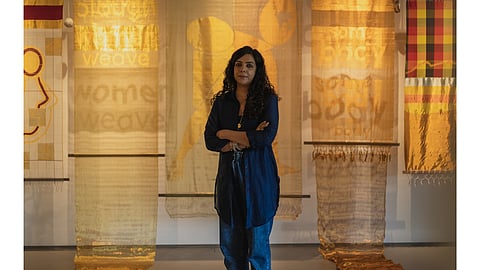
Kerala kasavu weaves enter Asian Art Museum’s permanent collection

Textile artist Lakshmi Madhavan is breaking boundaries between craft and fine art, as three of her signature kasavu weaves have been acquired by the Asian Art Museum, San Francisco. This marks the launch of a permanent Kerala section at the museum, highlighting the rich traditions of South Indian textiles on an international stage.
Kasavu as art, memory and identity
In a conversation with Indulge, Lakshmi talks about how kasavu becomes both art and evidence—of women’s work, caste histories, and endurance.
How does it feel to see your kasavu weaves soon becoming part of the Asian Art Museum’s collection?
It feels quite monumental—not only for me, but for the weaving community of Balaramapuram whose craft carries centuries of exquisite skill. I see it as a collective victory—for Kerala, for Indian craft, and for the communities who have kept these traditions alive through sheer persistence.
How did the collaboration with the museum come about?
The works were first shown at Rajiv Menon Contemporary in Los Angeles, and the museum curatorial team had a chance to experience the work. A genuine cultural exchange—one that honoured process, context, and community—followed. The museum didn’t treat the kasavu as an ethnographic textile, but as a living document of labour and contemporary thought.
“Decolonising the white cube.” How do you interpret this idea in the context of your work?
For me, “decolonising the white cube” is about shifting what is seen, and who gets to be seen. When a handloom weave enters a pristine museum space, it carries with it the stories of brown, labouring bodies; it disrupts the neutrality of the white wall. The kasavu becomes both art and evidence—of women’s work, caste histories, and endurance. It asks the viewer to see not only beauty, but the politics of touch.
It is also about dismantling inherited hierarchies—the idea that Western modes of display and interpretation are the only arbiters of value. Our materials are not secondary, and our aesthetics are not derivative; they are epistemologies in themselves—living systems of knowledge that have long been overlooked.
This idea takes on new urgency today, in a time when museums are repatriating artefacts and reassessing cultural ownership. There is a slow but important reckoning underway—a recognition that cultural objects must be understood within the communities and contexts that created them. In that sense, decolonising the white cube is not only a visual or spatial act; it is an ethical one—a return of narrative, of dignity, and of authorship to the right custodians.
What draws you to kasavu as your primary medium?
I often say kasavu is my umbilical cord—a link between body, ancestry, and geography. It is the cloth my grandmother wore every day, the fabric that carries the scent of home and the sensorial anchor of my earliest memories. When I first began working with this material, I didn’t imagine I would stay with it for so long—but I soon realised I had only touched the surface. What began as a personal excavation of identity slowly expanded into a larger inquiry into history, heritage, and the politics embedded in the cloth itself.
Kasavu is not just a textile; it is a potent marker of the body—of gender, caste, and community. In Kerala, it has always carried codes of purity and privilege, yet I’m interested in how it can also become a more inclusive and universal cloth. Beyond nostalgia, kasavu functions for me as a living archive of cultural memory, a surface where labour, identity and belonging continue to be inscribed through touch and thread.
What do you hope global audiences feel when they encounter your weaves?
I believe textiles have the power to transcend borders. It is one of the most universal materials—if you think about it, cloth is the first material that touches the human body after birth and remains the closest object to us through life. It shapes our personal expression through dress, but also carries deep geographical and cultural codes.
Through kasavu, I hope audiences can sense both its universality and its rootedness. For me, kasavu entered my practice as an act of remembrance—to honour my grandmother and reconnect with my birthland. What began as a personal gesture has become a larger inquiry into how material, memory, and belonging can be woven together across bodies, histories, and geographies.
What lies ahead for you?
Beyond the recent international acquisition, I’m looking forward to presenting my work in Paris this December at Ce qui se trame / Textile Matters: Woven Stories between India and France, held at the Galerie des Gobelins et Mobilier National. It’s a historic and iconic exhibition curated by Christian Louboutin, bringing Indian and French artists and designers into dialogue through textiles. Soon after, I’ll be showing Looming Bodies at the Kochi-Muziris Biennale, opening on December 12, 2025—a project deeply rooted in my long-term collaboration with the Balaramapuram weaving community.
In many ways, these projects continue the same thread of thought: that Indian craft is not a relic of the past, but a living, evolving practice—one that is finally finding its rightful place within the global discourse of contemporary art.
—manuvipin@newindianexpress.com
@ManuVipin
For more updates, join/follow our WhatsApp, Telegram and YouTube channels.
https://whatsapp.com/channel/0029Vb677uz60eBXiDYheb0n