
- LIFESTYLE
- FASHION
- FOOD
- ENTERTAINMENT
- EVENTS
- CULTURE
- VIDEOS
- WEB STORIES
- SPORTS
- GADGETS
- CAR & BIKE
- TRAVEL
- SOCIETY
- GALLERIES
- NORTH EAST
- INDULGE CONNECT

The last time Russell Peters did a full-scale India tour was in 2024 with his Act Your Age World Tour, and if you were in those rooms, you would remember the feeling. It was loud in that easy, familiar way — people laughing before the punchline fully landed, finishing bits in their heads because they had grown up on his comedy. Back then, the draw was comfort as much as it was curiosity. Russell was the guy who made Indian parents, accents, and immigrant contradictions globally funny without hesitation. The shows felt like a shared inside joke stretched across thousands of people.
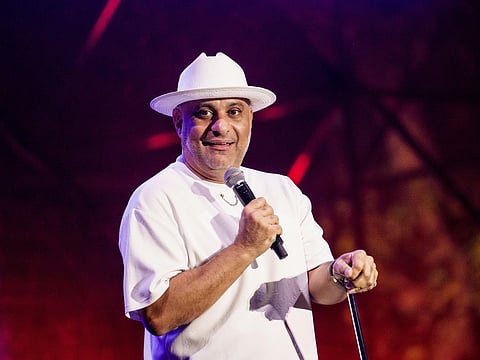
Cut to now, nearly two years later, and he’s back with the Relax Tour. We catch up with him as he closes his big Indian journey and talks about how this time, India isn’t the same audience it was. The stand-up scene here has grown bigger than ever, audiences have become sharper, more politically aware, and far less forgiving of easy material. So the excitement now isn’t just about seeing Russell again — it’s about seeing who he is in this moment, and whether that same instinct that once defined him still lands in a room that has moved forward.
That sense of movement is something you can feel in the way he talks about his own material too. The themes haven’t changed on paper — race, parents, immigration — but the way he sits with them clearly has. There’s a difference between joking about something as an observer and joking about it after you’ve lived through enough to see both sides of it. He doesn’t over-explain it, but he doesn’t need to. “Yeah, because now I’m not just the kid observing it, I’m the adult responsible for it. The jokes hit differently when you’ve lived long enough to understand both sides,” he says. It’s a small shift in words, but it changes the weight of everything. Earlier, the humour came from pointing things out; now, it comes from recognising where you stand in those same dynamics.
And that kind of shift doesn’t happen in isolation. Comedy, especially the kind Russell has built his career on, depends heavily on who’s sitting in front of you. The audience that laughed at him in the early 2000s isn’t the same audience showing up today, and he seems very aware of that balance. Ask him whether comedy grows with the comedian or the crowd, and he doesn’t pick a side. “It’s both,” he says. “You evolve, and the crowd evolves with you. If one of you stays stuck, the connection dies.” It’s a pretty blunt way of putting it, but it makes sense. Stand-up only works if there’s a meeting point, and if either side refuses to move, that gap starts to show.
India, in that sense, is probably one of the clearest examples of that evolution. The first time Russell performed here, there was a kind of distance — he was reconnecting with a place he knew through family, through stories, through a version of culture that existed outside of the country itself. The audience, in turn, was still figuring out what stand-up’s future was. It was exciting, slightly unexplored and unfamiliar. Now, that gap has closed. “Back then it felt like discovery,” he says. “Now it feels like home with the volume turned up. India doesn’t just listen anymore, it responds.” That one line says a lot. The audience isn’t passive anymore. They react, they question, they engage. And that kind of energy changes how a show feels from the stage.
A big part of that comes down to how much the local comedy scene has grown. Over the last few years, Indian stand-up has found its own voice — more political, more observational in its own way, less reliant on borrowed formats. That naturally changes what audiences expect when they walk into a show. Russell doesn’t ignore that. If anything, he seems to welcome it. “The audience is sharper and more informed now. You can’t just be funny, you have to be real,” he explains. It’s a simple distinction, but an important one. Being funny can be surface-level. Being real takes a little more effort, a little more honesty.
Even then, there’s still a risk that comes with stepping on stage after all these years. Not the kind of risk that comes from not knowing what you’re doing, but the kind that comes from knowing exactly what people expect from you. For someone like Russell, whose voice has been so consistent for so long, that expectation can be both a strength and a limitation. He sums it up in one line: “Trying something new in front of people who came for the old you — that’s always the gamble.” And it is a gamble. Audiences come with memory, with attachment, with a certain idea of what they want. Changing that, even slightly, means risking that connection.
But staying the same isn’t really an option either. That tension — between giving people what they know and pushing into something new — is what seems to drive a lot of where he is right now. It’s not about abandoning the past, but about not being stuck in it either. And maybe that’s where his background still plays a role. Growing up between cultures meant he was always explaining one thing to another, always finding a way to make two sides understand each other. That instinct hasn’t gone anywhere. “I’m still explaining one world to the other. Comedy is my way of making cultures understand each other without a fight,” Russell shares. It’s probably the simplest way to describe what he’s always done, even when the context around it keeps changing.
And context really is everything here. Because the people coming to watch him now aren’t just showing up for a set — they’re showing up with years of memory attached. For a lot of them, Russell was one of the first comedians they watched, one of the first people who made their own lives feel like material. That kind of connection doesn’t disappear, but it does change. Which is why the question of what audiences want from him now isn’t as straightforward as it might seem. He gets that too. “It’s both,” he says. “They want the guy they remember. But they also want to see if he’s still got something to say.”
That “something to say” is really what this tour comes down to. Not just whether he can still get laughs — because that’s almost a given — but whether those laughs mean something in the way they used to, or maybe even in a new way. The Relax Tour title might suggest ease, but there’s actually quite a bit happening underneath it. A return after years, a changed audience, a performer who isn’t in the same place he once was. All of it adds a kind of pressure to the whole thing.
At the same time, there’s also a certain confidence that comes from having done this as long as he has. He knows the rhythm of a room, knows how to read a crowd, knows when to lean in and when to pull back. That doesn’t disappear. If anything, it probably makes taking those risks a little easier. Because even if something doesn’t land the way he expects, he knows how to find his way back.
And maybe that’s the real reason people keep coming back to watch him. Not just for the jokes they already know, but for that ability to hold a room, to shift with it, to make it feel like something is happening in the moment. That hasn’t really changed, even if everything around it has.
So when Russell stepped back onto an Indian stage now, it wasn’t just a repeat of what came before. It was a continuation, but also a test. Of how much has changed, of how much hasn’t, and of whether those two things can still meet somewhere in the middle. And if there’s one thing he seems clear about, it’s that he’s willing to take that chance — even if it means gambling a little along the way.
Mail ID: anshula.u@newindianexpress.com
Twitter: @indulgexpress
For more updates, join/follow our WhatsApp, Telegram and YouTube channels.