
- LIFESTYLE
- FASHION
- FOOD
- ENTERTAINMENT
- EVENTS
- CULTURE
- VIDEOS
- WEB STORIES
- SPORTS
- GADGETS
- CAR & BIKE
- TRAVEL
- SOCIETY
- GALLERIES
- NORTH EAST
- INDULGE CONNECT

The Saawan month has a unique significance in Hindu culture. It is the most revered month in which people worship Lord Shiva. The link between the Saawan month and Lord Shiva has been established through legends of sacrifice and devotion. It is believed that praying to Lord Shiva in this month brings peace and protection.
Samudra Manthan is one of the major myths associated with Lord Shiva in this month. As per Hindu mythology, the devas (gods) and asuras (demons) churned the cosmic ocean to extract Amrit, the nectar of immortality. Many divine objects came out of it, but there was one very dangerous thing that also emerged from it. This thing was a very dangerous poison named Halahala. This poison was so deadly that it had the power to destroy the whole world.
At this crucial time, Lord Shiva emerged and consumed the venom so that no harm would befall any living creature. He did not consume the whole of it but kept it stored in his throat. Due to the poison, his throat turned blue, which is why he is called Neelkanth, ‘The blue-throated one.’
It is said that the poison had caused extreme heat in Shiva’s body. To neutralise its effect, Gangajal was sprinkled on him. This is why the Shivlingas are bathed with Gangajal, especially during the Saawan month.
A different explanation of the divine connection between Shiva and the Saawan month lies in the tale of Goddess Parvati. When Sati reincarnated into Parvati, the daughter of the King of the Himalayas, she started showing great dedication towards Lord Shiva.
During this time, Parvati engaged in severe tapasya and fasting on Mondays, which was named as Saawan Somvar. Parvati’s devotion to God Shiva impressed him, and he married her. Due to this incident, many followers fast on Mondays and pray to Shiva for their happiness and blessings.
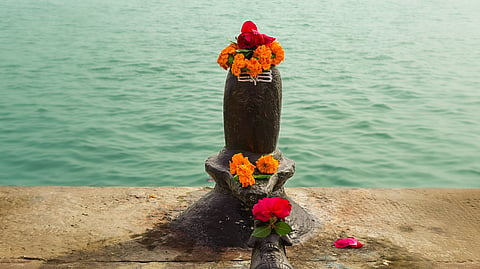
The followers practice the Saawan puja by taking a bath in the morning, putting on fresh clothes, and performing prayers with full dedication. They either visit the Shiva temples or worship at their homes. An important ritual practice is the Abhishekam in which water, milk, curd, honey, and ghee are poured over the Shiva Linga.
The symbolic significance behind each offering includes that of purity, prosperity, nourishment, sweetness, and enlightenment. Offerings of Bilwa leaves and lighting up of lamps are made along with the chanting of mantras like Om Namah Shivaya and Maha Mrityunjaya Mantra.
For more updates, join/follow our WhatsApp, Telegram and YouTube channels.