
- LIFESTYLE
- FASHION
- FOOD
- ENTERTAINMENT
- EVENTS
- CULTURE
- VIDEOS
- WEB STORIES
- SPORTS
- GADGETS
- CAR & BIKE
- TRAVEL
- SOCIETY
- GALLERIES
- NORTH EAST
- INDULGE CONNECT

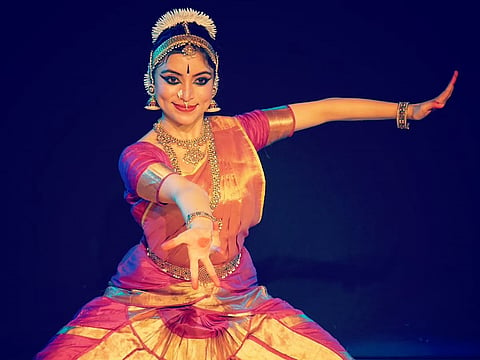
Bharatanatyam has travelled a remarkable path through history. What began as a sacred practice in temples evolved through royal courts, endured periods of decline under colonial rule and eventually found renewed life on modern stages. Today, the classical form navigates an era shaped by social media and shrinking attention spans.
For Bharatanatyam exponent Dr Shrusti Budhori Sharma, this very journey forms the foundation of Parinama, her presentation at Natya Tarangini.
“Parinama is about the journey of Bharatanatyam,” says Shrusti. “You shall see its evolution from the time it was performed in temples, to the period when it flourished under royal patronage, then the challenges it faced and finally its renaissance, when it was brought back to the stage and eventually even the silver screen. The pieces I have selected are all resonant with that thought.”
The idea emerged from a shared vision between the organisers and the artiste herself. While Natya Tarangini was initially conceived by Saga Celebrations’ Sudha Kuchalakanti and Sai Geetha Rajput, Shrusti saw an opportunity to present a theme that would educate as much as it entertained. “What inspired me was the fact that unlike earlier generations, people today don’t always have exposure to quality Bharatanatyam,” she says. “Because there is so much content available and patience levels have reduced, artistes often feel pressured to create fusions that do not necessarily show the essence of the art form in its truest sense. We wanted to bring audiences back to what Bharatanatyam really is.”
The presentation will include a special segment with live musicians, allowing audiences to experience the dance form in a format much closer to its traditional roots. “People often forget that classical dance was always performed with a live orchestra,” she explains. “A solo dancer and a group of musicians would build a rapport with one another, and that chemistry would transform the audience. There is a sacredness in that experience.” She adds, “When artists come together because of their love for the art, even a small idea can take a beautiful shape. The spontaneity, the interaction and the artistic capabilities of each individual make the presentation exciting not only for the audience but for the performers as well.”
The evening will also delve into the technical side of Bharatanatyam, exploring concepts such as navarasas and talas while highlighting the precision that underpins the art form.“We will demonstrate that Bharatanatyam is not just art,” says Shrusti. “There is mathematics involved. There is structure, discipline and an entire system behind what appears effortless on stage.”
Among the highlights of her repertoire are the pot dance and plate dance, forms that demand extraordinary balance and years of training. “The pot dance was originally conceived in the 1930s and 1940s as a way of drawing audiences back to Bharatanatyam performances,” she explains. “My guru’s lineage later expanded it by incorporating karanas, yoga postures, balancing mud pots on the head and candles in the hands, creating a representation of divine balance and the five elements.”
The challenges of the form go far beyond spectacle. “To stand on a pot while balancing multiple elements and executing difficult postures takes years to master. Every time you step onto the pot, you surrender completely and trust the process.” The plate dance, meanwhile, draws inspiration from Kuchipudi traditions. “My guru was deeply inspired by the plate dance and introduced additional elements, including chakras or turns, into the traditional format,” she says.
For Shrusti, however, technical mastery is only one half of the equation. “My guru always said that you can judge a dancer by how well they can carry both nritta and abhinaya,” she says. “A dancer may be technically brilliant or emotionally expressive, but somebody who can do both beautifully always stands out.”
That philosophy has shaped her artistic journey and also her career as a doctor. “Medicine and dance may seem very different, but both are deeply spiritual for me,” she reflects. “Both require patience, perseverance, hard work and showing up every single day. Dance taught me those lessons from a very young age, and they helped me throughout my medical training.”
Ultimately, Parinama is as much about the audience as it is about the performer. “I hope people remember the beauty, the struggle and the originality of this art form,” says Shrusti. “More importantly, I hope they become cultural torchbearers themselves, because preserving Bharatanatyam is not only the responsibility of dancers but also of audiences who choose to support and value it.”
Tickets at Rs 1,500. July 31, 5 pm. At Saptaparni, Banjara Hills.
Mail ID: anshula.u@newindianexpress.com
Twitter: @indulgexpress
For more updates, join/follow our WhatsApp, Telegram and YouTube channels