
- LIFESTYLE
- FASHION
- FOOD
- ENTERTAINMENT
- EVENTS
- CULTURE
- VIDEOS
- WEB STORIES
- SPORTS
- GADGETS
- CAR & BIKE
- TRAVEL
- SOCIETY
- GALLERIES
- NORTH EAST
- INDULGE CONNECT
A key artefact from the trans-Atlantic slave trade displayed at the National Museum of African American History and Culture in Washington will soon be removed from its gallery as a long-standing international loan agreement comes to an end.
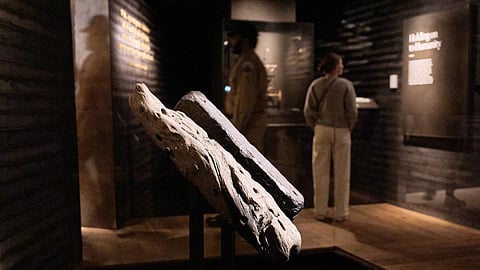
The artefact — a 33-pound timber fragment from the slave ship São José-Paquete de Africa — has been part of the museum’s Slavery and Freedom exhibition since the institution opened in 2016. Later this month, the piece will be taken off display and prepared for its return to South Africa.
The timber is one of several items recovered from the wreck of the Portuguese vessel, which sank off the coast of Cape Town in 1794 while transporting enslaved Africans from Mozambique to Brazil. The ship was carrying more than 400 captives when it struck a rock and went down. Historical accounts suggest that roughly half of those on board died, while the survivors were sold into slavery in the Western Cape.
The shipwreck was identified and studied after underwater investigations in 2015 confirmed the vessel’s link to the trans-Atlantic slave trade. Researchers working with the international Slave Wrecks Project helped verify the site, making it one of the earliest known recovered wrecks of a ship involved in transporting enslaved Africans who died during the voyage.
Displayed on the lowest public level of the museum, the timber has been presented in a darkened gallery that examines the Middle Passage — the forced maritime journey endured by millions of Africans during the slave trade. Suspended above a shadowy space and positioned beside a ballast stone used as counterweight on the ship, the fragment has served as a stark physical reminder of that history.

The original loan agreement between the Smithsonian museum and the Iziko Museums of South Africa was signed for five years when the institution opened. It was later extended in 2021 for another five-year period, concluding on 1 July this year. As the agreement ends, the timber will be returned to its home institution.
Because of its fragile condition, conservators are preparing a specially designed crate to transport the wooden artefact safely. Other objects recovered from the wreck, including ballast stones that were once used to stabilise the ship, will remain on display at the museum for the time being. They are expected to return to South Africa in about two years.
Once the timber fragment is removed, a historical cargo manifest from the ship will take its place within the exhibition. The document records details of the captives transported aboard the vessel and will continue to support the gallery’s narrative about the human impact of the slave trade.
Museum officials say the change reflects the conservation needs of the artefact and the terms of the international loan agreement. They have also acknowledged that alterations to historical exhibits in federal museums are receiving heightened attention at present, particularly as institutions review displays relating to the nation’s past.
Despite the upcoming change, staff say the exhibition’s central message will remain intact. Visitors frequently describe the gallery as one of the most affecting sections of the museum, where artefacts and carefully designed spaces help convey the realities of the Middle Passage.
Even as the timber fragment returns to South Africa, curators emphasise that the broader story it represents will continue to be told through the remaining artefacts, documents and interpretation within the gallery.
For more updates, join/follow our WhatsApp, Telegram and YouTube channels