
- LIFESTYLE
- FASHION
- FOOD
- ENTERTAINMENT
- EVENTS
- CULTURE
- VIDEOS
- WEB STORIES
- SPORTS
- GADGETS
- CAR & BIKE
- TRAVEL
- SOCIETY
- GALLERIES
- NORTH EAST
- INDULGE CONNECT

The tomb of China's first emperor, Qin Shi Huang, is a place of deep mystery. This is the tomb of the emperor who wanted to be immortal but couldn't defeat death, passing away in 210 BCE. The tomb was not discovered for centuries until a farmers accidentally dug the site in 1974.
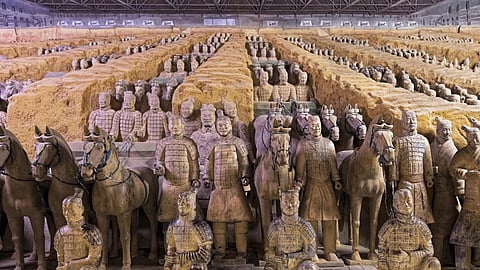
What was found next, was extraordinary. It was a large site and the famous Terracotta Warriors was revealed to the world. Thousands of life-sized soldiers, all made out of clay, armoured and ready. However, archaeologists refuse to dig in any further and have not opened the inner mausoleum.
Chinese emperor Qin Shi Huang's tomb is guarded by an entire army of clay soldiers and loaded with treasures. A magical place holds some dark secrets in the emperor's grave which has never been opened. There are rumours that the place is dangerous, poisonous even.
Historical records have listed mercury rivers among the many mysterious things found there. Historian Sima Qian wrote in the Records of the Grand Historian (Shiji) that Chinese craftsmen were asked to make crossbows and arrows designed to shoot at anyone who tried to enter the tomb. "Mercury was used to simulate the hundred rivers", he added.
While ancient beliefs could easily be debunked, modern science believes in the claims as well. This is because the soil around the tomb has high mercury levels, as reports have suggested. There are also believed to be underground traps that could be deadly.
Mercury is enough reason to be scared to open the tomb. Duan Qingbo, of the Shaanxi Provincial Archaeology Institute, had told Chinese media two decades ago, "We found by a survey that the mercury density in Qinshihuang's cemetery area is exceptionally higher than that in the area on the periphery".
Additionally, the dangers gave out warning at every step so far. The bright paint on the Terracotta Warriors had faded in just a few minutes after being exposed to air. The grave might just be balancing everything and exposing it can prove dangerous.
"It is not the proper time to open the tomb at the moment, since so many things remain unknown", Duan had said. China's motto is protection first. It is wiser to wait for the correct method to arrive that can detect the dangers, than to expose a population to danger. However, the debate around whether the site should be open, continues.
For more updates, join/follow our WhatsApp, Telegram and YouTube channels.