
- LIFESTYLE
- FASHION
- FOOD
- ENTERTAINMENT
- EVENTS
- CULTURE
- VIDEOS
- WEB STORIES
- SPORTS
- GADGETS
- CAR & BIKE
- TRAVEL
- SOCIETY
- GALLERIES
- NORTH EAST
- INDULGE CONNECT

In an era when the call for environmental consciousness is louder than ever, artists worldwide are increasingly turning to sustainability as both a subject and a medium for their creative expressions.
Art has always been a reflection of society, and today, as concerns over climate change, waste, and ecological degradation intensify, many artists are using their works to raise awareness and inspire action towards a greener future.
The two words, art and sustainability, when colliding, make the world a beautiful place to live in. The creative side of art mixed with sustainable outcomes creates wonders.
“I choose art as a voice to convey messages about anything and everything since art is a space that brings people of all kinds together as a community. When the community gathers, conversations spark, and with a ripple effect, creative solutions arise. This evokes emotions, inspiring viewers to care about sustainability,” says Diana, an artist, who runs her own art studio in the city. Diana also works on saving and preserving neglected art from Telangana called Cheriyal artwork.
Art has a unique ability to communicate complex ideas in ways that can stir emotions, provoke thought, and influence behaviours. When it comes to becoming environmentally conscious, artworks can challenge traditional narratives and encourage audiences to rethink their relationship with the natural world.
Artists like Diana, who are working within the realm of sustainability, offer both commentary and solutions, raising awareness about the environmental impact of human activity through their works. In doing so, they contribute to a larger conversation about how individuals and communities can engage with the natural world in more responsible, eco-friendly ways.
Sustainability in art isn’t limited to themes and subjects. Many artists are also adopting environment-friendly practices in their methods and materials. This includes upcycling discarded objects, creating eco-friendly sculptures using organic materials, or employing energy-efficient production processes. By integrating sustainability into the very fabric of their creations, artists are not only making statements about the environment but are also actively reducing their ecological footprint.
For example, some artists work with found objects or repurposed materials to create ‘zero waste’ installations, transforming what would have been discarded into thought-provoking pieces.
For artist Anjali Venkat, recycling and reusing have been a way of life since childhood. She has carried those practices with her right through.
“Art brings meaning into people’s lives; it shapes our perceptions and encourages conversations about society and social issues. By showcasing artworks using post-consumer materials, one hopes to fuel the creative imagination and inspire innovation,” Anjali says.
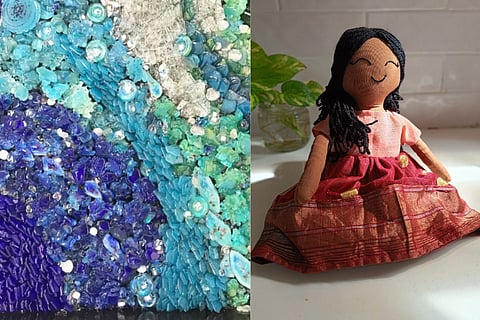
Her passion for our environment led her to primarily use post-consumer materials, like glass bottles, broken windows, discarded clothes and fabrics, and scrap yarn to make art. “The challenge is to transform society’s undesirable waste into something that is functional and aesthetically pleasing — to conjure up alternative uses of ordinary things,” she adds.
Another artist, G Gurunathan, works with found metal sheets — collecting old rusted pieces and transforming them into artworks.
Gurunathan, during his walks, draws little abstract pictures on a sketchpad, of the overlapping leaves, trees, branches, twigs, and shadows. Usually, these are in monochrome. They are then developed into more expansive, vibrant mixed-media pieces upon reaching his studio.
He defines sustainability in his work as a commitment to continuous artistic growth and an adaptable, lasting creative process.
Using creative thinking, these artists create visually arresting and philosophically complex works of art. This approach not only demonstrates the infinite potential of creativity but also provides a concrete illustration of how repurposing common materials may support a more environmentally responsible cultural scene.
“I strive to foster deeper connections with nature and society while valuing and practising selflessness in both my art and life, reflecting these principles in my work,” Gurunathan says.
Chennai-based Reshma Malliknath has always been passionate about recycling materials in her life. It’s not just about using fabric bags or paper cups, but about maximising the use of any item — whether it’s clothes, toys, or anything else. “After something has served its primary purpose, I always ask — can it be repurposed or reused? I’ve carried this mindset into my art and craft too.”
She further explains her process of doing the artwork, “After my son was born, I started making small toys for him. My son became my ‘R&D department’— he’d play with the toys, give feedback, and tell me what worked and what didn’t. For example, when he couldn’t move the arms of a doll, I redesigned it to be more flexible.”
When Anjali started working with glass in 1995, sourcing coloured glass sheets in India was difficult. She started experimenting with discarded bottles as her material and has grown on from there. “It’s been many challenging years of experimenting, making mistakes and figuring out the possibilities, but the joy of creating something beautiful from used and discarded materials is unsurpassed,” Anjali shares.
For Gurunathan, a major challenge he faces is identifying skilled craftsmen and ensuring their best performance in his artwork, given the scarcity of dedicated and hardworking artisans.
However, Reshma has it easy. She uses polyfil for stuffing because it’s washable and retains its shape, and uses cotton for the outer fabric. If the toy tears or is no longer needed, these polyfils can be reused in other toys or even in pillows. Furthermore, to reduce wastage, she creates art only as per orders.
While one approach to being ecological is through the use of recycled materials, non-toxic paints provide an additional means of artistic expression that is consistent with environmental preservation.
Diana emphasises the use of non-toxic materials or chemicals. “I don’t buy canvas or acrylics for my artwork. I use natural stone colours and natural clay colours, and I mix them with tamarind seed powder and Arabic gum.”
However, artist Maanas Udayakumar, who works with oil paints and ceramics, has a different perspective of sustainability in art. “I don’t see my ceramic or oil painting work aligning with sustainable practices. It’s often said that ceramics are sustainable, but I feel quite the opposite. While clay and other materials come from the earth, once clay is fired, it becomes non-degradable. This creates a lot of waste, much like the excess concrete in construction," he says.
Many ceramic artists, including myself, end up with damaged or broken pieces that are simply discarded. While some of these can be reused, such as broken ceramic bits being repurposed in tiling, it’s a very small fraction,” the artist adds.
For him, the creation of art is a spontaneous and personal journey, not one driven by the intent to raise social or environmental awareness. But Maanas has noticed that many artists tie their work to political or environmental causes, even when their practices may contradict those very causes.
According to Reshma, it’s not just about creating eco-friendly products, but also encouraging consumers to actively participate by using and reusing these items. “Art can play a major role in raising awareness about sustainability, but ultimately, it’s up to individuals to take action. For me, creating art and toys is about merging creativity with a responsibility to the environment,” she says.
In a world that is grappling with urgent ecological challenges, sustainable art offers a powerful medium for change. Through both message and medium, artists can inspire more responsible environmental behaviours, prompt public discourse on sustainability, and foster a deeper connection between humanity and the planet. As this movement continues to evolve, art remains a vital and vibrant force in the push for a more greener future.
What else could be a better platform for action and change other than the voice of art?
As Diana concludes, “In the next five years, I am not very sure, but I do believe the outcome or the wave is going to be massive, not just from me, or through my curations, but with growing technological advancements and environmental concerns, sustainability is going to be the mantra. People will have no choice but to pay attention to the increasing climate change issues and biodiversity loss.”
E-mail: apurva.p@newindianexpress.com
X: @appurvaa_