
- LIFESTYLE
- FASHION
- FOOD
- ENTERTAINMENT
- EVENTS
- CULTURE
- VIDEOS
- WEB STORIES
- SPORTS
- GADGETS
- CAR & BIKE
- TRAVEL
- SOCIETY
- GALLERIES
- NORTH EAST
- INDULGE CONNECT
Art, as a medium, operates like a critic of humans and their social scenarios. This exploration of the intricate relationship between humanity and nature is showcased at Sculpting in Time, a group sculpture show that brings together the works of several talented artists, including S D Hari Prasad, Sreekanth Kurva, Arun Pandit , Janarthanan Rudhramoorthy, Kotturu Lakshman Rao, Surakala Appala Raju, and Rajeev. The use of various materials such as iron, granite, steel, bronze, and fibre showcase their mastery and creativity in blending mechanical and organic aesthetics.
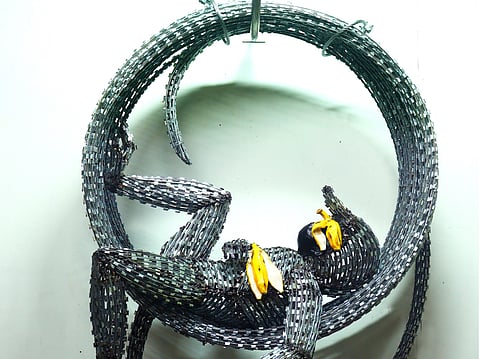
The exhibition encourages viewers to reflect on themes such as power dynamics, dependency, and conflict within human relationships. Lakshman Rao’s work exemplifies this exploration, as he tells us, “My work explores the dualities in everyday life, focusing on themes of protection and separation. Through metaphorical references, I depict notions of comfort, security, and the ways in which humans seek protection.” By employing common symbols from the animal kingdom, Lakshman transforms everyday items into profound representations of interpersonal dynamics.
The recurring symbol of the monkey in his artwork captures childlike curiosity and playfulness while also offering interpretations of human behaviour. His use of fencing wire further embodies contrasting qualities — delineating boundaries while simultaneously offering protection in society.
On the other hand, artist Arun Pandit challenges viewers to confront aspects of contemporary society. He explains his figure of Flying Man by elaborating on the dynamics between cities and villages. “I showcase multiple horizontal faces that symbolise movement, diverging from the traditional vertical forms associated with buildings. This design choice reflects the different developmental patterns of villages and cities: villages expand horizontally while cities grow vertically like building blocks.”
Another highlight of the exhibition is S D Hari Prasad’s Transform series. Composed primarily of granite, limestone, and basalt, these sculptures reinterpret traditional stonework by imbuing it with unexpected fluidity and lightness. The flowing structures appear almost alive, capturing the essence of metamorphosis — a theme central to both nature and human experience.
On using stone as his primary medium, he says, “I find it to be both challenging and rewarding. Working with stone requires precision; any mistake is irreversible. This inherent challenge transforms the sculptor into a meditator by default. When you engage with stone, you are fully present in the moment."
Janarthanan Rudhramoorthy’s work further emphasises the connection between humanity and nature through his sculptural interpretations of the human body. His sculptures often utilise iron and stainless steel to create intricate forms that convey movement and grace. He explains his work by saying, “The movement and coordination of the thoughts and the body is very interesting to be observed, and several layers of materials in the piece reflect the layers in the conscience.”
This exhibition stands as an invitation for viewers to engage deeply with each artwork while reflecting on their personal connections to nature.
Free entry. October 25 to November 24, 11 am to 7 pm. At Gallery Space, Banjara Hills.
Story by Anshula Dhulekar.
