
- LIFESTYLE
- FASHION
- FOOD
- ENTERTAINMENT
- EVENTS
- CULTURE
- VIDEOS
- WEB STORIES
- SPORTS
- GADGETS
- CAR & BIKE
- TRAVEL
- SOCIETY
- GALLERIES
- NORTH EAST
- INDULGE CONNECT

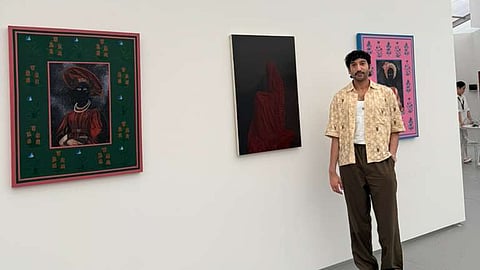
At the Untitled Art Fair during Miami Art Week, a modest booth from RMC drew crowds that felt less like fairgoers drifting between stands and more like visitors pulled toward a magnetic field.
The gallery’s curation of South Asian artists such as Ammama Malik and Sid Pattni, sparked a level of curiosity that seemed to catch even seasoned collectors off-guard. In a week known for spectacle, the attention felt unusually focused, almost studious.
Something was happening, and it was happening through work that insisted on its own specificity while speaking with clarity to a global audience.
Rajiv Menon, founder of RMC and one of the only Indian gallerists operating in the United States, has been at the centre of this shift. He describes the response less as a surprise and more as a realignment long in the making.
“American collectors were drawn to the universality of the works,” he explains, emphasising that questions around migration and the gendered body form a shared vocabulary across cultures. His artists draw from the subcontinent’s histories, yet they converse with European and American art lineages with ease.
In a fair that often collapses complexity into immediacy, the artists’ insistence on layered narratives felt refreshing. Much of the discussion around the booth circled back to The Missing Figure, a presentation grappling with colonial memory and movement across borders.
Menon notes that the themes resonated strongly with Western audiences who are re-examining inherited canons. “Western audiences are interested in reimagining their own canon from new perspectives,” he says. The work does not present migration as crisis imagery; instead, it unfolds as a lived continuum, a series of gestures and absences that refuse easy summarisation.
To place such work in front of collectors who may be encountering South Asian contemporary art for the first time is to ask for attentiveness rather than spectacle. RMC’s strategy hinges on education, context-building and a commitment to the long game.
Menon is frank about the hurdles artists face: protectionist systems, logistical challenges, and a general lack of familiarity with the region’s artistic discourse. “Western audiences often have limited context for South Asian art and require a substantial amount of education,” he says.
The booth’s rapid sell-out, within 24 hours, inevitably became a talking point. Yet the impact extends beyond the market’s usual metrics. Institutions, Menon observes, are moving quickly to address long-standing omissions.
“Institutions are collecting Indian artists rapidly because they know their collections have huge gaps in this space,” he notes. The gallery’s ambition to close fifteen museum acquisitions in its first year reflects a deliberate focus on permanence.
For RMC, museums operate as both custodians and catalysts; their engagement signals to collectors that these works are essential rather than supplementary. Still, the question lingers: is this momentum an inflection point or a passing enthusiasm?
Menon resists the framing entirely. “I reject the idea that this is a ‘moment,’ which makes it all feel like a temporary trend,” he says. Instead, he describes a landscape undergoing correction, one led from within the region itself.
His advice is clear: singularity matters more than pandering. Work that attempts to pre-empt an imagined Western gaze risks losing the spark that gives it integrity. The artists who stood out in Miami did so precisely because their practices were anchored in their own interiorities.
For more updates, join/follow our WhatsApp, Telegram and YouTube channels.