
- LIFESTYLE
- FASHION
- FOOD
- ENTERTAINMENT
- EVENTS
- CULTURE
- VIDEOS
- WEB STORIES
- SPORTS
- GADGETS
- CAR & BIKE
- TRAVEL
- SOCIETY
- GALLERIES
- NORTH EAST
- INDULGE CONNECT

In a world increasingly fragmented by borders and noise, this upcoming exhibition by Armenian artist Mari Poghosyan offers a quiet yet powerful communion of cultures, memories, and artistic expression. Inspired by the book The God of Deserted Memories, written by her husband and author Dr. Prashant Madanmohan, the exhibition maps the intertwined legacies of Armenia, India, and France through artworks. We spoke with Mari to know more about the show and her artistic journey.
Can you walk us through the exhibition?
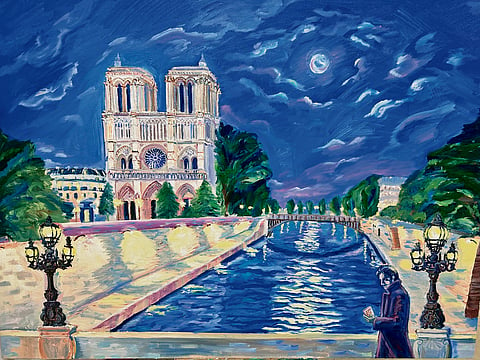
This exhibition is a cultural bridge and an invitation to reflect, pause, and remember. It features over 35 original impressionist works — including monument renditions, landscape paintings, portraits, and symbolic compositions — each exploring themes of memory, resistance, exile, beauty, and identity. The artworks reflect the intertwined legacies of Armenia, India, and France — three civilisations that, despite their distances, share profound spiritual and artistic kinships.
What was your inspiration behind the theme?
My inspiration was born from a deep yearning for cultural preservation through emotion and art. I began working on this body of art during a time of war — a time when many Armenian monasteries, artefacts, and symbols of identity were being lost or destroyed. As an Armenian, I carry within me the memory of a nation marked by profound silence and repeated attempts at cultural erasure.
But I believe that art is our greatest form of resistance. This theme emerged from that very impulse — to turn memory into colour, and resistance into beauty. To create a space where civilisations don’t just coexist, but converse — across time, geography, and pain.
My husband and collaborator, Dr. Prashant Madanmohan, explored many of these same themes in his book The God of Deserted Memories. His writing and philosophy reflects on how memory shapes identity — how we are defined not only by what we remember, but by what we choose to forget. His work gave a narrative spine to the emotions I was already trying to express through art. Together, our works became a shared act of remembering.
How do you want viewers to engage with your works?
I hope the viewer walks away with a sense of quiet remembrance — not sadness, but presence. My paintings are not created to be decoded or explained. They are meant to be felt slowly, like distant music or the warmth of a memory long buried.
If a viewer finds in them a part of themselves, or stumbles upon something they didn’t know they had forgotten — then the painting has fulfilled its purpose. Because what we remember shapes us, and what we forget continues to shape us, often in silence.
I see myself as a messenger of feeling. My art is not about answers, but about evoking reflection. If it makes someone pause, breathe a little deeper, or reconnect with a memory, an ancestry, or a longing — then I believe I’ve done my part.
Tell us about your collaboration with Dr. Prashant Madanmohan. What was the genesis?
Dr.Prashant and I are partners in both life and art. Our collaboration was not planned — it emerged organically, as if memory itself had brought us together through different mediums. While he journeyed through words, I journeyed through brushstrokes. The God of Deserted Memories and this exhibition were conceived as parallel odysseys, but somewhere along the way, they became inseparable.
We both felt an inner urgency — a need to reclaim memory, to resist cultural amnesia, and to spark dialogue between civilizations. The book’s themes — identity, resistance, loss, and belonging — resonated with my deepest artistic concerns. As I read the manuscript, I found myself moved not only as a reader, but as a fellow seeker. The words echoed my own unspoken thoughts — it felt as though my mind had been voiced in his writing.
I began painting while reading. My hands responded instinctively to the truth and tenderness in his prose. What I was creating was no longer just art — it was a visual dialogue with the text. As I sketched and painted, the lines between our expressions blurred. The book lived in my paintings. And the paintings gave breath and form to the book.
Interestingly, Prashant was also deeply affected by my solo exhibition last year. I saw reflections of those emotions shaping his narrative — which gave our collaboration a certain spiritual symmetry. It was no longer just his book or my art — it became our shared voice.
We both believe that when art and literature come together, they transcend boundaries — reaching something universal and timeless. Through this union, we hope to inspire a larger movement: a world without borders, where cultures don’t compete but converse, where memory is preserved, and where Yaadhu Uré, Yaavarum Kelir — “every place is my home, and all people are my kin” — is more than just poetry, but a living philosophy.
This is the spirit we have tried to embody — in brush and in word.
Please take us through your artworks. What kind of materials have you used?
My practice primarily involves oil and acrylic on canvas, though I also work with pencil sketches, layered textures, and occasionally incorporate symbolic motifs and scripts. The impressionist style gives me the freedom to blur the line between realism and emotion — to allow feeling to colour form. In some works, I’ve embedded fragments of Armenian script, visual symbols, and calligraphic gestures to evoke voices that history has tried to forget.
This particular collection is curated in three civilizational strands — Indian, French, and Armenian — each deeply rooted in memory, beauty, and resistance.
How has your practice evolved over the years?
In the beginning, I painted what I could see — the visible world, its shapes and forms. But over time, I began painting what I could no longer see — the things that were disappearing, fading, or silenced by time. My practice evolved into something I now call emotional archaeology.
Today, I feel as though I am painting memory itself — not just moments, but echoes. The brush has become a tool for excavation, for bringing to the surface something delicate and nearly lost.
Having been settled in Chennai now, what does the city mean to you?
Chennai is now my home — not just in geography, but in spirit. There is a spiritual gentleness here: in the light that filters through the temples, in the music that lingers in the air, in the quiet strength and compassion of the people. It welcomed my Armenian soul with grace, as though I had always belonged here.
In many ways, Chennai has become the canvas for my artistic evolution — where the rhythms of Tamil Nadu have mingled with my ancestral roots. I feel it was destiny that brought me here.
Open to all. Till May 17.11 am to 7 pm. At Lalit Kala Akademi.