
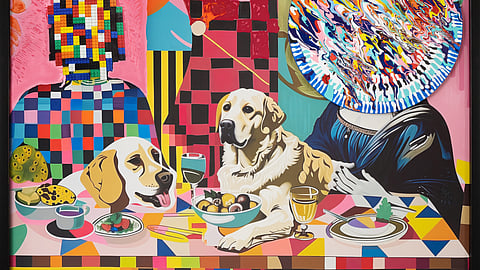
Devanshi Goenka’s Unfiltered debuts in Hyderabad, embracing raw expression

There are artists who paint to perfection, and then there are those who paint to reveal. Devanshi Goenka belongs to the latter. Born in Delhi in 1991, she first stepped into the art world as a teenager, presenting a solo exhibition at just 16. Since then, her practice has been marked by a fearless pursuit of expression, earning recognition from stalwarts like Anjolie Ela Menon and Sharan Appaprao, with her works now housed in collections across New York and London.
Devanshi Goenka’s Unfiltered explores vulnerability, memory, and motion on canvas
Yet Devanshi’s journey is not confined to canvas alone. A Wharton graduate and former McKinsey consultant, she also builds in the world of agri-tech — a duality that sharpens her instinct, balancing structure with chaos, discipline with risk, and vision with play.
Her latest series, Unfiltered, showcasing in the city as part of the Design Democracy Hyderabad 2025, is perhaps her most personal yet — a jubilant release of colour, rhythm, and raw honesty. Embedded with surprising materials like Lego blocks, toy fragments, and overlapping canvases, the works resist polish in favour of vulnerability. For Devanshi, painting unfiltered is about leaving behind the drip, the mess, the impulse — and letting instinct speak louder than perfection. As she debuts in Hyderabad, she invites audiences not just to see, but to feel.
Excerpts:
What does ‘unfiltered’ mean to you personally, and how does it manifest on canvas?
For me, ‘unfiltered’ is about showing up without polish or pretense. It’s painting with honesty — keeping the first gesture, the raw drip, the mark that wasn’t planned. On canvas, it means allowing instinct to take over and resisting the urge to neaten things up.
What was the inspiration behind Unfiltered? Is there a backstory?
It came from a very personal space. My life in recent years — balancing motherhood and entrepreneurship was full, layered, sometimes overwhelming. I realised I was holding back a lot. This series was a release, a way to put everything down as it was, without overthinking.
The works feel alive with rhythm and energy — almost as if they move. How do you approach capturing motion and emotion together?
I paint with my whole body — big movements, quick gestures, even letting paint spill or drip. That physicality creates motion. Emotion comes from not cleaning up after it — leaving the mess, the clash, the energy visible.
This series pushes beyond the surface into more layered, three-dimensional explorations. What drew you to experiment with form and material this time?
I wanted the paintings to feel more physical, not just visual. So I began embedding objects like Lego, toy blocks, even a metal camera, and layering canvas over canvas. These things bring in memory, familiarity, and surprise. They also connect back to childhood — building, stacking, playing — but here they refuse to stay as just objects. They live inside the painting, demanding attention, turning nostalgia into texture and depth you can’t ignore.
If Unfiltered had to be experienced without sight — through touch, sound, or emotion — how would you describe it?
Through touch, you’d feel bumps, edges, ridges — the hard corners of Lego, the curve of a camera lens, seams where one canvas overlaps another. Through sound, it would be irregular beats — bursts of energy followed by silence. Emotionally, it would feel like release — letting go of control and allowing things to take their own shape.
How do you want your Hyderabad audience to feel when they encounter Unfiltered for the first time?
This is my first time showing in Hyderabad, and I’d love for the audience to feel invited into my world. I want them to feel the energy, rawness and freedom in the work — that it wasn’t made to be decoded or overthought, but simply experienced. If it stirs something real in them — whether that’s excitement, curiosity, or nostalgia— then the work has done what I hoped.
You’ve written that the paint “flows before you ask it to.” How much of your process is instinct, and how much is intention?
It always starts with instinct. I rarely plan the first marks — they just arrive. Intention comes later, when I step back and decide what to exaggerate, what to hold back, and what to let breathe. That push and pull between impulse and choice is what keeps the work alive.
Do you think vulnerability plays a role in painting unfiltered, and if so, how do you navigate it?
Yes, very much. Painting unfiltered means showing impulses that aren’t always pretty or polished. It feels exposing, but I’ve come to accept that vulnerability is part of what makes the work real.
What role do colour and boldness play in your storytelling, especially in this body of work?
Colour sets the mood instantly — it’s the first thing you feel, even before form. Boldness isn’t just about bright colours; it’s also about leaving something raw or imperfect without trying to fix it. Both give the paintings their sense of energy and presence.
Can you share a specific moment in the studio where Unfiltered surprised you?
Once, I poured paint expecting smooth lines, but it dried into jagged, broken edges. I almost covered it, but then I realised those rough edges carried more energy than what I had planned. That “mistake” ended up being the focal point of the work.
How do you know when a piece in Unfiltered is complete, especially when the energy feels so ongoing and dynamic?
It’s instinct. When I no longer feel the urge to add or modify, I know it’s done. The energy might still feel alive, but the painting itself stops asking for more.
You’ve had an unconventional journey — from Wharton to McKinsey to agritech and back to art. How do these experiences shape your approach to the canvas?
Those experiences gave me discipline, structure, and a way of thinking in systems. In art, I almost do the opposite — I embrace chaos — but that background helps me trust the process. It also gave me resilience and the confidence to take risks, which I carry into the studio. For me, the journey isn’t unilateral — agritech and art sit side by side. It feels more like serendipity than a switch, with each world feeding the other in unexpected ways.
What does painting mean to you today — has its meaning shifted since your first solo show at sixteen?
At 16, painting was about ambition and proving myself. Today, it’s about expression and balance. It’s the one space where I can be completely myself, without roles or expectations.
As someone straddling multiple worlds — corporate, entrepreneurial, and creative — do you see painting as escape, confrontation, or perhaps integration?
For me, it’s integration. It brings together all sides of me — structured and chaotic, personal and professional. Sometimes it feels like escape, sometimes confrontation, but mostly it’s the way I make sense of everything else I do.
Finally, if Unfiltered is a statement about presence, what presence of Devanshi Goenka do you hope remains with your viewers after they leave the exhibition?
I’d like them to remember a sense of honesty and courage. Not perfection, not answers, but the willingness to show up raw and unfiltered. If that presence stays with them, then the work has done what I hoped.