
- LIFESTYLE
- FASHION
- FOOD
- ENTERTAINMENT
- EVENTS
- CULTURE
- VIDEOS
- WEB STORIES
- SPORTS
- GADGETS
- CAR & BIKE
- TRAVEL
- SOCIETY
- GALLERIES
- NORTH EAST
- INDULGE CONNECT

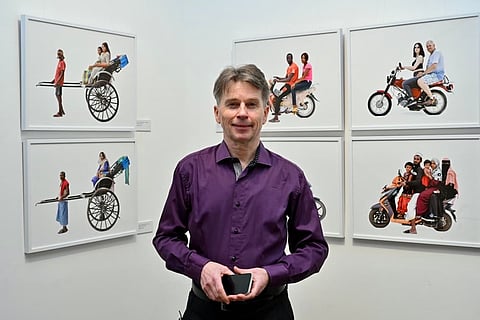
As Homo Mobilis arrives in India, Dutch photographer Martin Roemers brings with him a practice shaped by decades of observing how societies function and evolve. Known for long-term, globally exhibited projects, Roemers turns his lens in this series to vehicles—not as objects, but as deeply human markers of identity, class and survival. Shot against stark white backdrops, Homo Mobilis asks a simple yet disarming question: what does the way we move say about who we are? In conversation with Indulge Express, the artist opens up more…
You speak about removing the background in your images to focus on the subject. Could you explain that idea?
The background influences how you judge people. If I make a portrait of someone in front of a fancy building, I immediately get a different impression than if I see the same person on a dusty, unpaved road. In the first case, I might associate them with wealth; in the second, with poverty. That’s what I want to avoid. I want viewers to focus only on the object and the person who is driving it. Then, especially when you see multiple images together, you begin to notice what people have in common. You may see differences, but more importantly, you see shared experiences. That’s what I want to evoke — the realisation that we may have more in common than we think.
While traveling and documenting these stories across countries, what stood out as the most fascinating aspect?
The people who live in cars — the homeless. People who don’t have houses and use their cars as homes. That was one of the most striking stories for me because it says a lot about society. In the United States, for example, it’s a very extreme system. Even within homelessness, there’s a hierarchy. Some people sleep on sidewalks; some live in tents; and those who are slightly better off might have an old car to sleep in.
That’s surprising, especially considering how countries like the US are often seen as aspirational…
Yes, but there are always two sides to the story. The system is very extreme. There’s a saying — if you are rich, you’re better off in America because of lower taxes. If you are poor, you are better off in Europe because of stronger social security systems.
I always enjoy being in the US, but it’s a tough society. If you have money, everything works. If you don’t, you’re largely dependent on private support systems.
What was the most exciting part of photographing Indian vehicles and their people?
What makes India fascinating for me is the incredible diversity of vehicles. You have the hand-pulled rickshaw in Kolkata alongside motor rickshaws, bicycle rickshaws, tuk-tuks, decorated trucks and modern cars. This variety is something you don’t see elsewhere in the world. Also, something I had never seen before was performing a puja for a new car. I really enjoyed the ritual and the performative aspect of it. It was an eye-opener. People who express strong ideas through what they do are very important for my work.
What: Homo Mobilis exhibition
Where: ARTISANS’
When: On view until May 3, 2026 | 11 am – 7 pm
For more updates, join/follow our WhatsApp, Telegram and YouTube channels.