
- LIFESTYLE
- FASHION
- FOOD
- ENTERTAINMENT
- EVENTS
- CULTURE
- VIDEOS
- WEB STORIES
- SPORTS
- GADGETS
- CAR & BIKE
- TRAVEL
- SOCIETY
- GALLERIES
- NORTH EAST
- INDULGE CONNECT
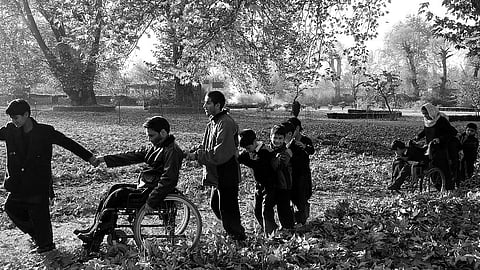
A man in a wheelchair and a group of children pushing him along a sunlit road.... Even without knowing the story behind the frame, the photograph lingers, moves. One can almost hear the children's laughter, their joy spilling beyond the image itself. The man's head hangs low, a faint smile plays on his lips. There is an unmistakable tenderness to the image—one that quietly invites the viewer to wonder about the story behind it.
The man is Javed Ahmad Tak, an activist from Kashmir, whose work has transformed countless lives. Captured by photographer Amit Mehra—who also curates 'Unsung'—his photograph is among the many stories that make up the project’s third volume, currently on display at the India International Centre (IIC) till August 4.
Across the gallery walls are portraits of people who have quietly reshaped their communities without fanfare or headlines: Lakshmi Kutty, or 'Amma', the tribal healer and poet from Kerala who has spent decades treating patients with traditional medicine; Tulasi Munda, who dedicated her life to educating thousands in Odisha's mining belt; environmentalist and poet Sugathakumari, whose role in the Save Silent Valley movement in Kerala helped shape India's conservation history; Lalitha and Regi George, the doctors who chose to build a hospital in the remote tribal village of Sittlingi rather than pursue lucrative urban careers; and Subhashini Mistry, the vegetable seller who built a charitable hospital in Hanspukur near Kolkata, after losing her husband because he could not afford medical treatment, among others.
Together, they form 'Unsung', a long-running project conceived by photographer Mahesh Bhat in 2004 as a tribute to Indians whose extraordinary contributions rarely find space in the public imagination. What began with Bhat photographing five unsung heroes later evolved into a collaborative project that ran into three volumes, the third being this exhibition.

Different stories, heroes
"The core remains the same," says Mehra. "It's about unsung heroes. We have only touched a fraction of the people who have contributed to society. There are so many more stories waiting to be told."
For Mehra, the exhibition is also a quiet challenge to a culture that reserves admiration for celebrities and public figures.
"We only talk about the mega figures," he says. "But there are people who work relentlessly without seeking recognition or financial support. They are simply doing their work."
That philosophy is perhaps best embodied in Tak's story. Shot in the spine during a militant attack as a young man, he spent years confined to bed before rebuilding his life to establish a school for children with disabilities and orphans, including children of militants.
"It is a story of forgiveness, compassion and dignity," says Mehra. "Someone whose own life was devastated is today looking after the children of those who caused so much suffering."
No spectacle
Yet 'Unsung' is not interested in heroism as spectacle. The exhibition slows the viewer down, asking them to look beyond achievement and into everyday acts of care. The accompanying essays are as evocative as the photographs themselves. They transport readers into Amma's modest home in Kerala's Ponmudi Hills, where the scent of fresh sambar fills the air; into the dimly lit homes of Varanasi's handloom weavers, whose craft survives despite dwindling returns; and into remote villages where doctors, teachers and activists quietly reshape lives, one person at a time.
For the photographers, the process extends beyond simply documenting. "These are photographers who feel about the issues they are photographing," says Mehra. "They don't just arrive, take photographs and leave." He recalls photographer Deepti Asthana living in Dhanushkodi, a coastal town in Tamil Nadu, teaching English at the local school and even raising money for one of her subjects, an involvement that reflects the deeper relationships many of the photographers build with the communities they document.
In a time often marked by conflict, uncertainty and political polarisation, Mehra hopes visitors leave with one thing above all else.
"Hope," he says. "When nothing seems to be working, these people continue despite all odds. They remind us that we have to believe in ourselves."
That sentiment echoes throughout 'Unsung'. None of its subjects set out to become heroes. They are doctors, teachers, activists, healers, conservationists and ordinary citizens who chose, often at great personal cost, to serve those around them.
Their stories may never dominate headlines. But as the exhibition gently reminds its visitors, history is shaped just as much by those working quietly in the margins as by those standing in the spotlight.
The exhibition is on view till August 4 at Art Gallery, Kamala Devi Complex, IIC
This article is written by Uthama Sankaranarayanan
For more updates, join/follow our WhatsApp, Telegram and YouTube channels.