
- LIFESTYLE
- FASHION
- FOOD
- ENTERTAINMENT
- EVENTS
- CULTURE
- VIDEOS
- WEB STORIES
- SPORTS
- GADGETS
- CAR & BIKE
- TRAVEL
- SOCIETY
- GALLERIES
- NORTH EAST
- INDULGE CONNECT
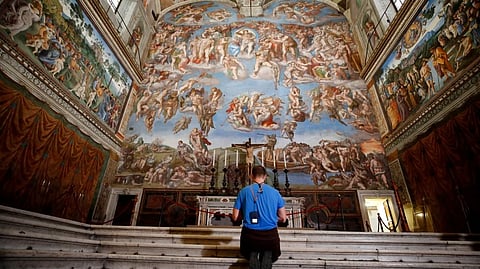
Michelangelo’s The Last Judgment, the vast and formidable fresco that dominates the altar wall of the Sistine Chapel, is undergoing its first major cleaning in more than 30 years, the Vatican has confirmed.
The three-month conservation effort, announced by the Vatican Museums, aims to remove layers of microscopic residue that have accumulated on the plaster over time. Despite the restoration work, the Sistine Chapel will remain open to visitors, though parts of the fresco may be partially obscured by scaffolding during the process.
According to the museum, the cleaning targets a “widespread whitish haze” caused by the deposition of airborne microparticles. These particles are the result of constant air movement in the chapel, intensified by the presence of millions of visitors each year. More than six million people pass through the Vatican Museums annually, with the Sistine Chapel among its most visited spaces.

To mitigate long-term damage, the Vatican closely monitors temperature and humidity levels inside the chapel and has introduced systems to regulate airflow. The current intervention is described as a preventive conservation measure rather than an aesthetic overhaul, intended to preserve the fresco’s surface without altering Michelangelo’s original work.
Painted between 1536 and 1541, The Last Judgment depicts a dramatic vision of salvation and damnation, unfolding across the wall behind the altar. It was commissioned by Pope Julius II’s successor, following Michelangelo’s earlier work on the chapel ceiling, including the iconic Creation of Adam, completed between 1508 and 1512.
The Sistine Chapel itself takes its name from Pope Sixtus IV, under whose patronage the structure was built in the 15th century. Beyond its artistic significance, the chapel continues to serve an active role in the Vatican, most recently hosting the May conclave that elected Pope Leo XIV.
For more updates, join/follow our WhatsApp, Telegram and YouTube channels.